




 $8.99City Highlights
Seminyak Audio Walking Tours
Self-guided, narrated walks through Seminyak. Buy a tour once, download it, and hear the story at each stop while you walk at your own pace.
Tours from $7.99
Friends walk free. One purchase covers everyone on your walk. Start the tour, invite your friends to join, and it plays on every phone in your group.
5.0 on Google Play
Seminyak audio tours
Each tour is a mapped route with narration at every stop. Buy it once and it is yours to keep, no subscription.
$8.99City Highlights $7.99City Highlights
What to expect on a Seminyak audio walking tour
Seminyak is one long stretch of sand and a strip of shops and temples just behind it, and an audio walk here moves between both worlds, a barefoot sunset walk up the coast from Legian and a short stroll from Eat Street to a sea temple that has watched over this shore for five hundred years.
The Legian to Seminyak Beach Walk never leaves the sand. It starts at Padma Beach in Legian and heads north along the water past the surf schools of Legian Beach and the sunset football games at Double Six Beach, then on past the rainbow umbrellas of La Plancha to Seminyak Beach and Ku De Ta, where the sunset is free from anywhere on the shore. It covers 3.2 kilometers, about 44 minutes of walking, across 6 stops, with no hills, no traffic and no shoes required.
The Seminyak Petitenget Walk starts on Jalan Kayu Aya, known to everyone as Eat Street, passes Seminyak Square, then turns toward the coast to Pura Petitenget, a sea temple linked to the Hindu priest Dang Hyang Nirartha, who is credited with founding or reshaping many of Bali's best known temples. It covers 2.4 kilometers, about 33 minutes of walking, across 5 stops.
From the temple gate the route drops onto Petitenget Beach and finishes at Potato Head Beach Club, known for its curved wall built from thousands of salvaged wooden window shutters. Time either walk for the hour before sunset, since that is when the coast is at its best and the whole island seems to turn and face the sea at once.
Where to walk in Seminyak
A few of the stops you will pass, and why they are worth slowing down for.
A Street Near Petitenget
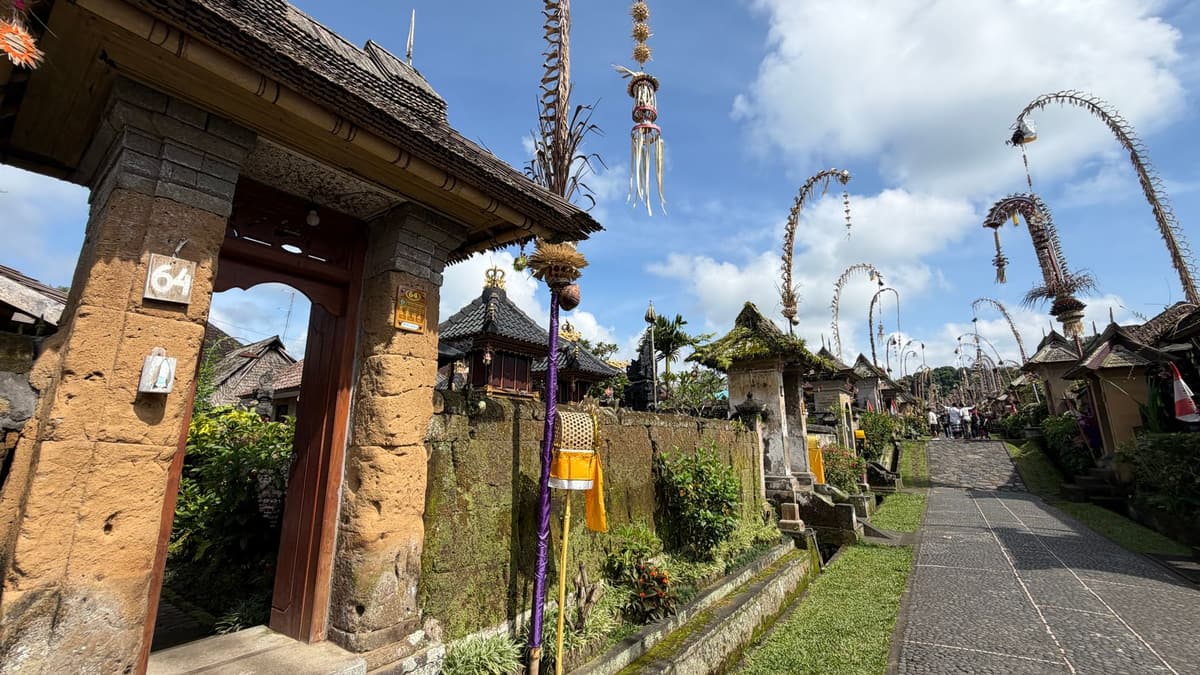
This stretch of Jalan Petitenget, lined with carved family compound gates and the tall curving bamboo poles called penjor, shows a side of Seminyak most visitors on Eat Street never see. Every Balinese home is built as a small family compound behind a wall like this one, with its own family temple in the corner closest to the mountains, since the island's Hindu faith is woven into daily life rather than kept for Sundays. The penjor here are raised for Galungan, a festival that comes every 210 days on the Balinese calendar to celebrate good over evil and welcome ancestors home. Not long ago this whole area was rice fields and coconut groves.
Pura Petitenget
This tiered tower, a meru, crowns Pura Petitenget, one of the sea temples strung along Bali's southwest coast, linked to Dang Hyang Nirartha, a Hindu priest from Java credited with founding or reshaping many of the island's most important temples, Tanah Lot and Uluwatu among them. Balinese temples are built as a series of walled courtyards rather than a single building, each one more sacred than the last, and a meru like this marks the innermost, holiest part, where the gods are invited to descend during ceremonies. Every temple on the island celebrates its own anniversary, an odalan, once every 210 days, when it fills with music and families in white and gold.

Potato Head Beach Club
This aerial view shows the kind of coastline that made Seminyak famous, a long beach fronted by loungers, umbrellas and beach clubs, with the Indian Ocean running in long, even lines of surf. Potato Head Beach Club, near this stretch of sand, opened in 2010 with a curved entrance wall built from thousands of old wooden window shutters salvaged from buildings across Indonesia, designed by the architect Andra Matin, and it helped start the wave of beach clubs that now lines this part of the coast. Businesses here change over time, but the beach stays open to everyone, and the sunset is just as good from the sand as from any club chair.
Legian Beach
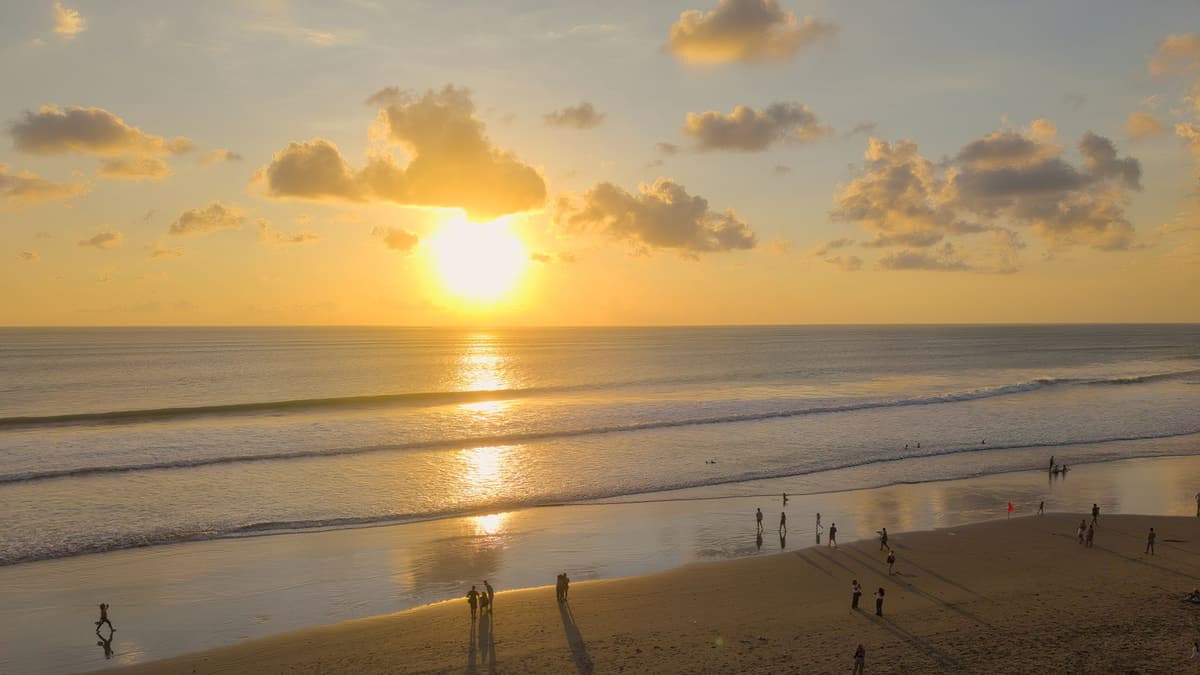
Late in the afternoon, Legian's beach fills with exactly this scene, surfers coming in from the water, families walking down from the hotels, and everyone slowly turning to face the same direction as the light changes. The waves here break over sandbanks rather than reef, which makes them softer and far more forgiving for beginners than the famous reef breaks further south, and surf schools gather their students on the sand before wading into the white water. A few minutes after the sun actually disappears below the horizon, the colors in the sky often get stronger rather than weaker, so it is worth staying a little longer than you think you should.
Get the Audio Tour in 3 Simple Steps
All in the free Walk With Me app, and the first stops of every tour are free to try.
Tap the Gold Headphones and Pick a Tour


01
Walk It Solo or Invite Someone


02
Press Play and Walk


03
Handcrafted for Your Time in the City
These tours aren't a checklist of sights. They're made to be walked slowly, headphones on, eyes on the city.
Meditative and Immersive
Each story is told where it happened. The app chimes when you reach a stop, one tap starts the story, and the stretch between stops is yours to take in at your own pace.
Handcrafted With Care
We choose every route and every stop ourselves and shape each story with care, so the time you have in the city goes to the places most worth seeing.
Better With Someone
Every walk is better with someone beside you, so if you can bring a friend, we really hope you do. That's why one purchase covers everyone you invite: they join your tour free.