
October 11, 2026 · 9 min read
Amsterdam Anne Frank Walking Tour
From the Hollandsche Schouwburg through the old Jewish Quarter, past the Dockworker and the Dam, to the Anne Frank House on the Prinsengracht.
589

October 11, 2026 · 10 min read

 Friends walk free
Every tour also runs as a scheduled group walk you can join in the app.
More audio tours in Paris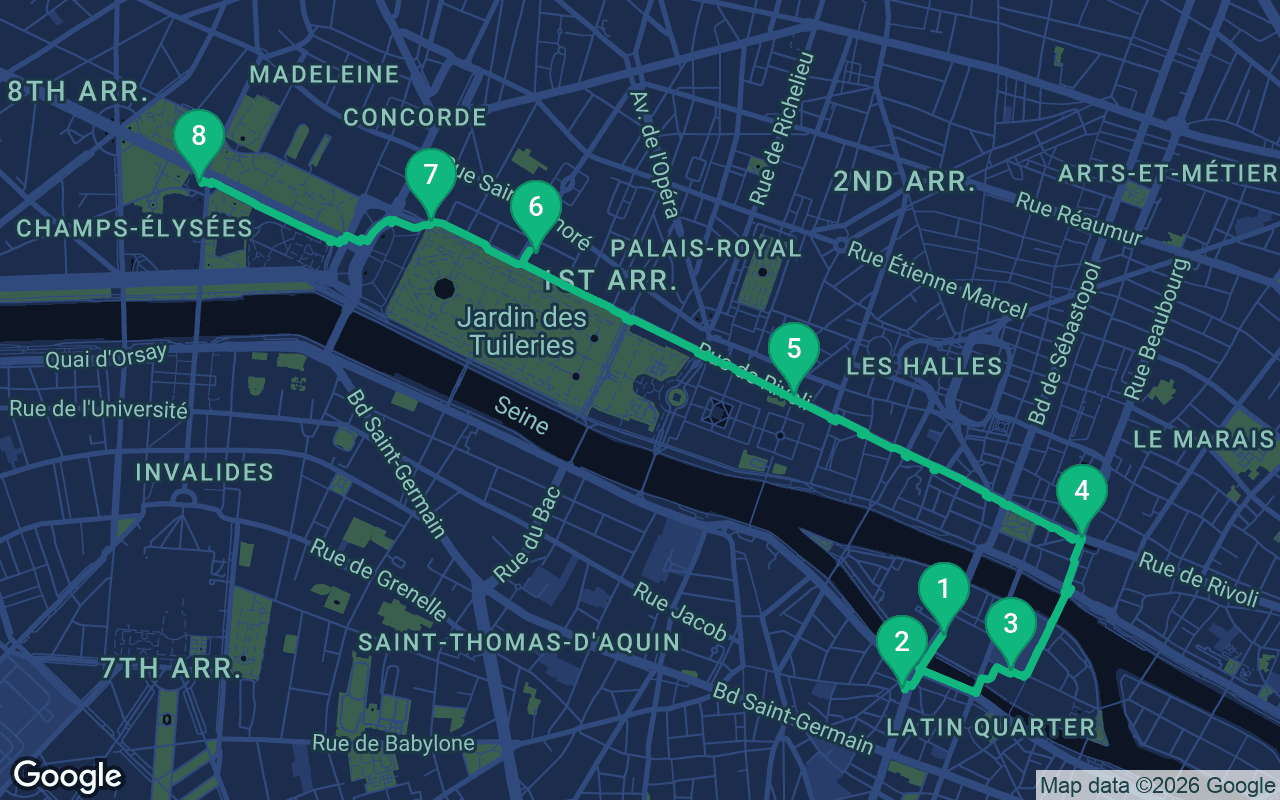
About 4.4 km, roughly 62 minutes at an easy pace.
This tour is narrated
Press play on the first 3 stops for a 30-second demo of the narration. In the app, the intro and those 3 stops play in full for free, each one chiming as you arrive. The whole narrated tour is yours for $16.99, a one-time purchase you keep for good.
Works with Garmin, Komoot, Strava, OS Maps and any GPX app.
In August 1944, after fifty months of German occupation, Paris did not wait to be freed. For seven days its people rose. Policemen seized their own headquarters. Ordinary Parisians fought behind barricades. A company made up largely of Spanish Republicans rolled up to the city hall in the dark while the great bell of Notre-Dame rang out, and the German commander was captured in his hotel on the Rue de Rivoli. This walk follows that week in the order it happened, from 19 to 26 August. You start at the Préfecture de Police on the Île de la Cité, cross the Seine to the Place Saint-Michel and back to Notre-Dame, then follow the Rue de Rivoli west to the Concorde, and finish at de Gaulle's statue on the Champs-Élysées. It is about four and a half kilometers. Of all our self-guided walking tours, this one is about the people who fought for their own city.
The walking takes about an hour; with the stories, allow two. The route is mostly flat, and the stretch of the Rue de Rivoli past the Tuileries runs under covered arcades, which helps in rain or hot sun. The nearest metro is a short walk from the start on the Île de la Cité, and another is close to the finish on the Champs-Élysées. If you want to go inside the cathedral, check entry times before you go.
Stand on the Boulevard du Palais and look at the big building in front of you. This is still the headquarters of the Paris police, and on 19 August 1944 it is where the uprising began.
Early that morning, policemen gathered on the square in front of Notre-Dame. Then about two thousand of them went into their own headquarters and took it over. They raised the French tricolor over the building. Charles Luizet arrived to take over, and the prefect, Bussière, was arrested. The Resistance leader Rol-Tanguy came by and told the men to wear the armbands of the FFI, the French Forces of the Interior.
Be honest about who these men were. For four years the Paris police had worked with the occupation authorities, and many of these same men had served the occupier. Now they turned.
The Germans struck back the same day and came at the building with tanks. That evening, at twenty to nine, a truce took effect. It was brokered by a Swedish diplomat, Raoul Nordling, and it spread to other buildings the insurgents held. But neither side really respected it, and by 21 August it was over.
Remember this building. On 25 August the German commander of Paris will be brought here to sign his surrender.
Walk south down the Boulevard du Palais and cross the Pont Saint-Michel to the fountain on the far side, about three minutes.
You're in front of a grand fountain from 1860. Now look down, at the base, for two inscriptions from 1944.
One of them sums up the whole week. In the year 1944, it says, from 19 to 25 August, after fifty months of German occupation, the people of Paris, as the liberating armies approached, rose up against oppression. The other honors the FFI fighters and the residents of the 5th and 6th districts who were killed fighting on this spot.
From 19 to 25 August, Resistance fighters held this square. They were protecting the Préfecture across the bridge, and blocking German traffic. The crossing just south of here, where the Boulevard Saint-Michel meets the Boulevard Saint-Germain, earned a grim nickname: the crossroads of death.
As the truce broke down, the first barricades went up on the evening of the 21st. On the 22nd Rol-Tanguy issued his order: "Tous aux barricades!" Everyone to the barricades. Nearly six hundred went up across Paris.
Across the city, about two hundred small plaques reading "Ici est tombé," here fell, mark where people died in the fighting.
Cross back over the Pont Saint-Michel and turn right along the river to the square in front of Notre-Dame, about six minutes.
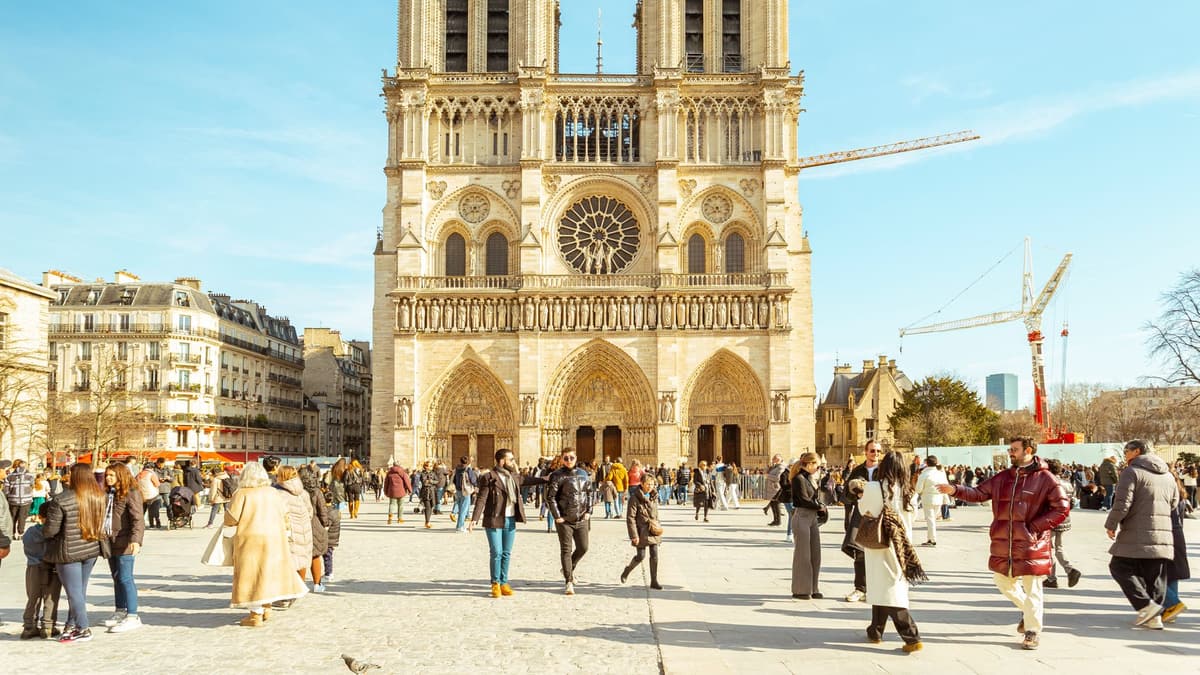 You're on the square in front of Notre-Dame, restored and reopened after the fire of 2019. Look up at the two towers. Up there hangs the great bell, Emmanuel.
By 23 August the truce was dead and the barricades were up. That day the German commander of Paris, General von Choltitz, received Hitler's directive to cause the greatest possible destruction. Hitler's order said that Paris must fall into enemy hands only as a field of rubble.
Then, on the evening of 24 August, the news came over the radio. The broadcaster Pierre Schaeffer announced the arrival and asked priests to ring the bells. At about nine o'clock, up in the towers, policemen rang Emmanuel. The newspaper Libération wrote the next day that like wildfire, Paris cried out: they are here.
But who were "they"? The answer was a few hundred meters north of here, and most of them were not French.
Walk north on the Rue d'Arcole and cross the Seine on the Pont d'Arcole to the square in front of the Hôtel de Ville, about seven minutes.
What's included
Our tours are made to be meditative and immersive: you keep moving and simply listen. They're always better together, and the app plays the narration in sync, so you, your partner and your friends hear every stop at the same moment.
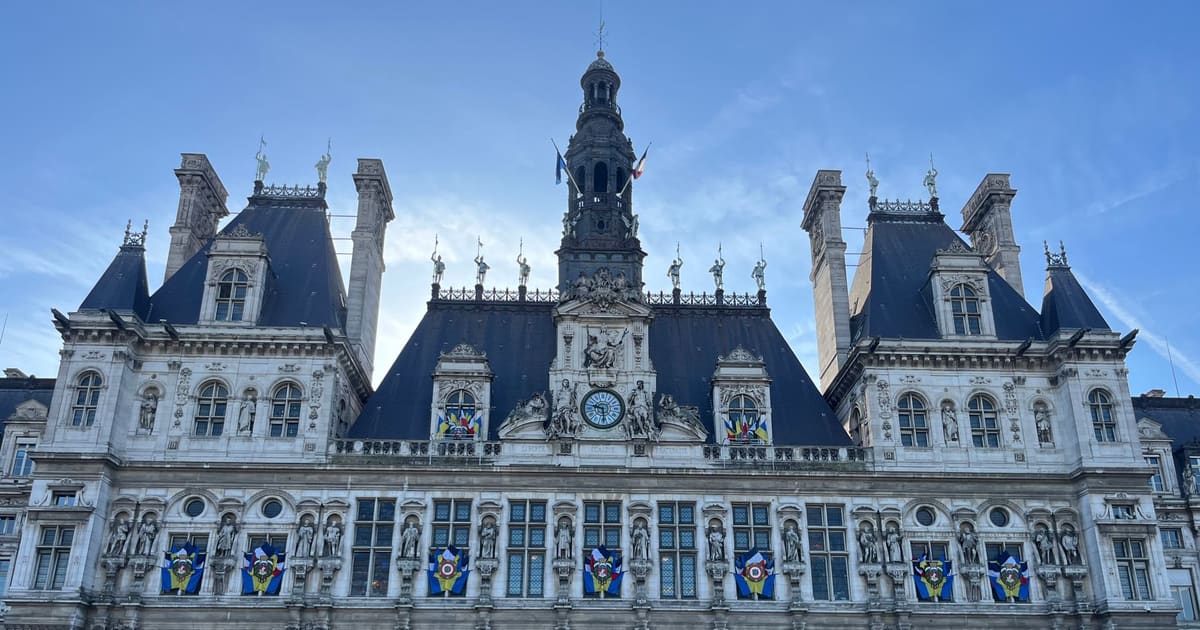
You're at the Hôtel de Ville, the Paris city hall, at the corner where its square meets the Rue de Rivoli.
The rest of this stop is in the full audio tour.
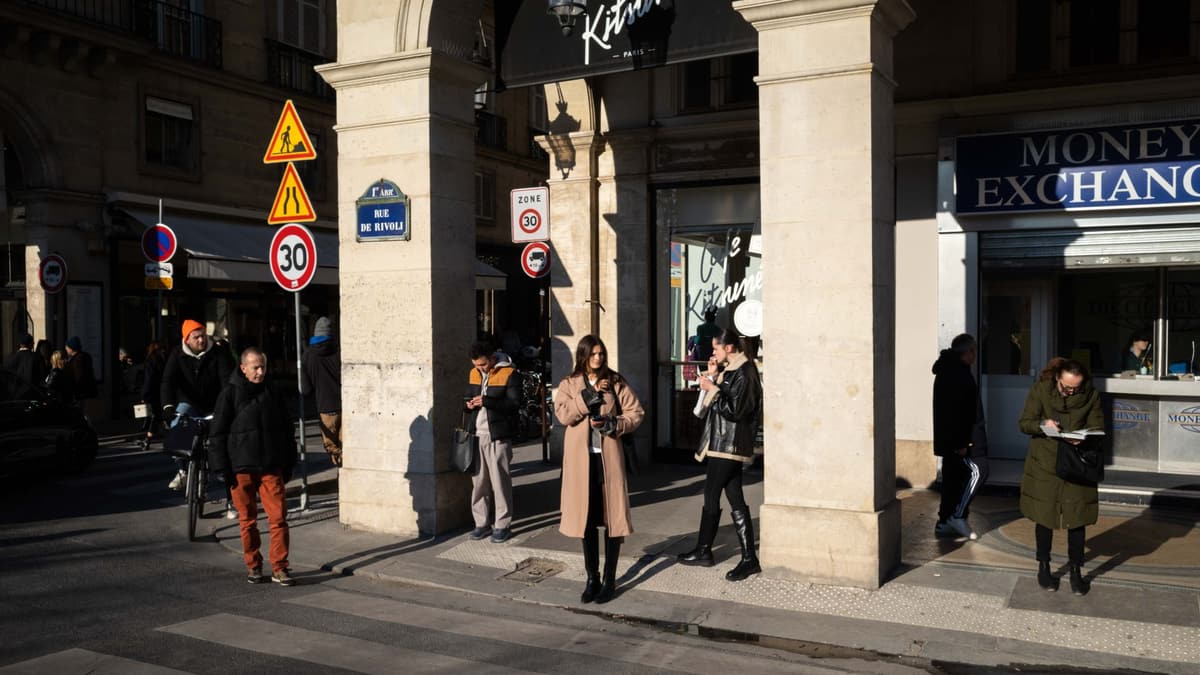
Picture this street, with the Louvre on your left, on 25 August 1944.
The rest of this stop is in the full audio tour.
You're outside Le Meurice, a luxury hotel under the Rivoli arcades. In August 1944 it was the headquarters of General von Choltitz, the commander of the German garrison in Paris.
The rest of this stop is in the full audio tour.
Each of these plaques honors someone killed here, at the Concorde end of the Rue de Rivoli, in August 1944. Some were soldiers, some civilians.
The rest of this stop is in the full audio tour.
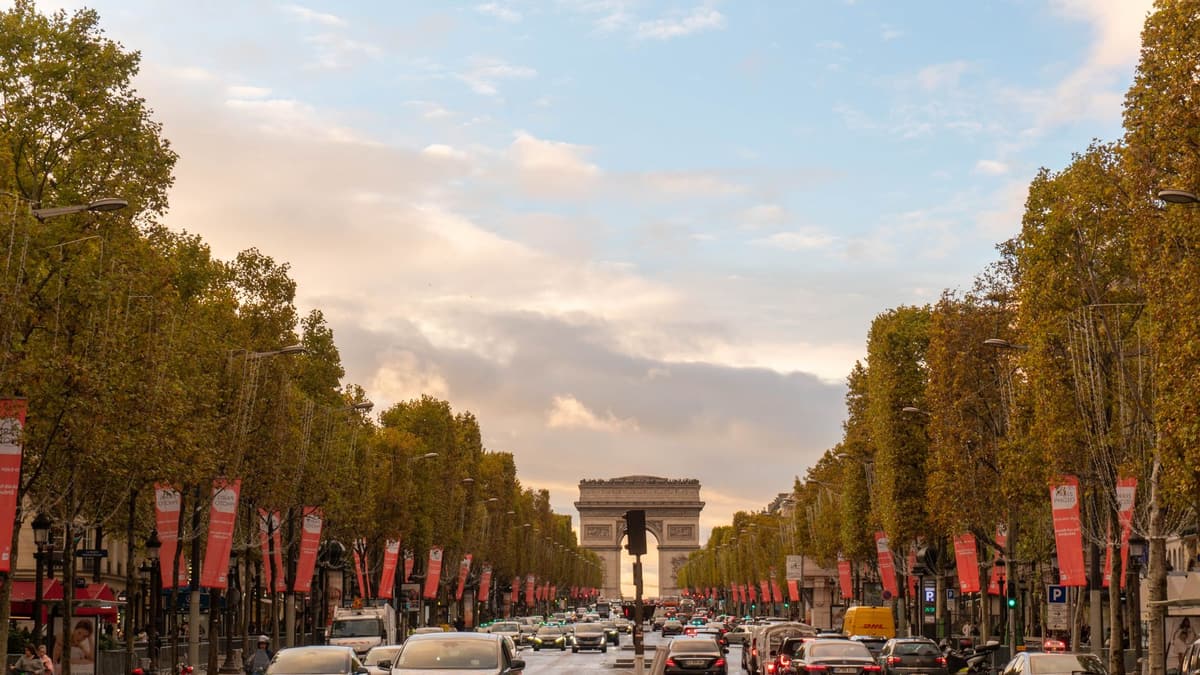
You're in front of a bronze of Charles de Gaulle, more than three and a half meters tall. The sculptor Jean Cardot based it on a photograph of de Gaulle walking down the Champs-Élysées on 26 August 1944.
The rest of this stop is in the full audio tour.
Do this walk with other people on the next scheduled tour.
About 4.4 km, roughly 62 minutes at an easy pace · 8 stops
Friends walk freeOctober 11, 2026 · 9 min read
From the Hollandsche Schouwburg through the old Jewish Quarter, past the Dockworker and the Dam, to the Anne Frank House on the Prinsengracht.
October 11, 2026 · 11 min read
From Van Houten's street by the Vondelpark past Leidseplein, the Rijksmuseum passage and the famous canal bench to the Anne Frank House.

October 11, 2026 · 10 min read
Follow the last days of April and May 1945 from the Anhalter Bahnhof ruin past the Gestapo site and Brandenburg Gate to the Moltke Bridge and the Reichstag.
