
 $12.99City Highlights
Milan Walking Tour: From the Duomo to the Arco della Pace
Choose how you'll do this walk in our app

 Friends walk free
Every tour also runs as a scheduled group walk you can join in the app.
More audio tours in Milan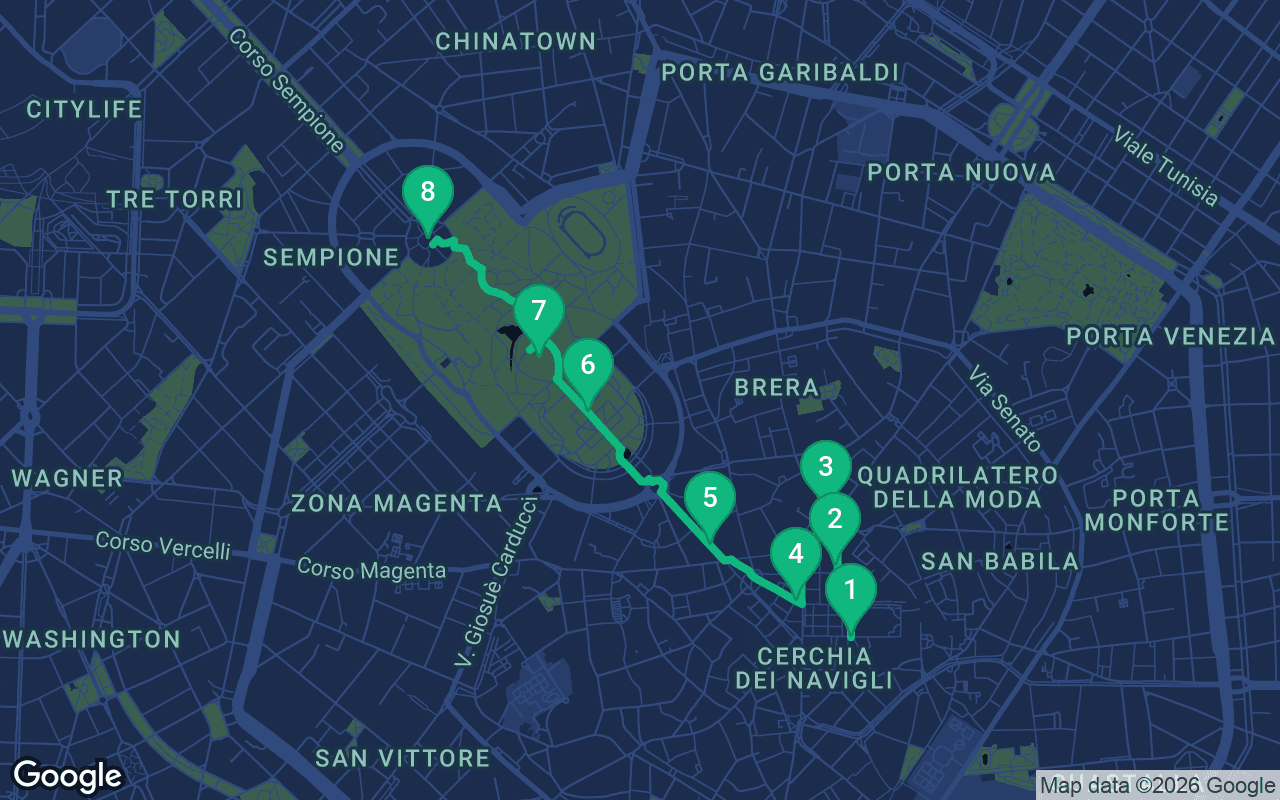
About 2.7 km, roughly 36 minutes at an easy pace.
- 1Piazza del Duomo~€16 · optionalOptional entry ticket, not included
- 2Galleria Vittorio Emanuele II
- 3Teatro alla Scala~€12 · optionalOptional entry ticket, not included
- 4Via DanteFull tour
- 5Sforza Castle~€5 · optionalOptional entry ticket, not includedFull tour
- 6Sempione ParkFull tour
- 7Arco della PaceFull tour
Not included in the tour: ~€33 entry (optional)Average per person. Prices change, so check before you go.
This tour is narrated
Press play on the first 3 stops for a 30-second demo of the narration. In the app, the intro and those 3 stops play in full for free, each one chiming as you arrive. The whole narrated tour is yours for $7.99, a one-time purchase you keep for good.
Works with Garmin, Komoot, Strava, OS Maps and any GPX app.
Milan likes to keep its grandest things in a straight line. This walk follows the ceremonial spine of the city, from the marble cathedral that took six centuries to finish, through the glass-roofed arcade the Milanese call their living room, past the most famous opera house in the world and down a broad avenue to the brick fortress of the dukes. Behind the castle a park opens up, and at the far end stands a triumphal arch begun for Napoleon. It is about three kilometers, flat and easy, and it is one of those self-guided walking tours that shows you a city's whole idea of itself: faith, money, music and power, one after the other.
Before you set off
Allow two to two and a half hours at a stroll, and more if you go up onto the cathedral roof or into the castle museums, which are both worth the time. The route is flat and paved, mostly on smooth stone slabs, so any comfortable shoes will do. The Duomo needs a ticket for the roof terraces, which you can reach by stairs or a lift, and the queues can be long, so book ahead and check the current times before you go. The cathedral also asks for covered shoulders and knees. The center is busy at lunchtime and on weekend afternoons, so a morning start gives you the Galleria and the cathedral square with more room. Milan can be hot and still in summer and damp and gray in winter, but the second half of the walk runs through the shade of a big park, which helps on a warm day. The castle courtyards are free to wander, and there are cafés all along the way, so stop whenever you like for a coffee taken standing at the bar, the Milanese way.
Piazza del Duomo
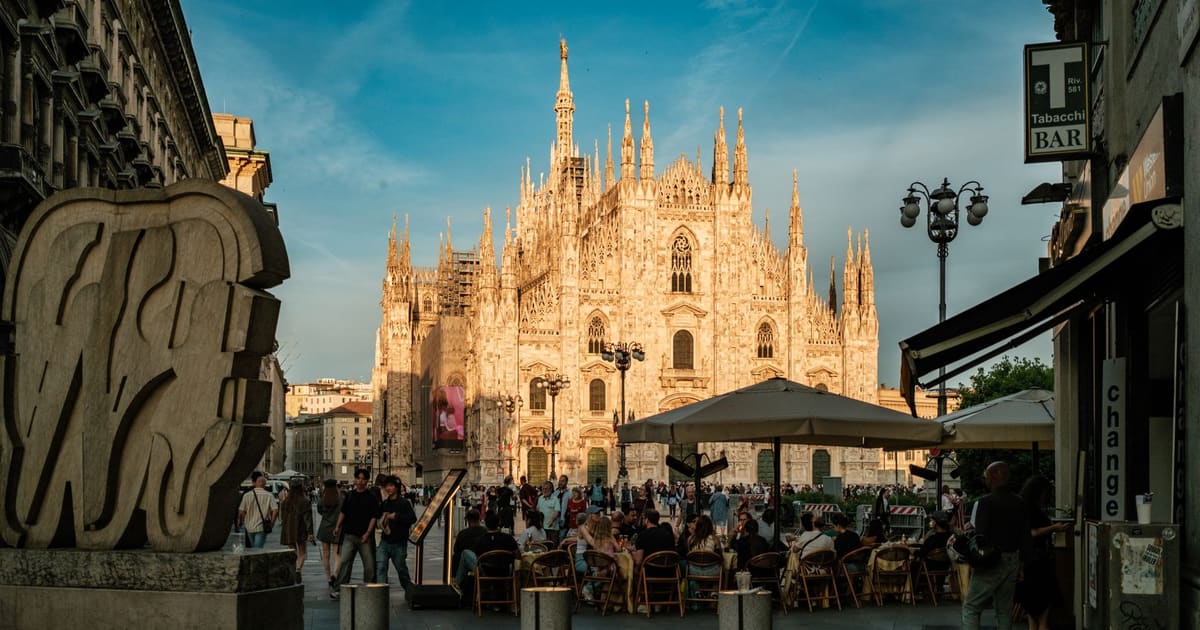
Stand back toward the middle of the square, near the bronze king on horseback, and take in the cathedral. Milan's Duomo is a forest of white marble, with well over a hundred spires and more than three thousand statues, and nowhere else does Gothic look quite so much like lace. It was begun in 1386 under the ruling Visconti family, and it took so long to finish that the Milanese still describe any never-ending job as being like the fabbrica del Duomo, the cathedral works. The pale pinkish marble came from quarries near Lake Maggiore and was brought into the city by water. The facade was the last big piece, and it was finally pushed toward completion on the orders of Napoleon, who wanted it ready for his coronation as King of Italy inside this church in 1805. Remember his name, because he will come back at the end of this walk. Now look for the very top spire. The small golden figure there is the Madonnina, the Little Madonna, placed in the eighteenth century, and for a long time no building in Milan was allowed to rise higher. When the first skyscrapers went up in the twentieth century, the city solved the problem by putting copies of her on top of them. To continue, walk to the great arched entrance on the north side of the square, to your left as you face the cathedral, a minute away.
Galleria Vittorio Emanuele II
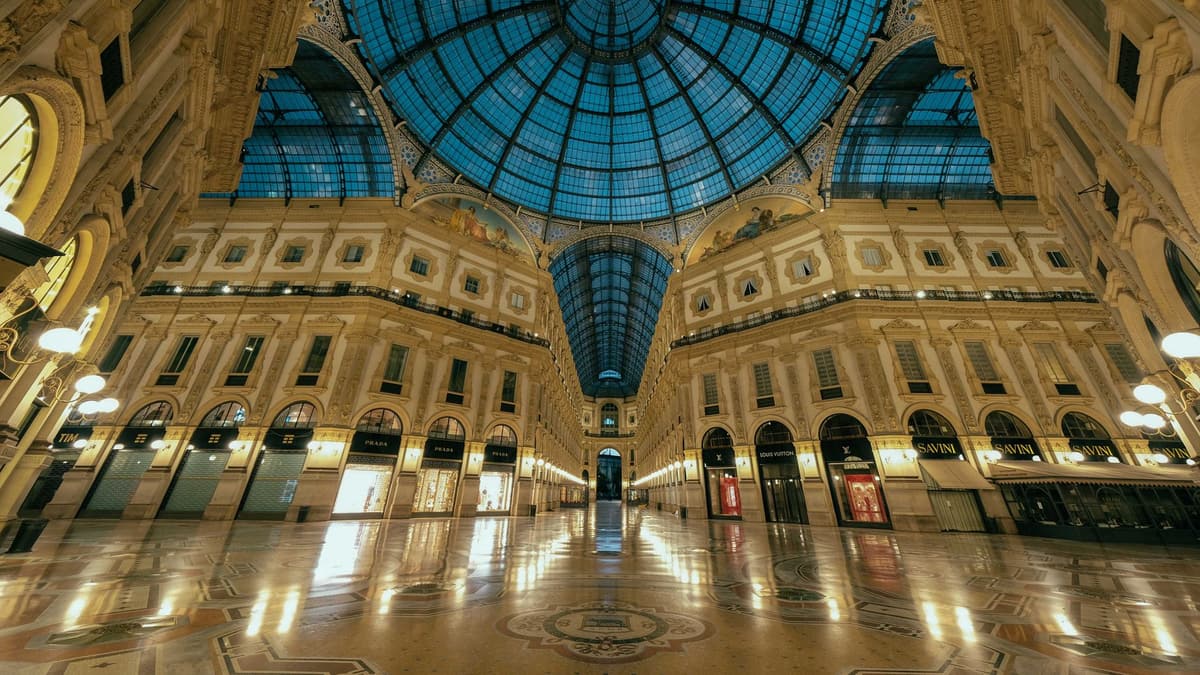 Walk in under the arch and look up. Two glass-roofed streets cross beneath a great glass dome, lined with shops and cafés behind facades of carved stone, and the light pours down onto a mosaic floor. The Galleria was built between 1865 and 1877, just after Italy became one country, and it was named after its first king. Its architect, Giuseppe Mengoni, never saw it finished: he fell from the scaffolding shortly before it opened. The Milanese call it il salotto, the living room, and they mean it; this is where the city has come to meet, shop and be seen for a century and a half. In the center, under the dome, the floor mosaics show the coats of arms of four Italian cities: the red cross of Milan, the wolf of Rome, the lily of Florence and the bull of Turin. Look for the small worn hole in the bull, and for the line of people taking turns to spin on it with one heel. It is meant to bring good luck, and the tiles have to be repaired every so often because of it. Some of the shops here have long histories; one of Milan's most famous fashion houses opened its first store in this arcade in 1913. To continue, walk straight through the arcade to its far end, away from the cathedral, and step out into a small square, about two minutes.
Teatro alla Scala
You come out into Piazza della Scala, and the opera house is the pale, quiet building on your left. People are often surprised by how plain it is. The outside is simple and neoclassical; the magic is all inside, in a horseshoe of red and gold boxes rising in tiers to the ceiling. It opened in 1778 and took its name from a church that stood on this spot before, which had in turn been named after a noblewoman of the Della Scala family. Some of the great nights of opera happened here. Verdi's Nabucco had its first performance in 1842, and its chorus of exiles longing for home, "Va, pensiero", became an unofficial anthem for Italians who wanted to be free of foreign rule. In 1943 bombs badly damaged the theater, and the Milanese rebuilt it fast; it reopened in 1946 with a concert conducted by Arturo Toscanini. The season still opens every year on 7 December, the feast of Milan's patron saint, Ambrose, the biggest night in the city's social calendar. If there is no rehearsal, the theater museum often lets you look into the hall from one of the boxes. In the middle of the square stands a statue of Leonardo da Vinci, who spent many years working in Milan, with four of his pupils around the base. Opposite the theater is Palazzo Marino, the city hall. To continue, follow Via Santa Margherita, the street leaving the square beside the Galleria's exit, south-west to the round Piazza Cordusio, then cross it to the broad pedestrian avenue on its far side, about seven minutes.
The full tour continues in the app
- Distance
- 2.7 km
- Walking
- 36 min
- Steps
- ~3,800
- Narration
- 14 min
What's included
- All 7 stops, fully narrated
- Works offline once downloaded in the app
- Friends walk free one purchase covers everyone on your walk
Our tours are made to be meditative and immersive: you keep moving and simply listen. They're always better together, and the app plays the narration in sync, so you, your partner and your friends hear every stop at the same moment.
Via Dante
You are walking down one of the newest streets on this route, which is why it is so straight.
The rest of this stop is in the full audio tour.
Sforza Castle
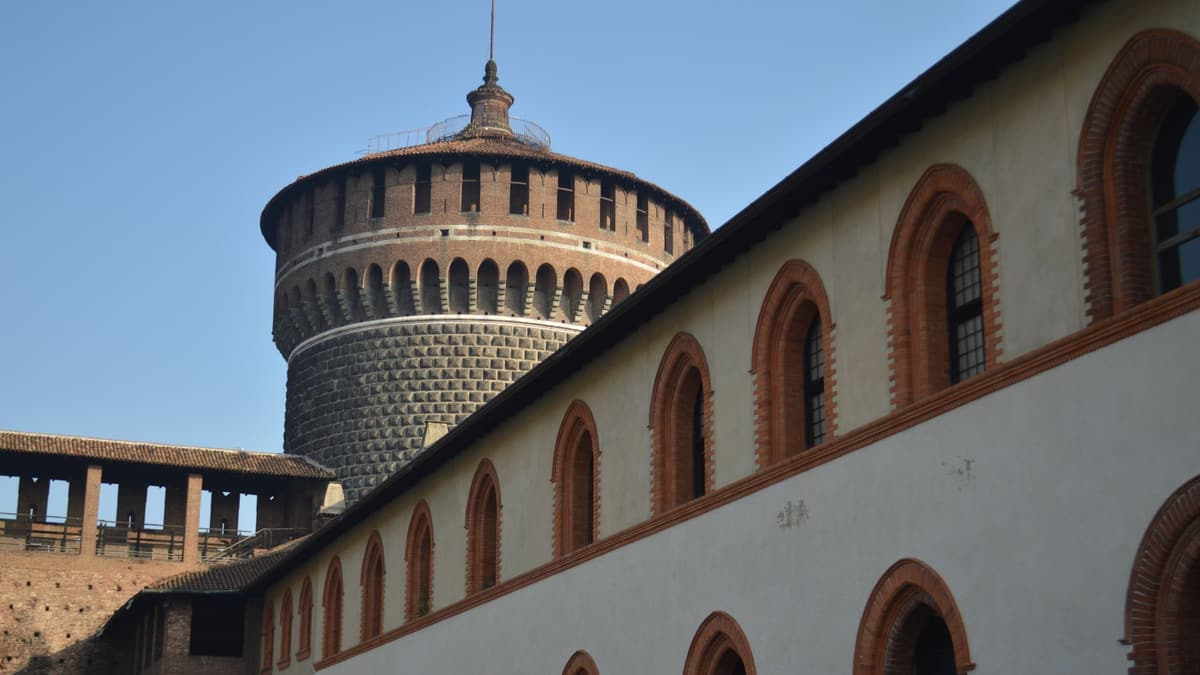
The tower above the gate is the Filarete Tower, and it is younger than it looks. The castle itself was built in the fifteenth century by Francesco Sforza, a soldier who married into the ruling Visconti family and made himself Duke of Milan.
The rest of this stop is in the full audio tour.
Sempione Park
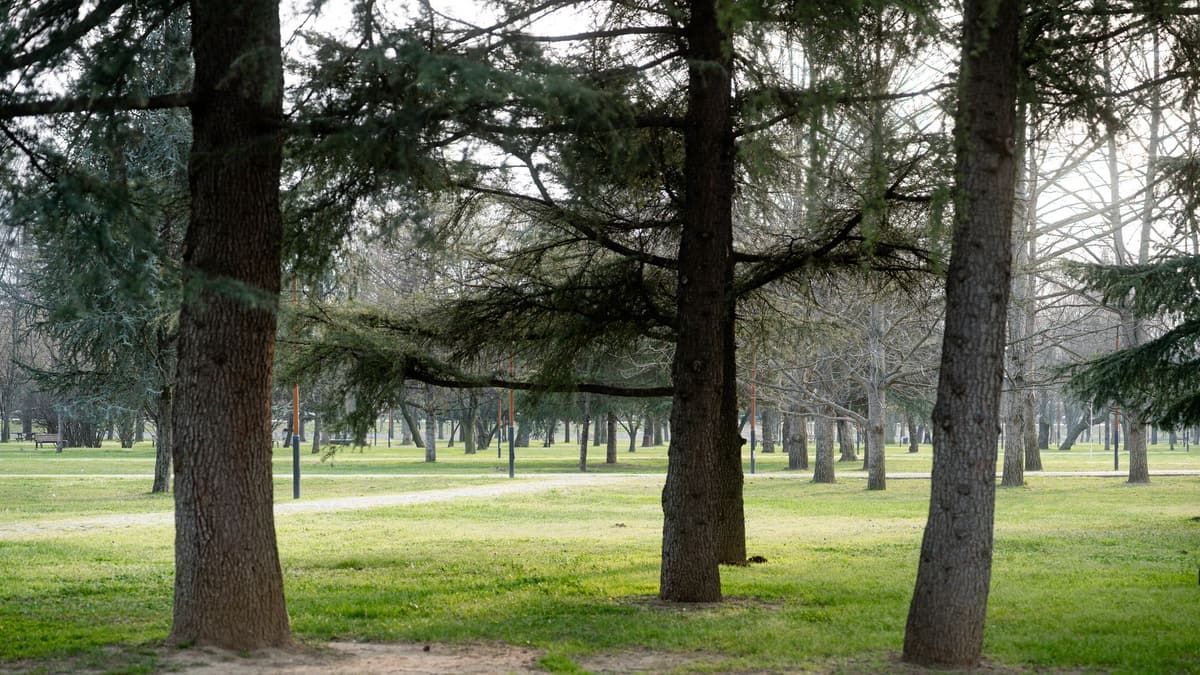
For centuries the land in front of you was the private hunting ground of the dukes.
The rest of this stop is in the full audio tour.
Arco della Pace
You finish at the Arch of Peace, a triumphal arch of white marble topped by a bronze chariot pulled by six horses, with the figure of Peace riding it. Here is the twist in its story.
The rest of this stop is in the full audio tour.
Do this walk with other people on the next scheduled tour.
About 2.7 km, roughly 36 minutes at an easy pace · 7 stops
Friends walk freeMore audio tours in Milan
$12.99City Highlights