
October 11, 2026 · 9 min read
Amsterdam Anne Frank Walking Tour
From the Hollandsche Schouwburg through the old Jewish Quarter, past the Dockworker and the Dam, to the Anne Frank House on the Prinsengracht.
589

October 11, 2026 · 10 min read

 Friends walk free
Every tour also runs as a scheduled group walk you can join in the app.
More audio tours in Berlin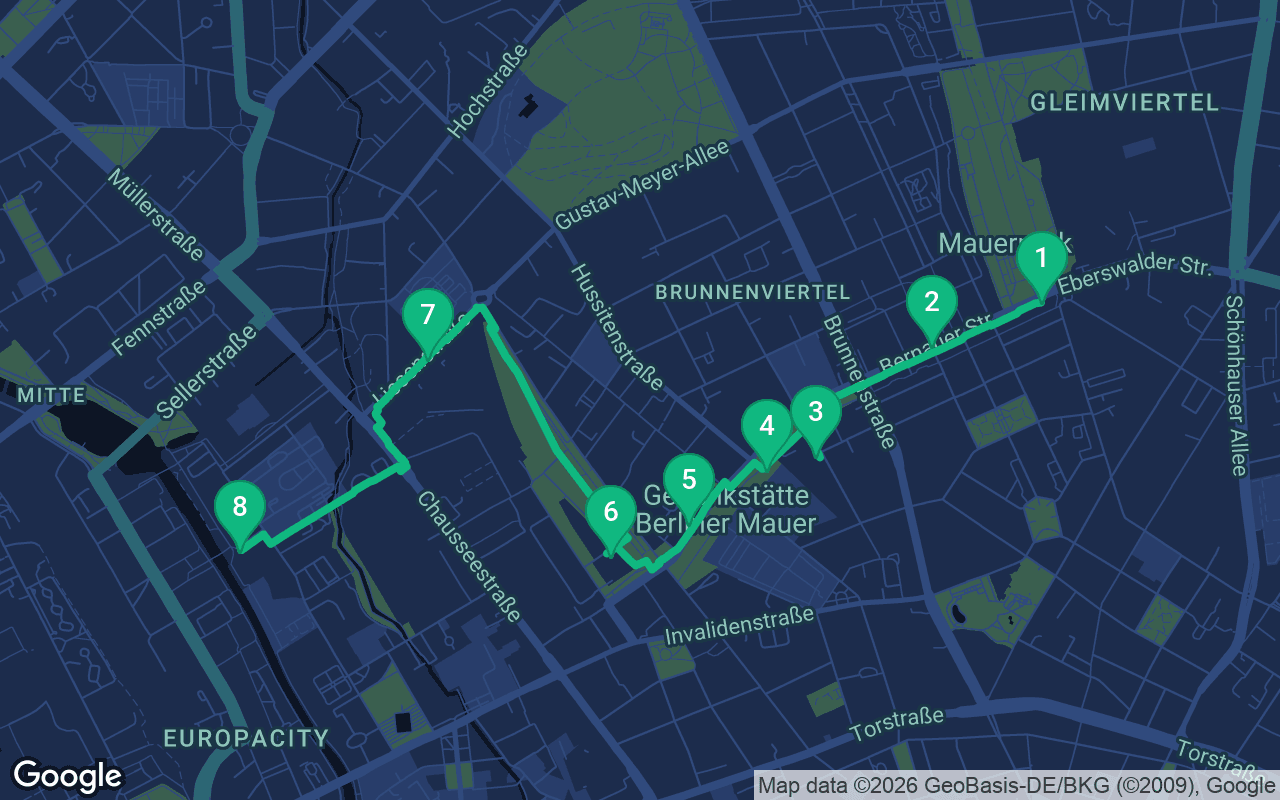
About 4 km, roughly 54 minutes at an easy pace.
This tour is narrated
Press play on the first 3 stops for a 30-second demo of the narration. In the app, the intro and those 3 stops play in full for free, each one chiming as you arrive. The whole narrated tour is yours for $15.99, a one-time purchase you keep for good.
Works with Garmin, Komoot, Strava, OS Maps and any GPX app.
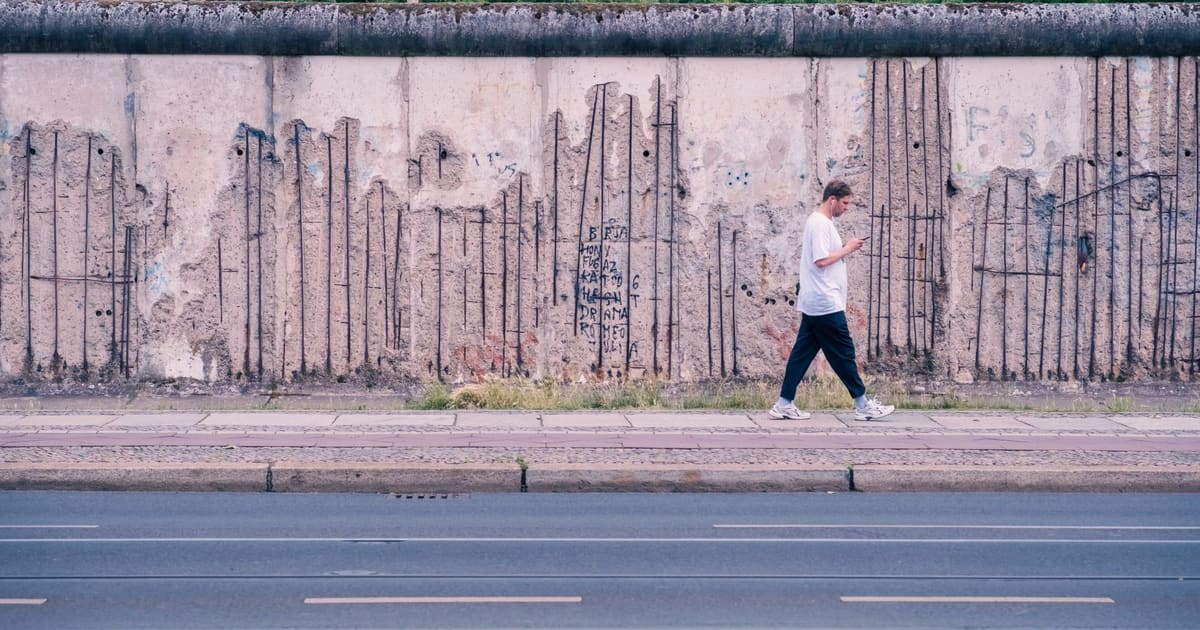
In August 1961 the border between East and West Berlin ran along the front walls of the houses on Bernauer Strasse. The buildings stood in the East. The sidewalk outside their doors was in the West. Within days, people were climbing out of windows and jumping over wire to get across. Later they dug under the street. Some of them died trying. This walk follows them, in roughly the order it happened, along the open-air Berlin Wall Memorial. You start at the memorial to Ida Siekmann near the Bernauer Strasse subway station, pass the corner where a young border policeman leapt the wire, the courtyard where a tunnel came up, the chapel built from the rubble of a church the state blew up, and the wall of faces of the dead. You end at a watchtower kept for Günter Litfin, about four kilometers later. It is one of our quieter self-guided walking tours, and it is about real people.
The walking takes just under an hour; with the stories and time to look, allow about two. The route is flat and paved. Start at the Bernauer Strasse stop on the U8 line, or at the Wolliner Strasse tram stop on the M10. The walk ends about a kilometer north of Berlin Hauptbahnhof, with buses on Invalidenstrasse. The memorial strip is outdoors and open, with little shade, so bring a hat in summer and a warm layer in winter. The chapel and the watchtower keep limited opening hours, so check before you go, but everything on the route can be seen from outside.
You're standing in the memorial strip, in front of the spot where the apartment house at Bernauer Strasse 48 used to stand. The house is gone. Look for the memorial column with her name.
Picture the street as it was in August 1961. The border had just been sealed. The houses on this side belonged to East Berlin, but the sidewalk below their windows was West Berlin. For some of the people inside, those windows looked like a way out.
Ida Siekmann was a single woman who lived in a third-floor flat in the front building here. On 22 August 1961, at about ten to seven in the morning, by the East German police record, she threw her bedding and some belongings down to the street, and then she jumped. West Berlin firemen were on the sidewalk with a net. They had no chance to catch her. She died on the way to the nearby Lazarus Hospital. It was one day before her fifty-ninth birthday, and nine days after the Wall went up. She was the first refugee to lose her life at the Wall.
She was not the only one. Rudolf Urban slid down a rope from number 1 and died a month later. Olga Segler jumped from number 34 in September. Bernd Lünser jumped from the roof of number 44. Within weeks, the authorities emptied these houses and bricked up the windows and doors. That September, the West Berlin district of Wedding put up a memorial here.
Walk southwest along Bernauer Strasse, with the memorial strip on your left, for about five minutes, to the corner of Ruppiner Strasse.
Stop at this street corner. Look around for the blank side wall of a building nearby, where a famous photograph is reproduced large.
It was taken here, a week before Ida Siekmann's fall, on 15 August 1961, at about four in the afternoon. At that point the border on this corner was still barbed wire. On the East side stood Conrad Schumann, a border policeman. He was nineteen, from the village of Zschochau in Saxony, and he had trained as a shepherd.
He pressed the wire down. He signaled to the photographers on the West side. West Berlin police pulled a car up a few meters away and opened the back door. Then he ran, jumped the wire, and was driven off at speed. A photographer caught him in midair, and the picture went around the world.
On the other side of the wire, the Stasi and the East German police agreed to call it a kidnapping. Schumann spent the next weeks in the Marienfelde refugee center, then built a new life in Bavaria. Many years later, in the summer of 1998, he took his own life. The reasons are not known.
Others would try another way across: under the ground.
Keep going southwest along Bernauer Strasse for about six minutes, then turn left into Strelitzer Strasse and stop by number 55, a few steps along.
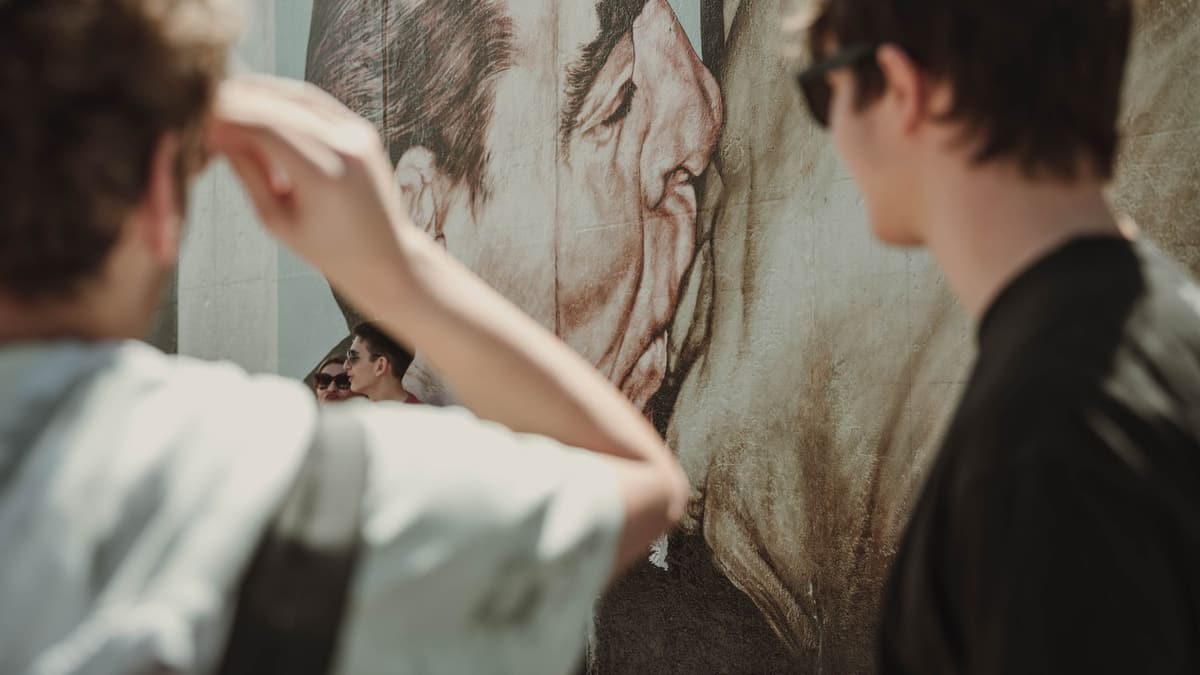 You're on a quiet residential street. Behind the house at number 55 is a courtyard. It is private, so stay on the sidewalk. Back on Bernauer Strasse, the routes of the tunnels are marked in the ground of the memorial strip.
At least ten tunnels were dug under this street between 1962 and 1971. Only three were ever used for escapes. The Stasi listened with hidden microphones and dug tunnels of its own to catch them.
In 1962, West Berlin students dug from a ruined factory at Bernauer Strasse 78 to a basement on Schönholzer Strasse. They broke through on 14 September, and over two nights twenty-nine people crawled through mud and leaking water. An NBC film crew was waiting to film them come out.
Two years later, another team started in the basement of a bakery on the West side, at Bernauer Strasse 97, about twelve meters down. They came up here, in the courtyard of number 55. On the nights of 3 and 4 October 1964, fifty-seven people crawled through. That gave the tunnel its name.
On the second night, someone betrayed it. Border soldiers came into the courtyard, and there was an exchange of fire. Egon Schultz, a twenty-one-year-old sergeant and a former teacher from Rostock, was hit and died on the way to the hospital.
The East German state made him a hero murdered by the escape helpers. It named regiments, schools and streets after him, including this one. But the fatal shot, the memorial now says, came from one of his own comrades. The state hid that; the truth came out only after the Wall fell. He was a victim of the Wall too.
Walk back to Bernauer Strasse and turn left. The chapel is about two minutes ahead, on your left.
What's included
Our tours are made to be meditative and immersive: you keep moving and simply listen. They're always better together, and the app plays the narration in sync, so you, your partner and your friends hear every stop at the same moment.
In front of you is a small chapel with walls of rammed earth. Outside it stands a wooden frame with the bells of an older church, rung by hand.
The rest of this stop is in the full audio tour.
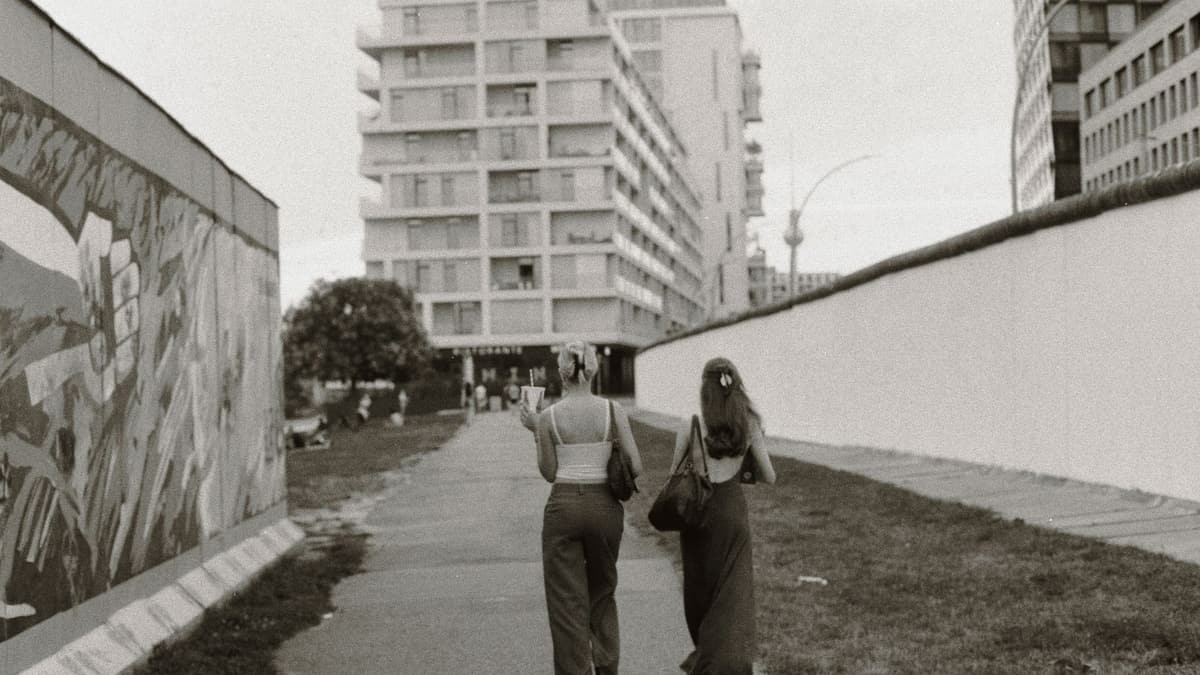
Step close. The wall is divided into niches, and most of them hold a portrait.
The rest of this stop is in the full audio tour.
The wall along the edge of these sand courts is original. It was part of the inner wall, the barrier on the East Berlin side of the border strip.
The rest of this stop is in the full audio tour.
You're at the gate of a French Reformed cemetery. Stay by the gate for this story, and keep your voice down.
The rest of this stop is in the full audio tour.
In front of you is a square East German border command post. It was one of thirty-two towers like it, each one controlling the crews of the border watchtowers.
The rest of this stop is in the full audio tour.
Do this walk with other people on the next scheduled tour.
About 4 km, roughly 54 minutes at an easy pace · 8 stops
Friends walk freeOctober 11, 2026 · 9 min read
From the Hollandsche Schouwburg through the old Jewish Quarter, past the Dockworker and the Dam, to the Anne Frank House on the Prinsengracht.
October 11, 2026 · 11 min read
From Van Houten's street by the Vondelpark past Leidseplein, the Rijksmuseum passage and the famous canal bench to the Anne Frank House.

October 11, 2026 · 10 min read
Follow the last days of April and May 1945 from the Anhalter Bahnhof ruin past the Gestapo site and Brandenburg Gate to the Moltke Bridge and the Reichstag.
