
October 11, 2026 · 9 min read
Amsterdam Anne Frank Walking Tour
From the Hollandsche Schouwburg through the old Jewish Quarter, past the Dockworker and the Dam, to the Anne Frank House on the Prinsengracht.
589

October 8, 2026 · 10 min read

 Friends walk free
Every tour also runs as a scheduled group walk you can join in the app.
More audio tours in Budapest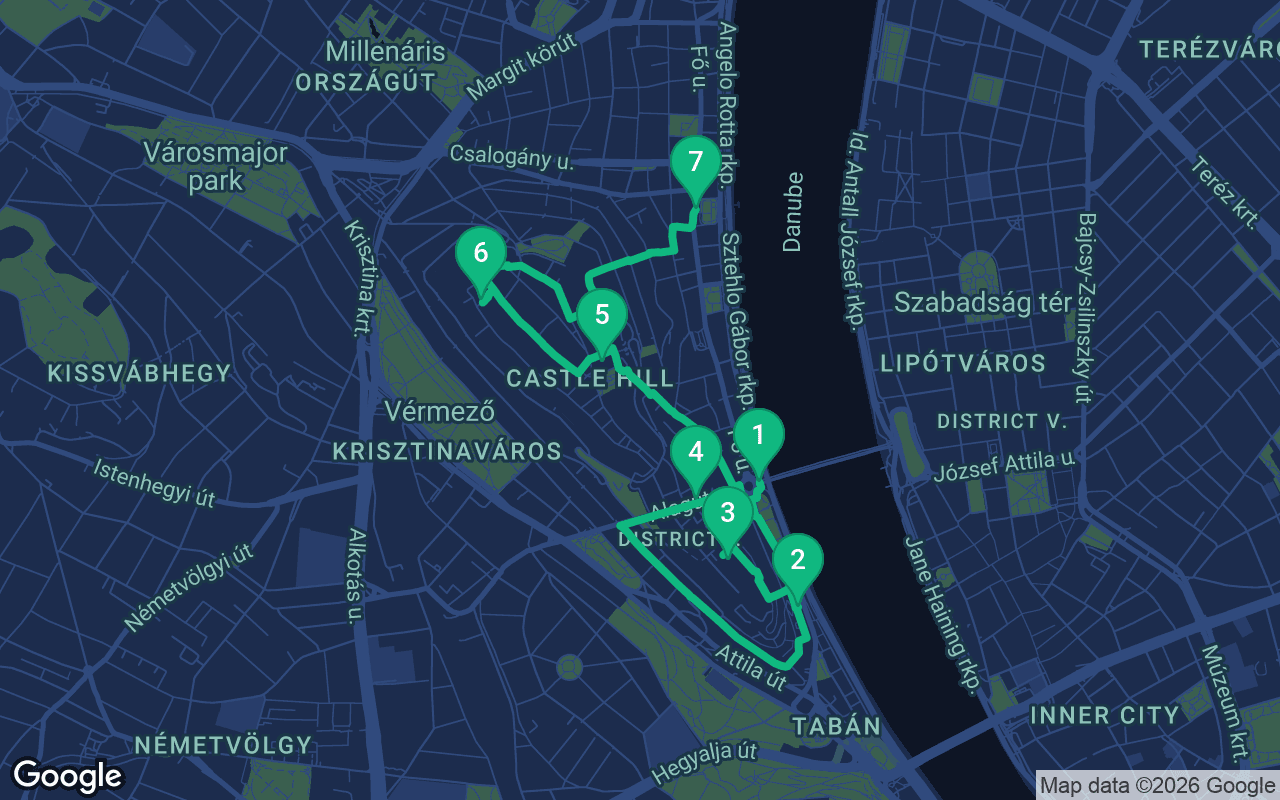
About 5.1 km, roughly 77 minutes at an easy pace.
This tour is narrated
Press play on the first 3 stops for a 30-second demo of the narration. In the app, the intro and those 3 stops play in full for free, each one chiming as you arrive. The whole narrated tour is yours for $11.99, a one-time purchase you keep for good.
Works with Garmin, Komoot, Strava, OS Maps and any GPX app.
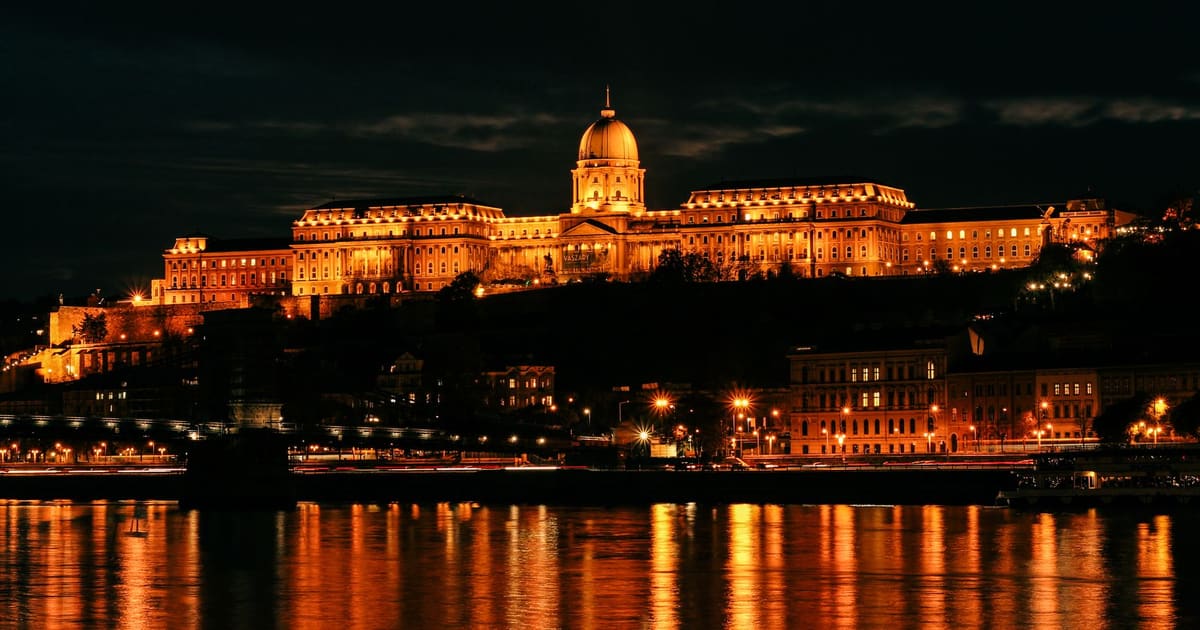
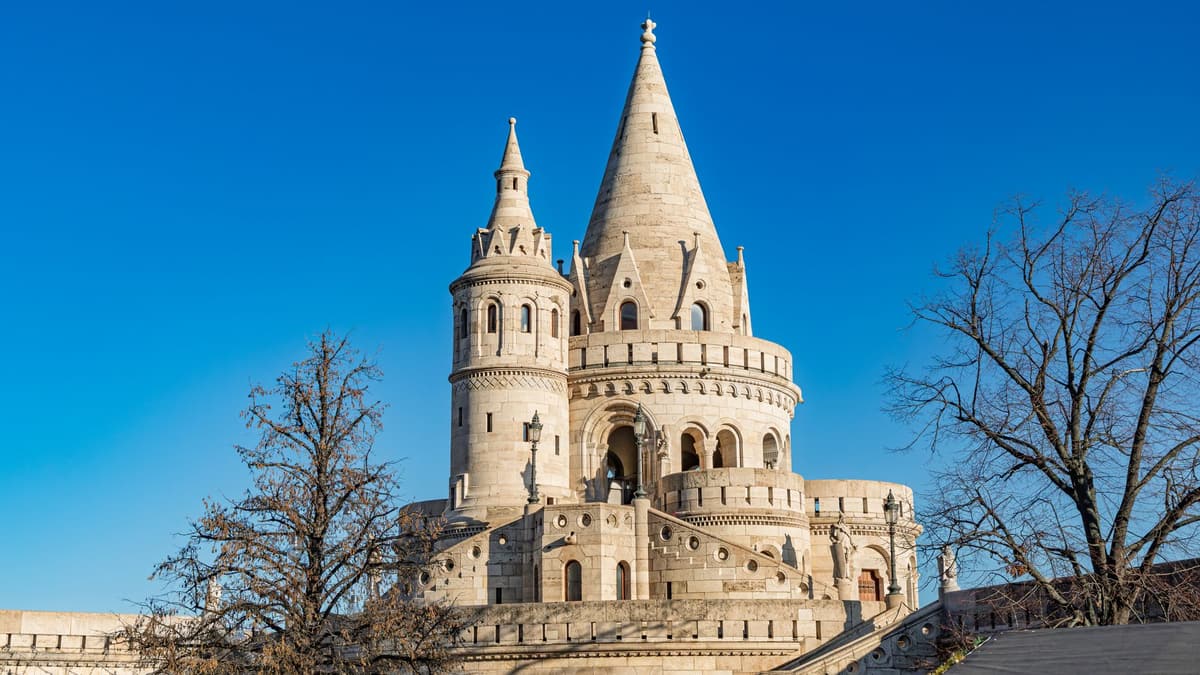
Look across the Danube from almost anywhere in Pest and your eye goes straight to Castle Hill, a long limestone ridge on the Buda side, crowned by a palace dome, a patterned church roof and a row of white turrets. This walk takes you up there. It starts at the foot of the Chain Bridge, climbs through a restored riverside arcade to the Royal Palace, then follows the hilltop north past the president's palace, Matthias Church and the Fisherman's Bastion to a lonely medieval tower at the quiet end of the hill, before coming down to Batthyány Square on the river. It is the Buda half of a pair of self-guided walking tours, and from many points along the way you will look straight back across the water to the Pest half. The route is about five kilometers, with one real climb and a gentle descent.
Set aside around three hours. The walking itself takes a little over an hour, but the hilltop is full of reasons to stop. The climb from the river to the palace is steep, though the Castle Garden Bazaar has escalators and lifts that do most of the work, so you can choose stairs or machinery depending on your legs. Up top, the streets are cobbled and fairly flat. The way down at the end is on lanes and steps, so wear shoes with grip, especially in wet weather or ice. Castle Hill is busiest from late morning to late afternoon, when the tour groups arrive. Early morning is calm and the light falls softly on Pest across the river, while the hour before sunset turns the Parliament gold. The upper terraces of the Fisherman's Bastion, Matthias Church and the museums in the palace charge for entry and keep their own hours, so check before you go. There are cafés along the main streets, and water fountains in summer.
You are standing at the Buda end of the Chain Bridge, in a busy roundabout with the river behind you and the hill rising right in front. Look for a small sculpture at the edge of the green, a round stone shape with a zero carved into it. This is the zero kilometer stone, the point from which road distances across Hungary are measured, so every highway sign in the country is counting back to where you are standing. The square is named after Adam Clark, the Scottish engineer who came to build the Chain Bridge with his namesake, the English designer William Tierney Clark, and then stayed in Hungary for the rest of his life. He also dug the road tunnel straight through the hill in front of you, and locals used to joke that it was built so the new bridge could be slid inside when it rained. Beside the tunnel mouth, a little funicular railway, first opened in 1870, crawls up the slope to the palace. The bridge itself was blown up by retreating German troops in 1945 and reopened in 1949, on its hundredth birthday. Now turn left and walk south along the riverside road, with the Danube on your left, to the long arcaded building at the foot of the hill, about seven minutes.
The long, cream-colored building with arches and terraces climbing the hillside is the Castle Garden Bazaar. It was designed in the 1870s and 1880s by Miklós Ybl, the architect behind the Hungarian State Opera House, as a grand garden staircase linking the riverside to the palace above, with shops tucked under its arcades and pavilions along its terraces. The idea was to make the royal hill feel open and elegant from the water. It did not last. After the Second World War the bazaar fell slowly into ruin, and for decades it stood fenced off and crumbling, with trees growing out of its stonework, one of the saddest sights on the riverfront. A long restoration finally reopened it in 2014, and now its gardens, staircases and arcades are back, along with exhibition spaces and cafés. Stand on one of the lower terraces and look at the view across the river to Pest, then up at the palace walls above you. The best part for walkers is practical. Inside the bazaar, escalators and lifts carry you most of the way up the hill. Take them, or climb the garden stairs if you prefer, and follow the signs up to the palace terrace, about ten minutes.
Come out onto the wide terrace on the river side of the palace and walk to the parapet. Below you, the Danube sweeps past, and across it lies the whole of Pest: the Chain Bridge, the Gresham Palace, the dome of St. Stephen's Basilica and, up the river, the spires of the Parliament. Behind you rises the long palace with its green dome, guarded by a bronze statue of Prince Eugene of Savoy on horseback, the general who helped drive the Ottomans out of Hungary. There has been a royal castle on this hill since the thirteenth century, when kings fortified it after the Mongol invasion. In the fifteenth century, King Matthias Corvinus turned it into a famous Renaissance court. Then came disaster after disaster. The palace was wrecked in the siege of 1686, rebuilt by the Habsburgs, grandly enlarged around 1900, and burned almost to a shell in the siege of 1945. What you see now is largely a postwar rebuilding, and it holds the Hungarian National Gallery, the Budapest History Museum and the National Széchényi Library. Walk north along the terrace toward the gateway topped by a great bronze bird with spread wings and a sword in its claws. That is the turul, the mythical falcon of Hungarian legend. Pass through that gate into the square beyond, about four minutes.
What's included
Our tours are made to be meditative and immersive: you keep moving and simply listen. They're always better together, and the app plays the narration in sync, so you, your partner and your friends hear every stop at the same moment.
You are now in Saint George's Square, and the elegant white neoclassical building on its edge, with its columned front, is Sándor Palace. It was built in the early 1800s for Count Vincent Sándor.
The rest of this stop is in the full audio tour.
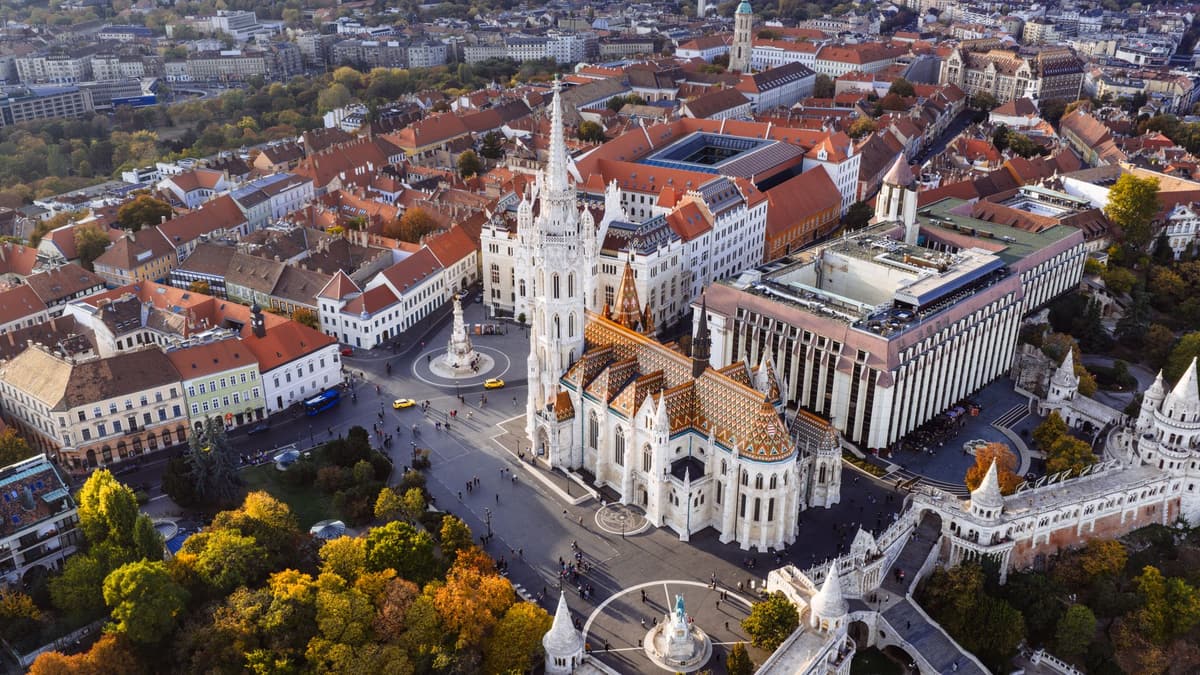
The street opens into Holy Trinity Square, with a tall white plague column in the middle and, beside it, the church you have been seeing from the river all along.
The rest of this stop is in the full audio tour.
The street opens into a quieter square, and in the corner stands a single Gothic stone tower, with a single rebuilt Gothic window standing beside it and the outline of a vanished church marked out in the grass.
The rest of this stop is in the full audio tour.
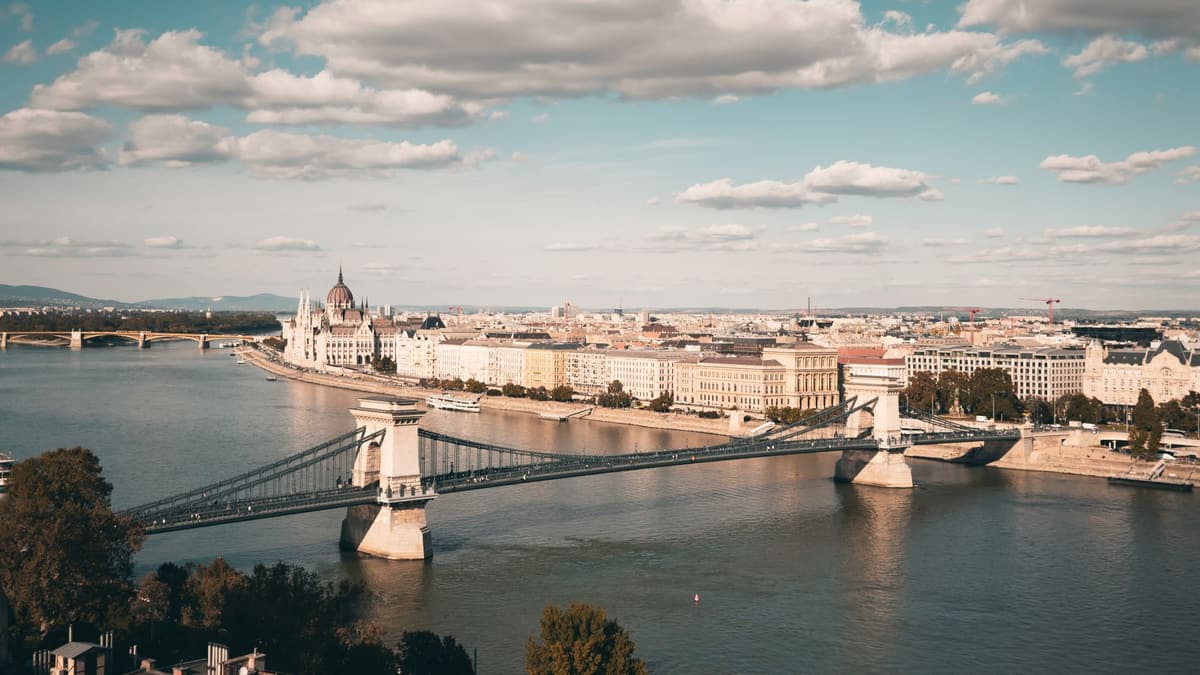
You have come down off the hill into Batthyány Square, at the riverside in the old Water Town district. Walk to the edge of the square closest to the Danube and look across.
The rest of this stop is in the full audio tour.
Do this walk with other people on the next scheduled tour.
About 5.1 km, roughly 77 minutes at an easy pace · 7 stops
Friends walk freeOctober 11, 2026 · 9 min read
From the Hollandsche Schouwburg through the old Jewish Quarter, past the Dockworker and the Dam, to the Anne Frank House on the Prinsengracht.
October 11, 2026 · 11 min read
From Van Houten's street by the Vondelpark past Leidseplein, the Rijksmuseum passage and the famous canal bench to the Anne Frank House.

October 11, 2026 · 10 min read
Follow the last days of April and May 1945 from the Anhalter Bahnhof ruin past the Gestapo site and Brandenburg Gate to the Moltke Bridge and the Reichstag.
