
 $8.99City Highlights
Toronto Walking Tour: Downtown from Yonge-Dundas to the Lake
Choose how you'll do this walk in our app

 Friends walk free
Every tour also runs as a scheduled group walk you can join in the app.
More audio tours in Toronto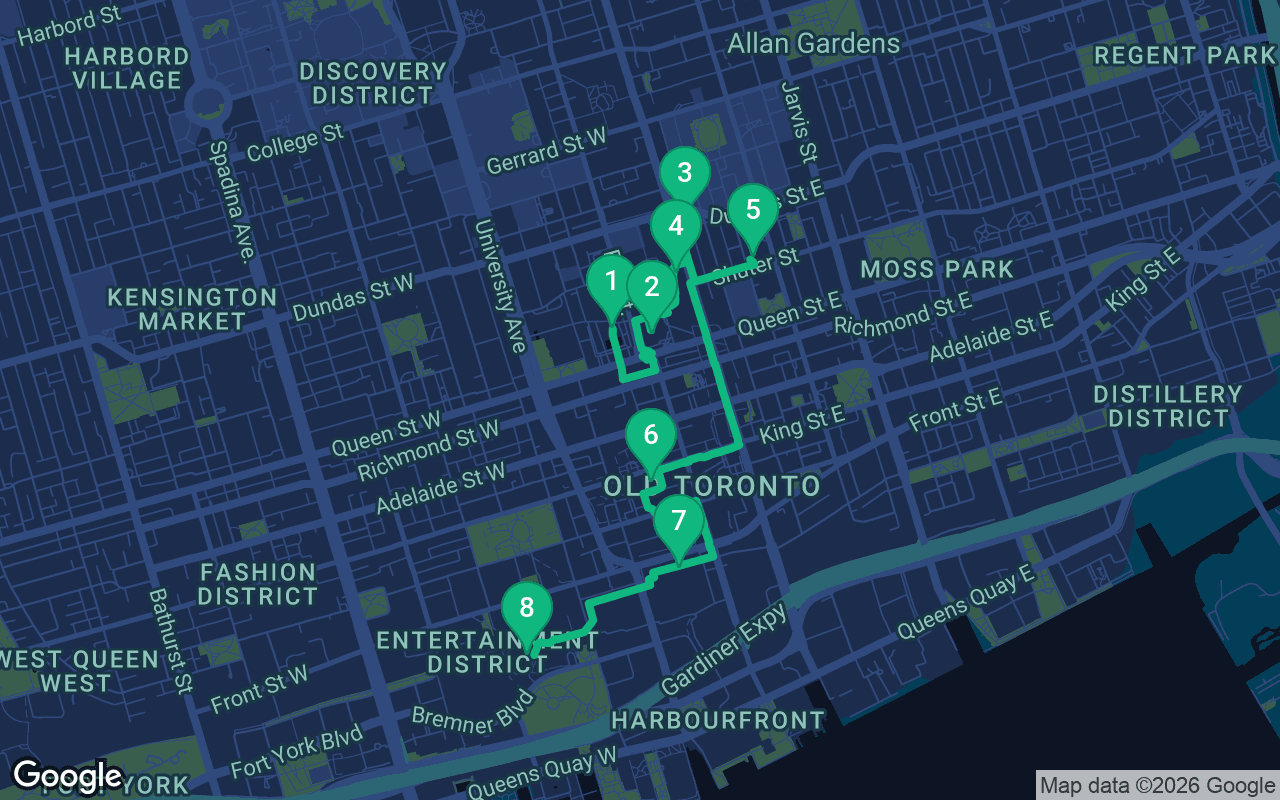
About 4.7 km, roughly 65 minutes at an easy pace.
- 1Yonge-Dundas Square
- 2Nathan Phillips Square and the two City Halls
- 3Osgoode Hall
- 4Financial DistrictFull tour
- 5Brookfield PlaceFull tour
- 6Union StationFull tour
- 7CN Tower~CA$45 · optionalOptional entry ticket, not includedFull tour
- 8Harbourfront CentreFull tour
Not included in the tour: ~CA$45 entry (optional)Average per person. Prices change, so check before you go.
This tour is narrated
Press play on the first 3 stops for a 30-second demo of the narration. In the app, the intro and those 3 stops play in full for free, each one chiming as you arrive. The whole narrated tour is yours for $10.99, a one-time purchase you keep for good.
Works with Garmin, Komoot, Strava, OS Maps and any GPX app.
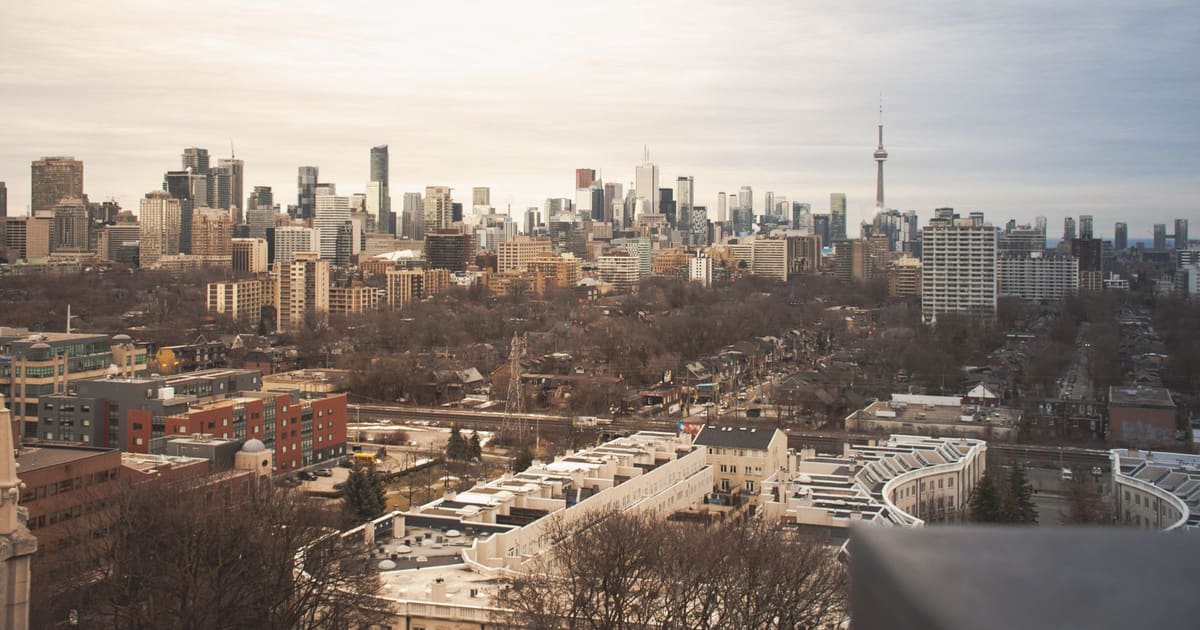
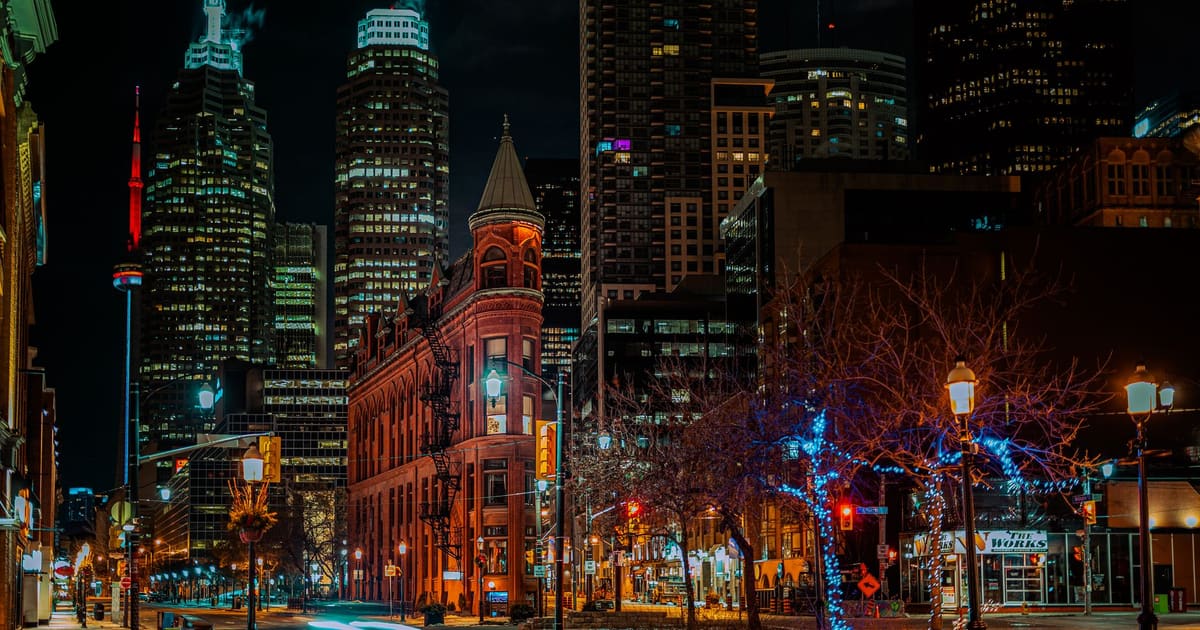
Downtown Toronto is a city of big gestures: one of the busiest crossroads in the country, a city hall that looks like it landed from the future, a forest of bank towers and the tallest tower anyone in the city has ever built. This walk strings them together in one line from north to south, starting under the giant screens at Yonge and Dundas and ending on the boardwalk by Lake Ontario, with the island ferries coming and going in front of you. On the way you pass both city halls, a lawyers' palace behind an iron fence, the corner of King and Bay where Canada keeps its money, a grand railway station and the foot of the CN Tower. It is a little under five kilometers, flat the whole way, and among the most useful self-guided walking tours in Canada for a first day in the city, because it gives you the shape of downtown and finishes at the water.
Before you set off
The walk takes a little over an hour at a stroll, but plan for two and a half to three hours if you want to look inside Union Station, sit by the skating rink or reflecting pool at City Hall, or linger at the lake. If you want to go up the CN Tower or visit the Hockey Hall of Fame, add more time and book or check tickets and hours before you go. The route is flat and paved, so any comfortable shoes will do. Toronto summers are hot and humid and its winters are cold, with a biting wind between the towers, so dress for the season. In bad weather you can do much of the middle section indoors, through the PATH, the underground network of passages and food courts that links the towers of the Financial District, Union Station and the stations around them. The streets are busy with streetcars and traffic, so cross at the lights. Weekday lunchtime shows the Financial District at full speed, while a weekend morning gives you the towers almost to yourself.
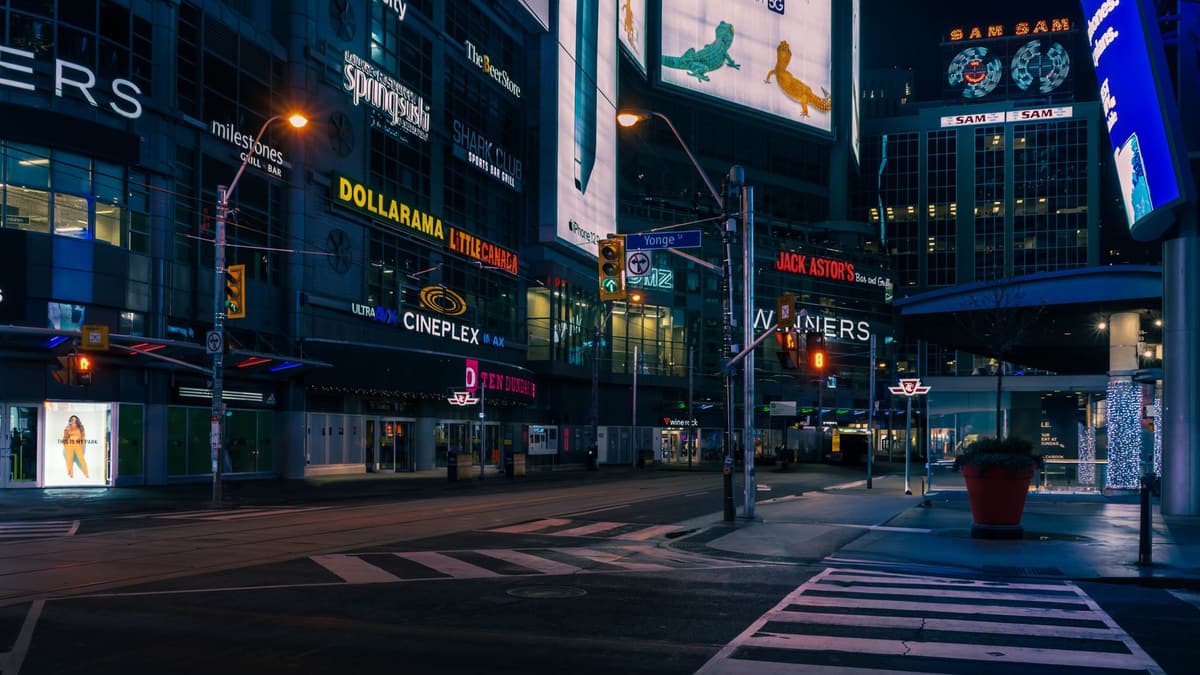
Yonge-Dundas Square
Stand in the open plaza on the corner and turn a slow circle. Giant screens and billboards light up the buildings around you, buskers and street preachers compete for the crowd, and two of the city's main streets cross right beside you. This is the closest thing Toronto has to Times Square, and it is busiest and brightest after dark. Yonge Street, running north and south, was laid out in the 1790s and named for Sir George Yonge, a British politician of the time, and for years it was billed as the longest street in the world, when its route was counted together with the highway that carries on north for hundreds of kilometers. The plaza itself is young; it opened in the early 2000s. The city has since renamed it Sankofa Square, after a word from Ghana's Akan languages about going back to fetch what was left behind, in other words learning from the past. The renaming followed a long public debate about Henry Dundas, the eighteenth-century British politician whose name the street still carries and who helped delay the abolition of the slave trade. Across Yonge, the glass and steel front belongs to the Eaton Centre, where a flock of sculpted Canada geese flies under the glass roof. From here, walk south on Yonge Street, past the Eaton Centre and the old Elgin and Winter Garden Theatre, a rare pair of theaters stacked one on top of the other. At Queen Street turn right and walk west past Bay Street. The square opens on your right in about seven minutes.
Nathan Phillips Square and the two City Halls
Stand on the square facing north, with Queen Street behind you, and take in two very different ideas of what a city hall should look like. In front of you, two curved towers of different heights wrap around a low, saucer-shaped council chamber. This is City Hall, opened in 1965, designed by the Finnish architect Viljo Revell, who won an international competition for it but died the year before it was finished. From the air, the towers and the dome look like an eye, and Torontonians still call it that. In front of it, a reflecting pool under three concrete arches turns into a skating rink in winter, and the big, colorful TORONTO sign is one of the most photographed spots in the city. The square is named for Nathan Phillips, the mayor who pushed for the project and the city's first Jewish mayor. Look for the large bronze sculpture by Henry Moore, The Archer, bought after a fierce public argument about modern art. Now turn to your right. The heavy sandstone pile with the clock tower is Old City Hall, opened in 1899 and designed by E. J. Lennox in a bold Romanesque style. The story goes that when the council refused him a plaque, he carved his own name into the stonework under the eaves, so look for it. For more than a century it also housed courts. From here, walk west along Queen Street for about three minutes, to the long iron fence and stone building on the corner of University Avenue.
Osgoode Hall
 Stand outside the iron fence and look through it at the pale classical building set back behind a lawn. This is Osgoode Hall, named after William Osgoode, the first chief justice of Upper Canada, and it has been the home of the province's lawyers since the 1830s. It houses the Law Society of Ontario and some of the province's highest courts, and it grew wing by wing through the nineteenth century into the stately building you see now, with columns, a balustrade along the roofline and a garden behind. Now look down at the fence itself. Set into it are the famous cow gates, narrow, angled openings shaped so that a person could slip through but a wandering cow or horse could not. In the 1860s, when the fence went up, animals still roamed the city's streets, and the lawyers wanted their lawn to stay a lawn. If the building is open, the interior is grand, with a magnificent library under a high vaulted ceiling, and the garden behind is sometimes open to the public in summer. Check before you go. To move on, cross Queen Street and walk south down York Street to King Street, then turn left and walk east along King, with the bank towers rising on both sides, to the corner of Bay Street. It takes about eight minutes.
The full tour continues in the app
- Distance
- 4.7 km
- Walking
- 65 min
- Steps
- ~6,500
- Narration
- 15 min
What's included
- All 8 stops, fully narrated
- Works offline once downloaded in the app
- Friends walk free one purchase covers everyone on your walk
Our tours are made to be meditative and immersive: you keep moving and simply listen. They're always better together, and the app plays the narration in sync, so you, your partner and your friends hear every stop at the same moment.
Financial District
You are at the corner of King and Bay, the center of corporate Canada, and on each of the four corners stands a different bank's idea of power.
The rest of this stop is in the full audio tour.
Brookfield Place
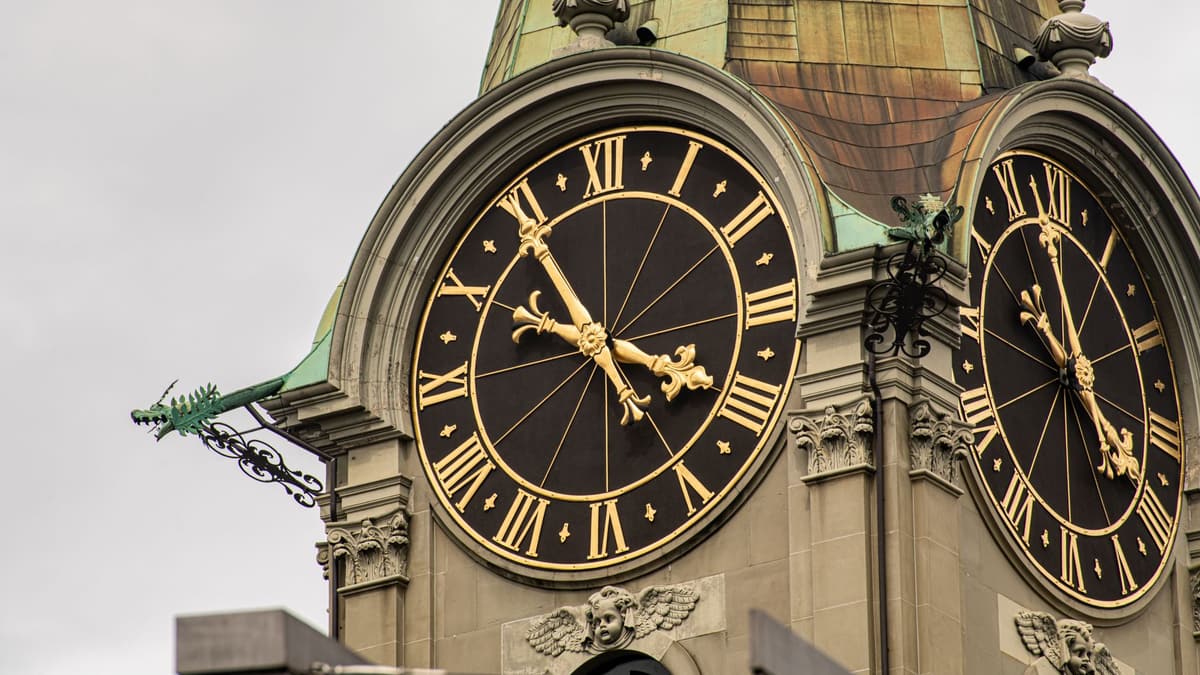
Step inside and look up. Brookfield Place is an office complex, but its central space, the Allen Lambert Galleria, is one of the most beautiful public rooms in the city.
The rest of this stop is in the full audio tour.
Union Station
Stand on Front Street facing the long colonnade of stone columns. This is Union Station, opened in 1927 in the Beaux-Arts style, the grand classical manner of the great railway stations of its age, and still the busiest transport hub in Canada by most counts.
The rest of this stop is in the full audio tour.
CN Tower
Stand at the foot of the CN Tower and try to follow it all the way up.
The rest of this stop is in the full audio tour.
Harbourfront Centre
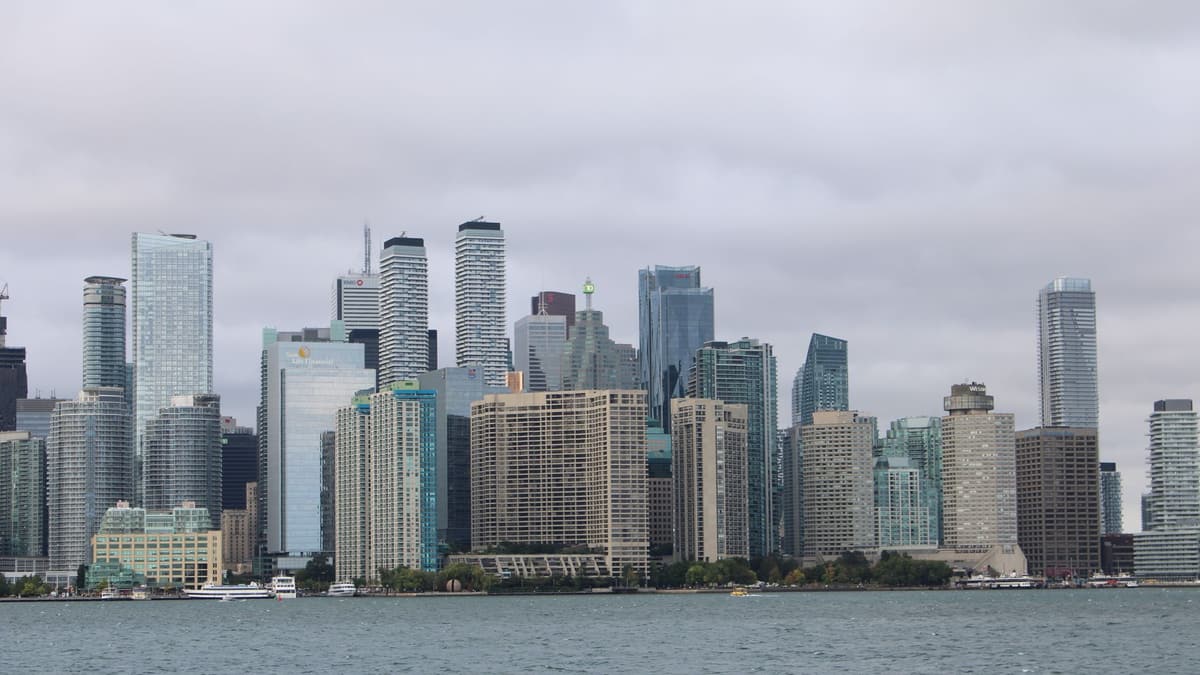
You have reached the lake. Stand at the edge of the boardwalk and look south across the harbor to the long, green line of the Toronto Islands, with the small island airport off to the right and sailboats, water taxis and ferries crossing in between.
The rest of this stop is in the full audio tour.
Do this walk with other people on the next scheduled tour.
About 4.7 km, roughly 65 minutes at an easy pace · 8 stops
Friends walk freeMore audio tours in Toronto
$8.99City Highlights