
 $15.99Turning Points
Warsaw Walking Tour: The Rebuilt Old Town, Square by Square
Choose how you'll do this walk in our app

 Friends walk free
Every tour also runs as a scheduled group walk you can join in the app.
More audio tours in Warsaw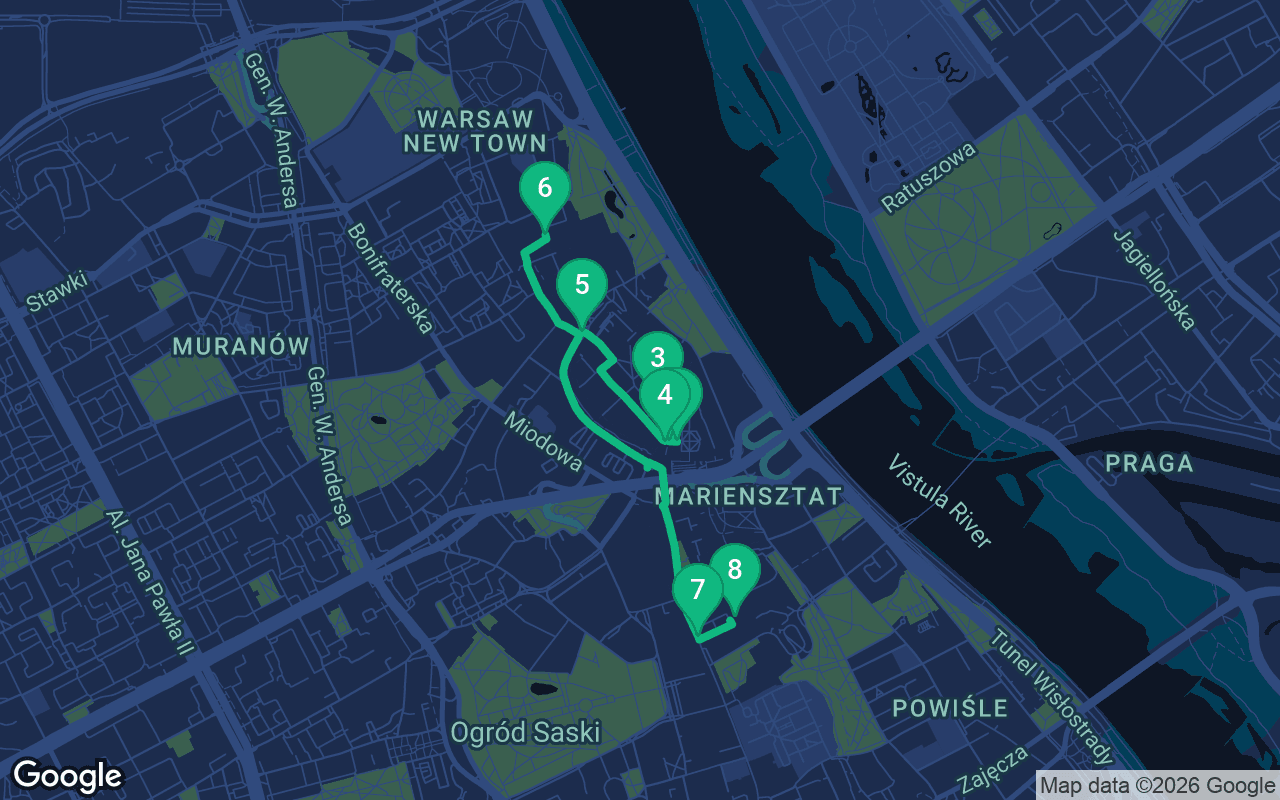
About 1.7 km, roughly 23 minutes at an easy pace.
- 1New Town Square
- 2Warsaw Barbican
- 3St. John's Archcathedral
- 4Castle SquareFull tour
- 5Royal Castle~PLN 60 · optionalOptional entry ticket, not includedFull tour
- 6St. Anne's Church~PLN 10 · optionalOptional entry ticket, not includedFull tour
- 7Krakowskie PrzedmiescieFull tour
- 8Presidential PalaceFull tour
Not included in the tour: ~PLN 70 entry (optional)Average per person. Prices change, so check before you go.
This tour is narrated
Press play on the first 3 stops for a 30-second demo of the narration. In the app, the intro and those 3 stops play in full for free, each one chiming as you arrive. The whole narrated tour is yours for $6.99, a one-time purchase you keep for good.
Works with Garmin, Komoot, Strava, OS Maps and any GPX app.
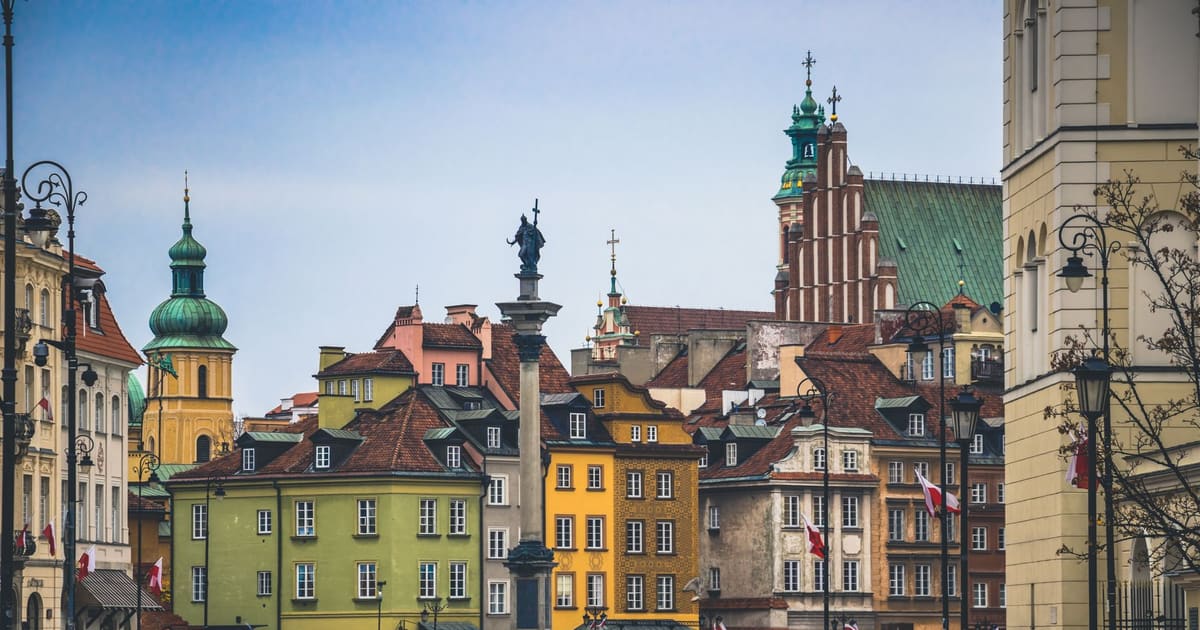
Every stone in Warsaw's Old Town tells two stories. One is the long history of a royal capital, with its merchants, kings and coronations. The other is what happened in the autumn of 1944, when German forces, after crushing the Warsaw Uprising, set out to erase the city and blew up most of the Old Town building by building. What you walk through today was rebuilt by hand after the war, from old paintings, drawings, photographs and memory, so carefully that UNESCO listed it as a World Heritage Site. This is one of our shorter self-guided walking tours, just under two kilometers, and it runs from the quiet New Town Square through the red brick Barbican into the old streets, past the cathedral to Castle Square and the Royal Castle, then down the first stretch of the Royal Route to the Presidential Palace.
Before you set off
The walking takes only about half an hour, but give yourself two hours to enjoy it, or half a day if you plan to tour the Royal Castle, which deserves a long visit of its own. The route is flat apart from a gentle rise toward the castle, and almost all of it is on cobbles, so comfortable shoes with some grip make a difference, especially in winter when the stones get icy. Mornings are quiet, while late afternoon and evening bring buskers and full café terraces to the squares. Summer days can be warm and winters properly cold, so dress for the season. The Royal Castle, St. Anne's bell tower and the cathedral's crypts have their own opening hours and tickets, so check before you go. There are cafés and bakeries all along the way, and the Old Town Market Square, which you will pass through between stops, is a fine place to stop for a coffee or a plate of pierogi.
New Town Square
Start in New Town Square, a gently sloping, irregular square with a small well in the middle and low, pastel houses all around. Despite the name, the New Town is old. It grew up just outside the walls of the Old Town in the late Middle Ages, a separate town for craftsmen and traders, and only later merged with its neighbor. It is calmer than the Old Town and feels more like a neighborhood, so it is a good place to start. Look to the east side of the square, where a white baroque church with a green dome rises above the houses. That is the Church of St. Kazimierz, built in the late 1600s for the Benedictine Sisters of the Blessed Sacrament. Queen Marie Casimire paid for it as a thank you for her husband, King Jan III Sobieski, and his great victory over the Ottoman army at Vienna in 1683. The street that leads south out of the square is Freta Street, and at number 16 a plaque marks the house where Maria Skłodowska, later Marie Curie, was born in 1867. There is a small museum to her there. Walk south down Freta Street, past that house, to the round red brick fortification at its end, about four minutes.
Warsaw Barbican
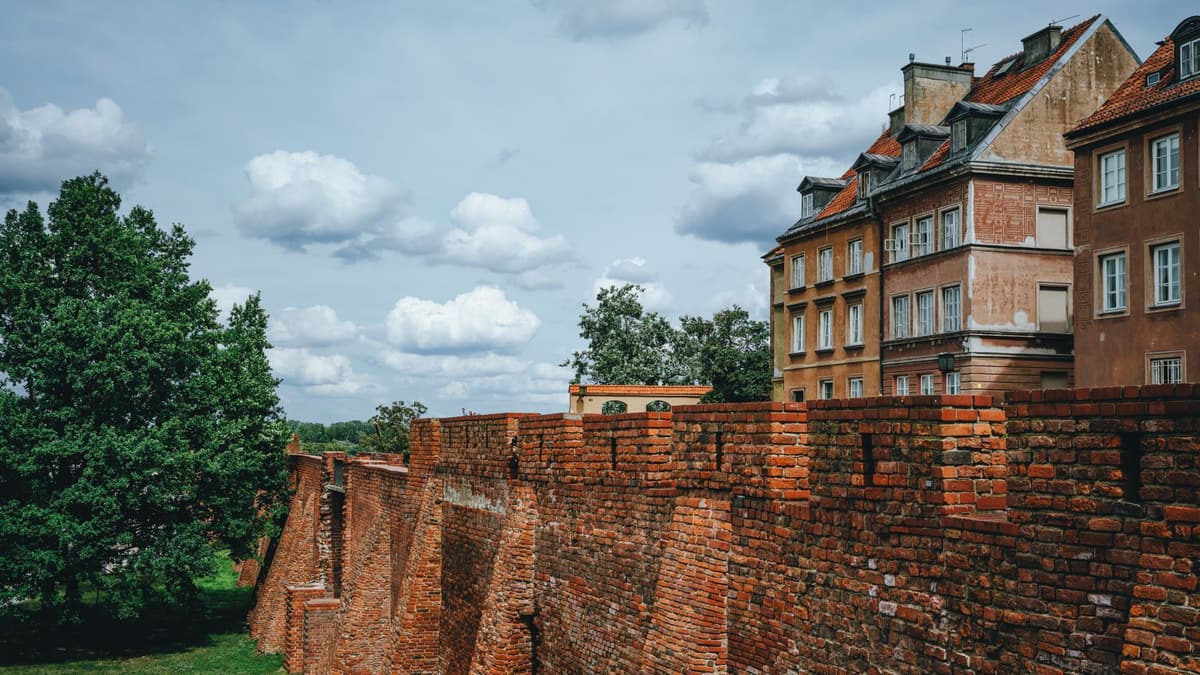
In front of you rises the Barbican, a half-moon of red brick with a gateway through the middle, little turrets on top and a dry moat below. It was built in the 1540s to guard the northern gate of the Old Town, and by the time it was finished it was already nearly useless, because artillery had made such walls easy to knock down. Over the following centuries it was partly demolished and built over, and by the twentieth century most of it had vanished into the surrounding houses. What you see now was reconstructed in the 1950s, part of the great postwar rebuilding. Walk a little way along the outside of the walls to your right and look for a small bronze statue of a boy in a helmet much too big for him, holding a gun. This is the Little Insurgent, a memorial to the children who fought and carried messages during the Warsaw Uprising of 1944, some of them no older than twelve or thirteen. It is one of the most touching monuments in the city. Then go back and walk through the Barbican gate along the street straight ahead into the Old Town Market Square, with the mermaid statue in its center, the symbol of Warsaw. Cross the square and leave by its far corner along the street toward the cathedral, about five minutes.
St. John's Archcathedral
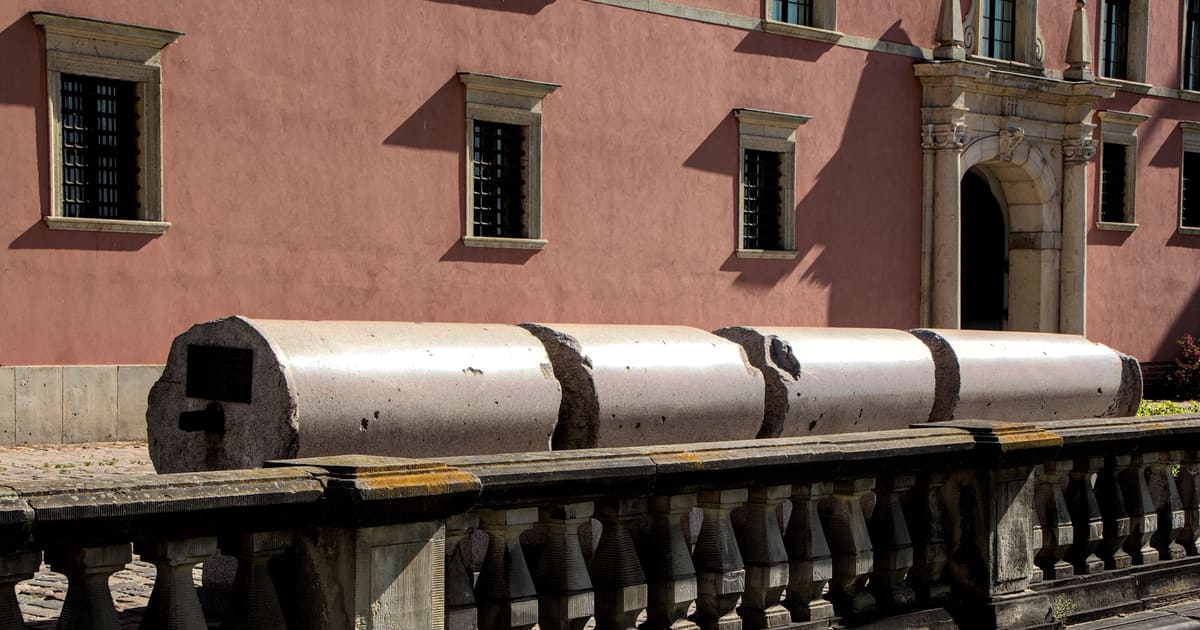
You are standing in front of St. John's Archcathedral, a tall, stepped Gothic facade of red brick and white tracery, squeezed into the narrow street so that you need to step back to see it. It began as a parish church in the fourteenth century and grew into the most important church in Warsaw. Polish kings were crowned here, including the last one, Stanisław August Poniatowski, in 1764, and in 1791 the king and the parliament came here to swear an oath to Poland's new constitution, one of the first written constitutions in the world. Down in the crypts lie the last dukes of Masovia, Poland's first president Gabriel Narutowicz, the novelist Henryk Sienkiewicz and the pianist and statesman Ignacy Paderewski. Like the streets around it, the cathedral was almost entirely destroyed in 1944 and rebuilt after the war. Walk along the side of the church on the narrow lane beside it and look up at the wall. You will see a large piece of metal track hanging there. It is part of the tread of a German remote-controlled demolition vehicle used against the insurgents in August 1944, left as a reminder of how the church was lost. Continue down the street for a minute, and it opens out into a wide square below the castle.
The full tour continues in the app
- Distance
- 1.7 km
- Walking
- 23 min
- Steps
- ~2,400
- Narration
- 15 min
What's included
- All 8 stops, fully narrated
- Works offline once downloaded in the app
- Friends walk free one purchase covers everyone on your walk
Our tours are made to be meditative and immersive: you keep moving and simply listen. They're always better together, and the app plays the narration in sync, so you, your partner and your friends hear every stop at the same moment.
Castle Square
You have stepped out into Castle Square, the big, open, triangle-shaped space where the Old Town meets the rest of Warsaw. Walk to the tall column in the middle and look up.
The rest of this stop is in the full audio tour.
Royal Castle
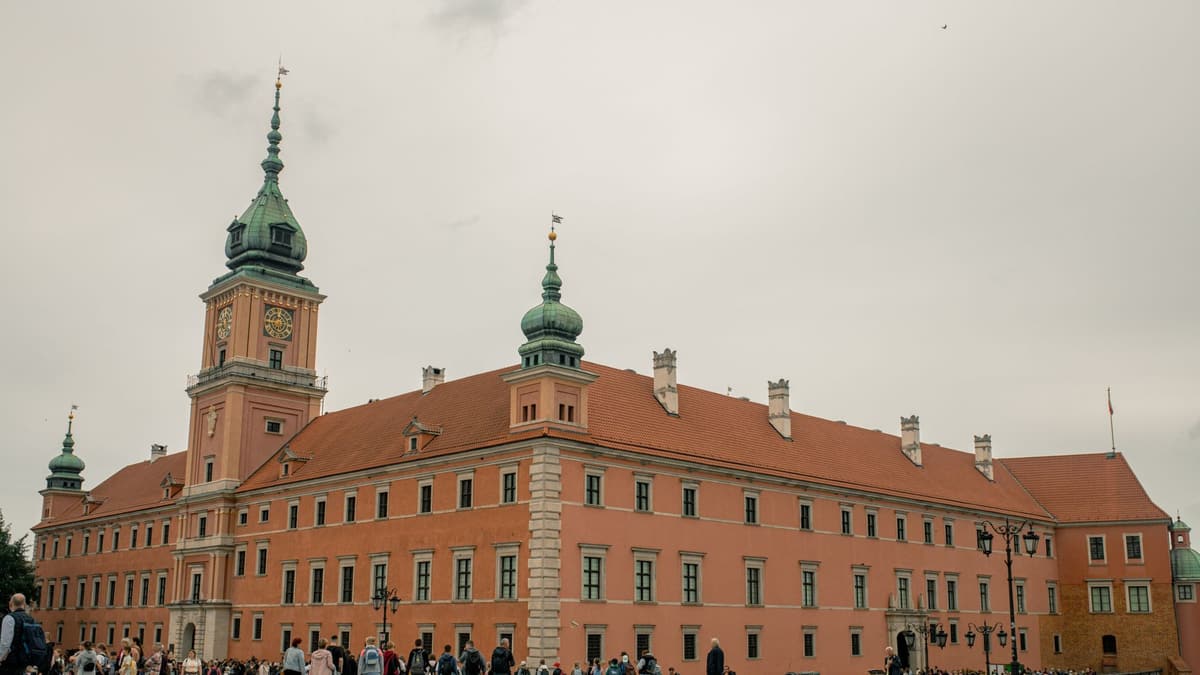
Stand facing the castle, with its square clock tower rising above the main gate.
The rest of this stop is in the full audio tour.
St. Anne's Church
You are at St. Anne's Church, set back slightly where the Royal Route begins. Look at its front.
The rest of this stop is in the full audio tour.
Krakowskie Przedmiescie
You are on Krakowskie Przedmiescie, the grandest street in Warsaw.
The rest of this stop is in the full audio tour.
Presidential Palace
Stand at the railings and look into the forecourt. Four stone lions guard the entrance, and in front of the white palace rides a bronze statue of Prince Józef Poniatowski, the nephew of the last king, who died fighting in Napoleon's army.
The rest of this stop is in the full audio tour.
Do this walk with other people on the next scheduled tour.
About 1.7 km, roughly 23 minutes at an easy pace · 8 stops
Friends walk freeMore audio tours in Warsaw
$15.99Turning Points $9.99City Highlights