
October 11, 2026 · 9 min read
Amsterdam Anne Frank Walking Tour
From the Hollandsche Schouwburg through the old Jewish Quarter, past the Dockworker and the Dam, to the Anne Frank House on the Prinsengracht.
589

October 9, 2026 · 10 min read

 Friends walk free
Every tour also runs as a scheduled group walk you can join in the app.
More audio tours in Chiang Mai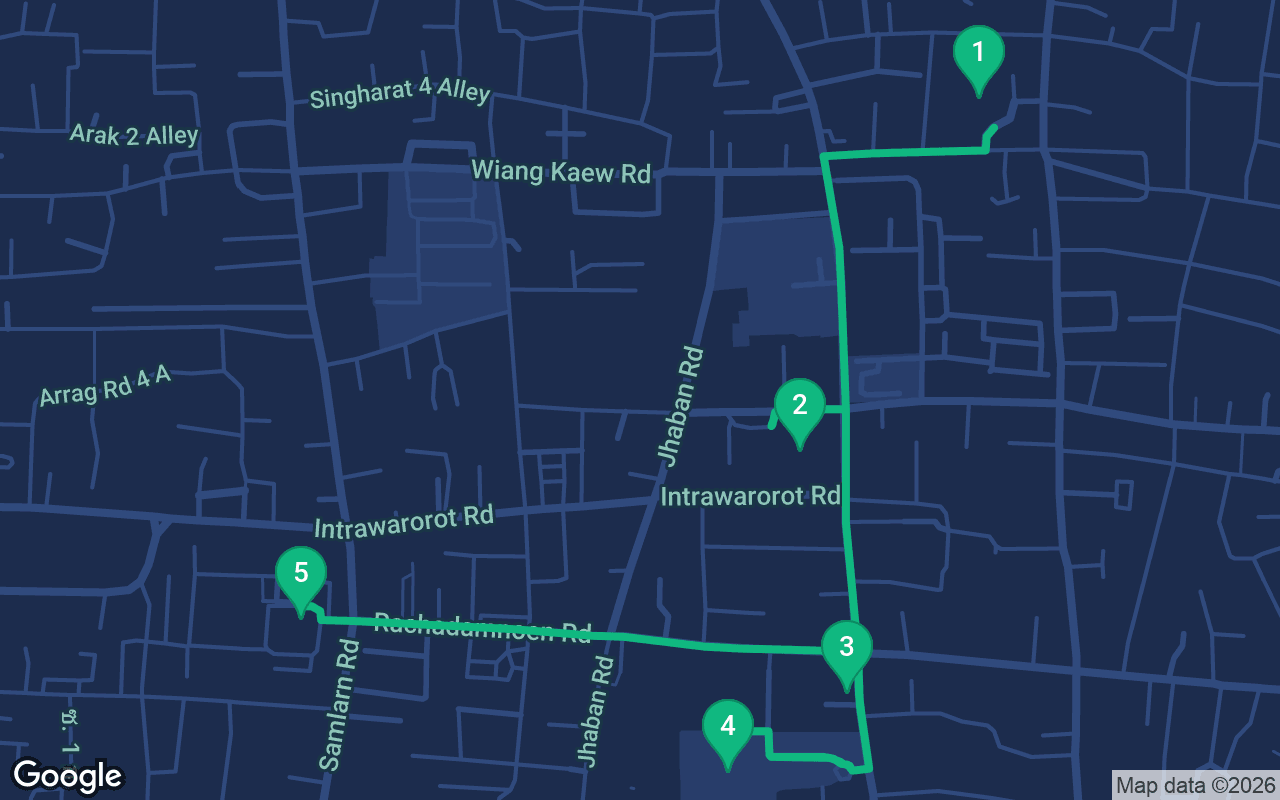
About 2.3 km, roughly 31 minutes at an easy pace.
This tour is narrated
Press play on the first 3 stops for a 30-second demo of the narration. In the app, the intro and those 3 stops play in full for free, each one chiming as you arrive. The whole narrated tour is yours for $7.99, a one-time purchase you keep for good.
Works with Garmin, Komoot, Strava, OS Maps and any GPX app.
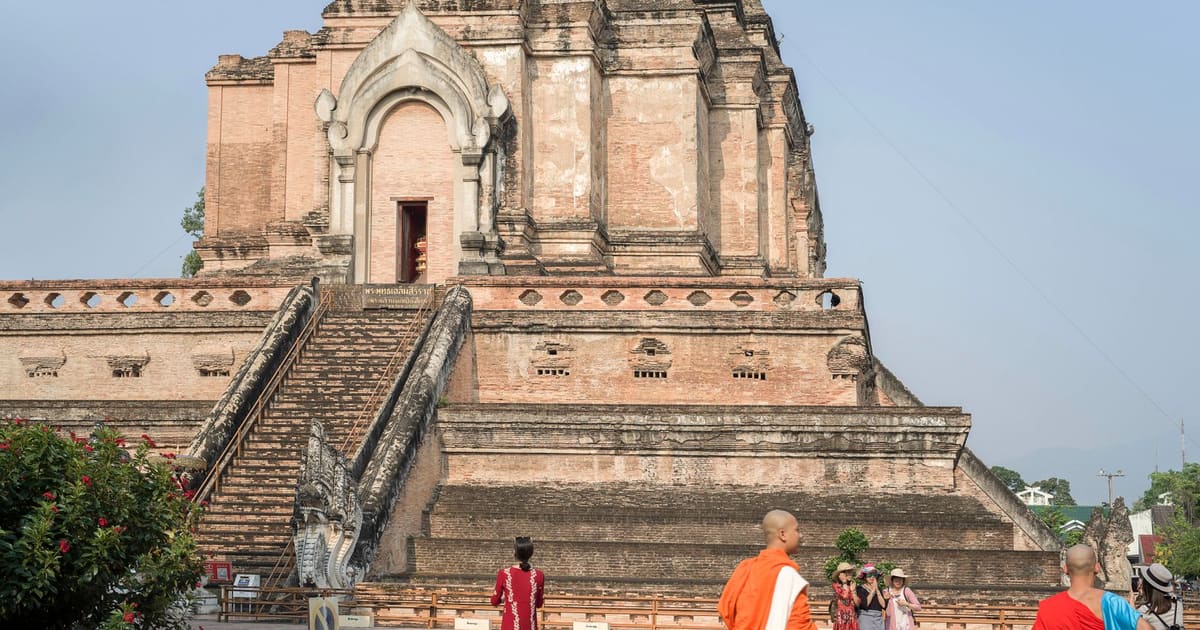
Chiang Mai's old city is a square of streets about a mile on each side, held inside a moat and the crumbling remains of brick walls, and it has been the heart of the north for more than seven hundred years. This walk stays inside that square. It starts at Wat Chiang Man, the temple where the city's founder lived while his new capital was being built, passes the statue of the three kings who chose the spot, and threads through the temples at the center of town, from a hall built entirely of teak to the broken giant of Wat Chedi Luang. It ends at Wat Phra Singh, the most revered temple in the north. The whole route is only about two kilometers on flat lanes, one of the easiest self-guided walking tours you can do in Thailand, and one of the richest.
The walking itself takes barely half an hour, but give it two to three hours, because every stop is a temple worth time inside. Go early in the morning. The heat builds fast for most of the year, the temples are calmer, and if you are out at first light you may see monks in saffron robes walking the lanes on their alms round. Late afternoon works too, as the sun drops behind the mountain to the west. The old city has some shade from big trees in the temple grounds, but very little along the streets, so carry water and a hat. Dress for temples all day: shoulders and knees covered, which matters more here than almost anywhere. Take your shoes off before stepping into any hall, sit or kneel with your feet tucked away rather than pointing them at a Buddha image, and give monks room; women in particular should avoid touching a monk or handing things to him directly. Some temples ask for a small entry fee for foreign visitors, and opening times change, so check before you go. Traffic on the narrow streets is lighter than outside the walls, but scooters appear from nowhere, so keep to the side.
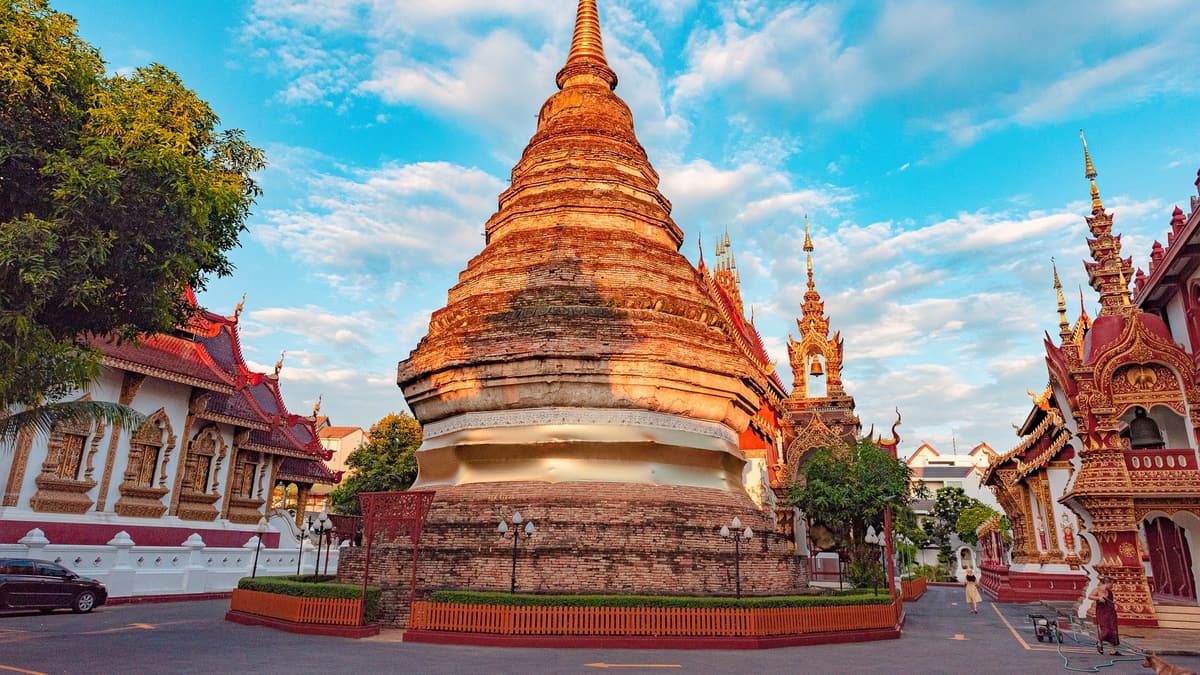
You are standing in the oldest temple in Chiang Mai, and in a sense the place where the whole city began. In 1296, King Mangrai, ruler of the young Tai kingdom of Lanna, decided to build a new capital on this plain between the Ping River and the mountain of Doi Suthep. While his workers dug the moat and raised the walls, he camped on this spot, and afterward the camp became a temple. An old stone inscription kept here records the founding of the city, which is why historians lean on this quiet compound so heavily. Walk around to the chedi at the back and look at its base. A row of brick elephants stands shoulder to shoulder around it, half emerging from the structure as if they were carrying it on their backs, an image of strength and royal power that turns up across the north. Then find the smaller hall to the side, where two small and very old Buddha images are kept behind grilles: one carved in stone, one made of crystal. Both are deeply venerated, and people come here to pray in front of them, so keep your voice low. Notice too the steep, layered roofs and the carved gables of the halls, the classic Lanna style that you will see again and again on this walk. When you are ready, leave by the main gate and work your way south and west through the lanes to Phra Pokklao Road, the main street running north to south through the middle of the old city. Turn left along it. The three bronze kings stand in a forecourt a short way down, about seven minutes in all.
 In front of you, three kings in bronze lean together as if deep in conversation. In the middle is Mangrai, the founder of Chiang Mai. On either side stand his two allies, King Ngam Muang of Phayao and King Ramkhamhaeng of Sukhothai, rulers of neighboring Tai kingdoms. The chronicles of the north say the three of them met to choose the site for Mangrai's new capital, and that auspicious signs were seen here, among them white deer and a family of white mice, so the ground was judged lucky. They named it Nopphaburi Si Nakhon Ping Chiang Mai, and the last two words simply mean "new city," because Mangrai had already built an earlier capital nearby, Wiang Kum Kam, which kept flooding from the Ping River. The new city was laid out as a square, with the moat and walls you crossed on the way in, and this spot sat near its heart. Mangrai went on to rule for many years and made Lanna, the "kingdom of a million rice fields," a power in the region for the next two and a half centuries. The handsome white building behind the statues was once the provincial government hall and now houses a museum of the city's history. It makes a good place to come back to on a hot afternoon. Locals leave flowers, candles and incense at the base of the monument, especially for Mangrai, who is still honored here as the city's protector, so step around the offerings with care. To go on, walk south along Phra Pokklao Road and cross Ratchadamnoen Road with care. The dark wooden hall of Wat Phan Tao is just beyond, about four minutes away.
After the gilt and white paint of most temples in town, Wat Phan Tao feels like walking into a different century. The main hall is built almost entirely of teak: dark wooden walls made from big panels, a floor of planks, and a roof held up by massive teak columns that have turned nearly black with age. It was not built as a temple at all. The hall was once part of the palace of one of Chiang Mai's nineteenth century rulers, and it was taken apart and rebuilt here as a place of worship, which is why it has the proportions of a grand house rather than a temple. Look up over the entrance for the gilded peacock spreading its tail inside the carved panel, a royal emblem and one of the loveliest pieces of woodcarving in the city. Step inside, shoes off, and let your eyes adjust to the dim light. The wood keeps the room surprisingly cool, and the old Buddha images at the far end glow against the dark walls. The name is usually explained as "thousand kilns," after the furnaces that are said to have stood on this ground to cast bronze images for the great temple next door. Out in the courtyard there is often a small garden with a pond and a few trees, a peaceful corner, and during Yi Peng, the lantern festival that usually falls in November, the grounds are lit with candles and paper lanterns. Wooden temples like this were once common across the north, and very few survive. When you are ready, walk out the side of the compound into the grounds next door. The ruined giant is right there, two minutes away.
What's included
Our tours are made to be meditative and immersive: you keep moving and simply listen. They're always better together, and the app plays the narration in sync, so you, your partner and your friends hear every stop at the same moment.
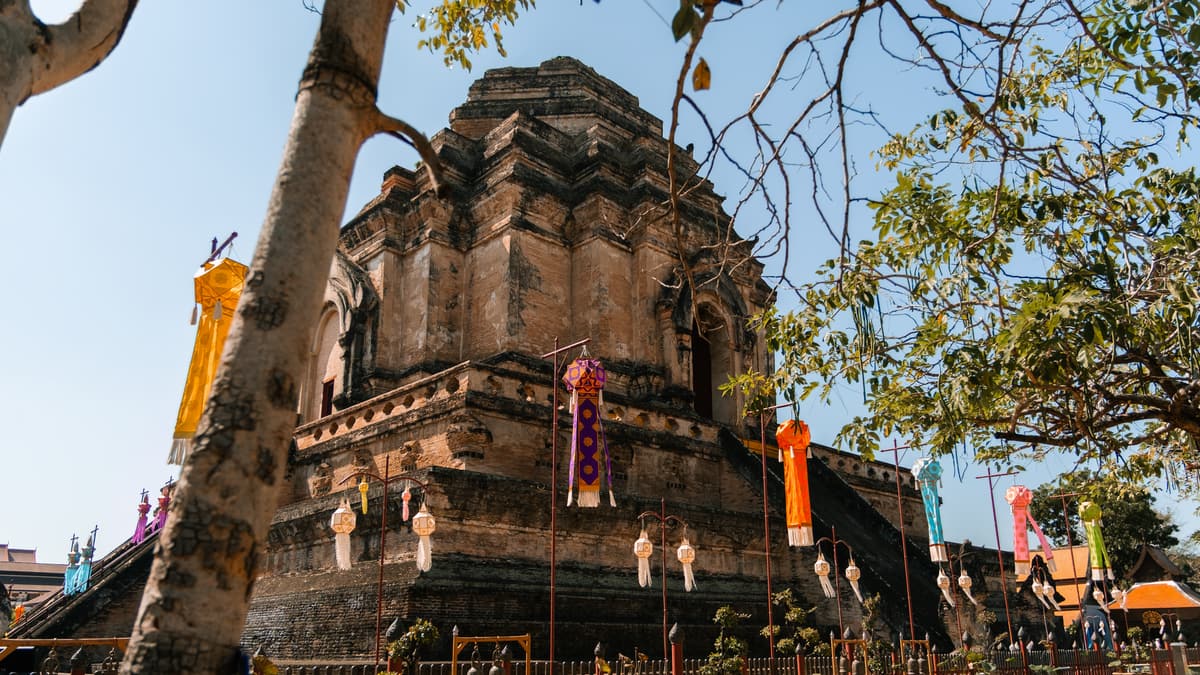
Stand back far enough to take in the whole thing, because the size of this ruin only makes sense from a distance.
The rest of this stop is in the full audio tour.
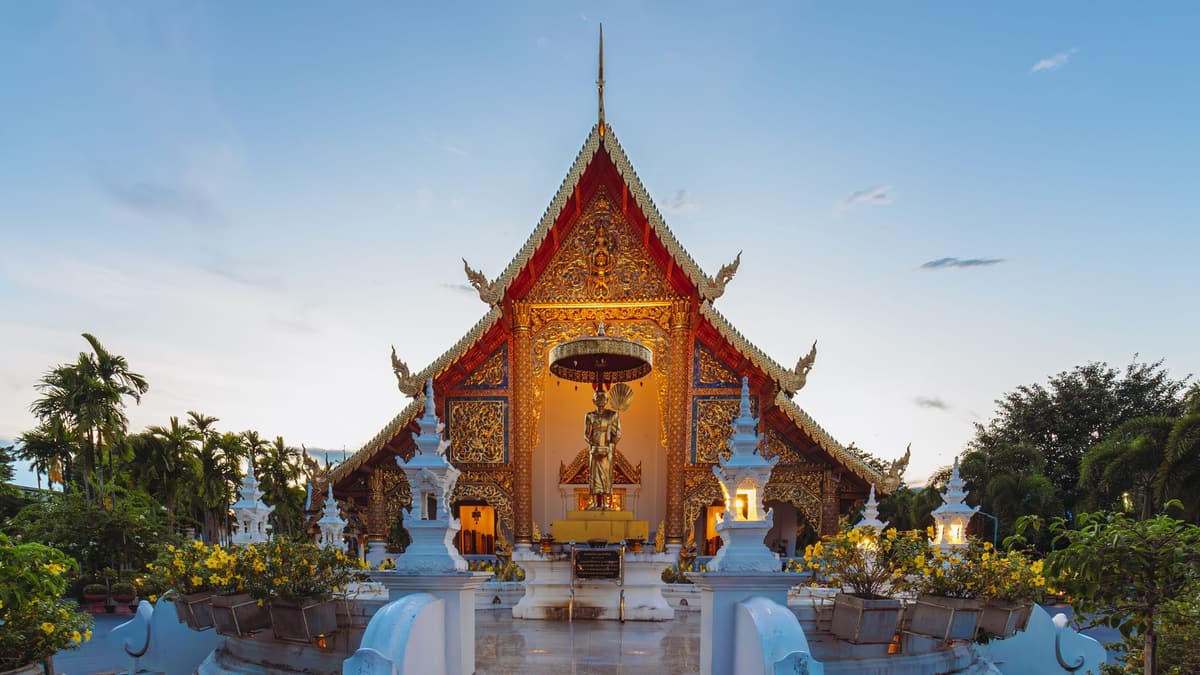
The walk ends at Wat Phra Singh, the most revered temple in Chiang Mai and the one that the whole city turns toward at Songkran, the Thai new year in April.
The rest of this stop is in the full audio tour.
Do this walk with other people on the next scheduled tour.
About 2.3 km, roughly 31 minutes at an easy pace · 5 stops
Friends walk freeOctober 11, 2026 · 9 min read
From the Hollandsche Schouwburg through the old Jewish Quarter, past the Dockworker and the Dam, to the Anne Frank House on the Prinsengracht.
October 11, 2026 · 11 min read
From Van Houten's street by the Vondelpark past Leidseplein, the Rijksmuseum passage and the famous canal bench to the Anne Frank House.

October 11, 2026 · 10 min read
Follow the last days of April and May 1945 from the Anhalter Bahnhof ruin past the Gestapo site and Brandenburg Gate to the Moltke Bridge and the Reichstag.
