
October 11, 2026 · 9 min read
Amsterdam Anne Frank Walking Tour
From the Hollandsche Schouwburg through the old Jewish Quarter, past the Dockworker and the Dam, to the Anne Frank House on the Prinsengracht.
589

October 9, 2026 · 9 min read

 Friends walk free
Every tour also runs as a scheduled group walk you can join in the app.
More audio tours in Wellington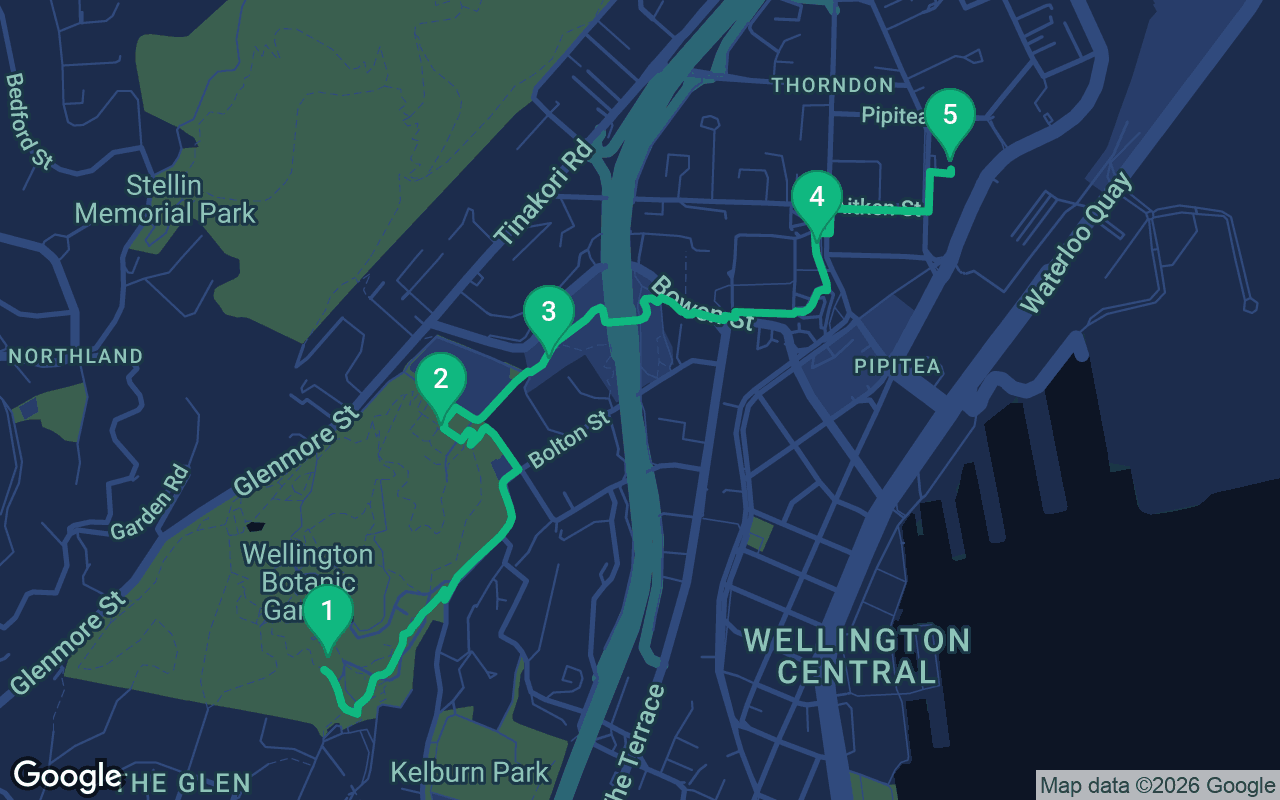
About 2.4 km, roughly 32 minutes at an easy pace.
This tour is narrated
Press play on the first 3 stops for a 30-second demo of the narration. In the app, the intro and those 3 stops play in full for free, each one chiming as you arrive. The whole narrated tour is yours for $7.99, a one-time purchase you keep for good.
Works with Garmin, Komoot, Strava, OS Maps and any GPX app.

This is a walk with a trick to it: you let a machine do the climbing, and then gravity walks you home. You start on Lambton Quay in downtown Wellington and ride the little red cable car up the hill to Kelburn, where the city and the whole sweep of the harbor open out below you. From the top you walk down, through the Botanic Garden and its rose beds, past the graves of the city's founders in Bolton Street Cemetery, to the seat of government at Parliament and finally to Old St Paul's, a Gothic church built entirely of native timber. The walk itself is about two and a half kilometers, a mile and a half, and nearly all of it runs downhill, which makes it one of the gentlest self-guided walking tours in a famously hilly city.
Ride up, walk down. The cable car leaves from Cable Car Lane, off Lambton Quay, and climbs about 120 meters in a few minutes to the Kelburn terminus at the top, where this walk begins. It runs every few minutes through the day, but closes for maintenance for about a week each winter, so check before you go. Allow about two hours for the walk at a gentle pace, and more if you take a tour of Parliament or stop at Space Place. The paths through the Botanic Garden are downhill and in places steep and winding, so wear shoes with some grip, especially after rain, when the paths can be slippery. If you have trouble with slopes, take it slowly and use the handrails where there are some. Wellington weather changes quickly, and the hilltop is more exposed to the wind than the city below, so bring a warm, windproof layer even on a bright day. The garden has plenty of shade, the streets at the bottom very little. Parliament runs free guided tours on most days, which need a little time for a security check, and Space Place and Old St Paul's keep their own hours, so check all three before you go. The roses are at their best from late spring through summer, roughly November to March.
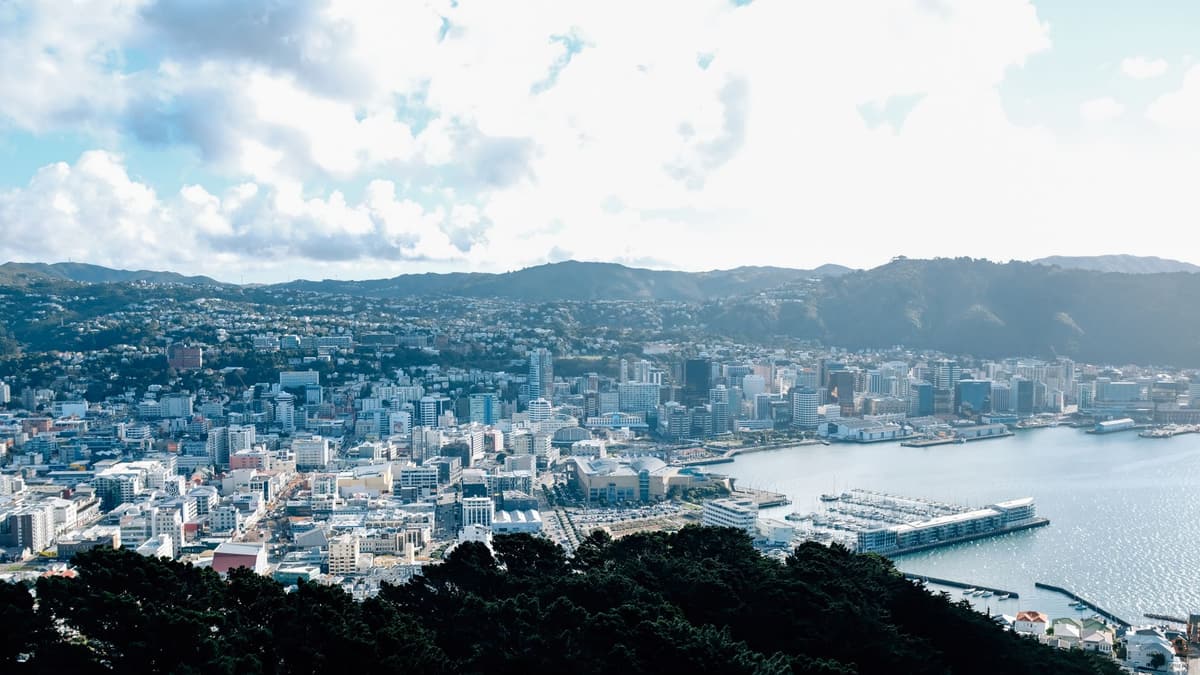
Step out of the cable car at Kelburn and walk to the lookout first, because the view is the best introduction to Wellington there is: the city squeezed between the hills and the harbor, ferries heading out toward Cook Strait, and the hills of the far shore beyond. The old winding house beside the station holds a small museum about the cable car, which opened on 22 February 1902 and was rebuilt as a modern funicular in 1978 and 1979 with new cars from Switzerland. A short walk into the garden brings you to Space Place, the domed building among the trees. It opened as the Carter Observatory on 20 December 1941, funded by a bequest from Charles Rooking Carter, a settler and politician who died in 1896 and left the rest of his estate for an observatory. It took decades for the money to grow enough to build it. Its pride is the Thomas Cooke telescope, a refracting telescope made in England in 1867 and in use here since the observatory opened. In 2010 the observatory reopened as Space Place, with a digital planetarium, and it now tells the story of the southern sky. That sky is very different from the one northern visitors know. You can see the Southern Cross, the two Magellanic Clouds and, in midwinter, the rising of Matariki, the cluster also called the Pleiades, which marks the Māori new year and has been a public holiday since 2022. Polynesian navigators read these same stars to find their way across the Pacific. From Space Place, follow the paths downhill through the garden, heading northeast and following the signs for the rose garden, about ten minutes.
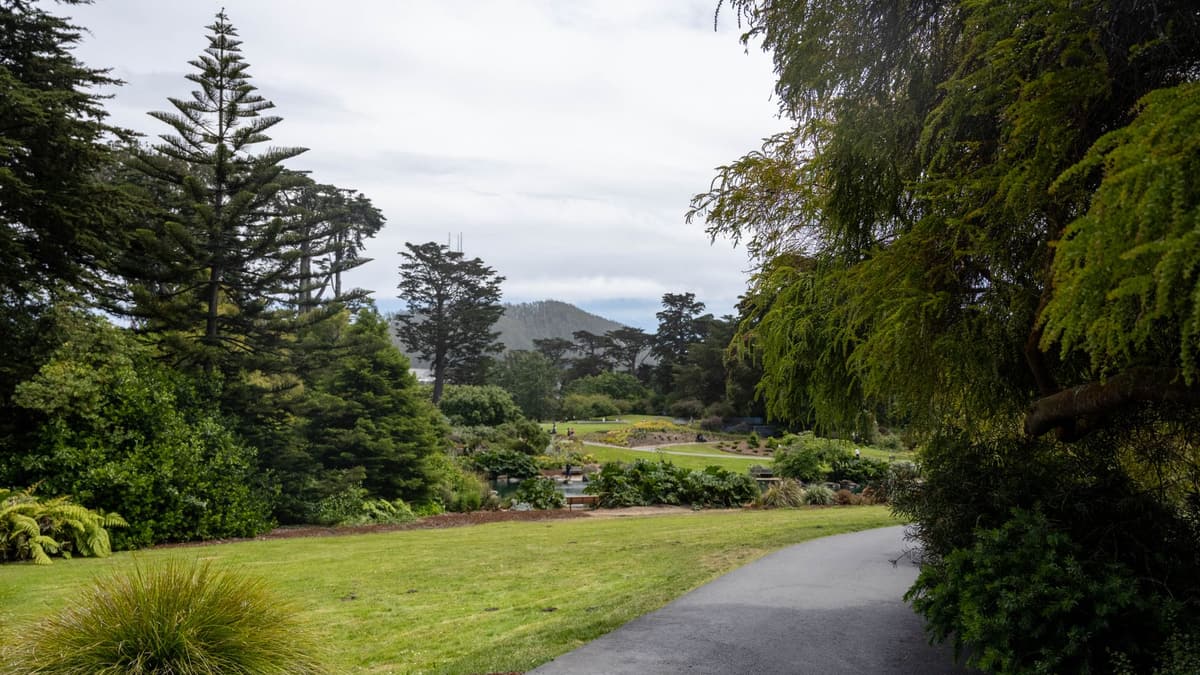 The Lady Norwood Rose Garden is the formal circle of rose beds laid out on the flat ground at the bottom of the garden, surrounded by a curving colonnade covered in climbing roses. It opened in 1953 with help from the Norwood family, after whom it is named, and it has about 110 beds in a neat geometric pattern, holding something like three hundred varieties, from old favorites to new introductions. In late spring and summer the scent is extraordinary. In winter the bushes are pruned back hard and the garden has a stark beauty of its own. The Botanic Garden around you, Wellington Botanic Garden ki Paekākā, is one of the oldest public gardens in New Zealand. Land for it was set aside from the Town Belt in 1844, and the garden as it exists today was established in 1868. Its early job was practical, testing which imported trees and plants could thrive in New Zealand, and some of the tall exotic conifers on the slopes date from those first decades. Alongside them, the garden keeps stretches of native forest, with tree ferns and kawakawa, so the native and the imported grow side by side. Next to the roses is the Begonia House, a glasshouse full of tropical plants, with a cafe that makes a good stop on a cold day. Leave the rose garden on its eastern side and follow the signposted path into Bolton Street Cemetery, which borders the garden, about five minutes.
Bolton Street Cemetery is a green, overgrown slope full of tilted headstones, and it is Wellington's oldest cemetery. It opened in 1840, the year the first New Zealand Company settlers arrived, and it was the city's main burial ground until it closed to new burials in 1892. Around eight thousand people were buried here, in three sections: one for the Church of England, one for other denominations and one for the city's Jewish community. Among them are the Wakefield brothers, two of the men at the center of the colonization of New Zealand. Edward Gibbon Wakefield, who spent three years in prison in England for abducting a teenage heiress, devised the theory of systematic colonization behind the New Zealand Company. His brother William led the company's first expedition in 1839 and made the hurried, much disputed land deals with local chiefs on which the settlement was built. Look for the tall memorial to Richard Seddon, the longest-serving Prime Minister in the country's history, who led the government from 1893 until his death in 1906. He lies in a crypt beneath it with his wife and a daughter. In the late 1960s the city's urban motorway was driven straight through the middle of the cemetery, despite public protest. About 3,700 burials were exhumed and their remains placed in a shared vault, and a footbridge now links the two halves. A replica of the old mortuary chapel serves as a small visitor center. Follow the paths down through the cemetery to Bowen Street, then walk downhill along it, heading east, to Parliament, about ten minutes.
What's included
Our tours are made to be meditative and immersive: you keep moving and simply listen. They're always better together, and the app plays the narration in sync, so you, your partner and your friends hear every stop at the same moment.
You arrive at the seat of New Zealand's government, three very different buildings side by side. The round one is the Beehive, the executive wing, where the Prime Minister and the ministers have their offices.
The rest of this stop is in the full audio tour.

Your walk ends at Old St Paul's, a small white Gothic church on Mulgrave Street that hides one of the most beautiful interiors in the country. It was designed by the Reverend Frederick Thatcher and built in 1866.
The rest of this stop is in the full audio tour.
Do this walk with other people on the next scheduled tour.
About 2.4 km, roughly 32 minutes at an easy pace · 5 stops
Friends walk freeOctober 11, 2026 · 9 min read
From the Hollandsche Schouwburg through the old Jewish Quarter, past the Dockworker and the Dam, to the Anne Frank House on the Prinsengracht.
October 11, 2026 · 11 min read
From Van Houten's street by the Vondelpark past Leidseplein, the Rijksmuseum passage and the famous canal bench to the Anne Frank House.

October 11, 2026 · 10 min read
Follow the last days of April and May 1945 from the Anhalter Bahnhof ruin past the Gestapo site and Brandenburg Gate to the Moltke Bridge and the Reichstag.
