
 $16.99Famous Lives
Amsterdam Walking Tour: A Self-Guided Route Along the Canal Ring
Choose how you'll do this walk in our app

 Friends walk free
Every tour also runs as a scheduled group walk you can join in the app.
More audio tours in Amsterdam
About 3.2 km, roughly 44 minutes at an easy pace.
- 1Prinsengracht and Noordermarkt
- 2Westerkerk and the Anne Frank House Area
- 3Jordaan District's Hidden Courtyards
- 4De Negen Straatjes (The Nine Streets)Full tour
- 5Herengracht's Golden BendFull tour
- 6Bloemenmarkt (Floating Flower Market)Full tour
- 7Rembrandtplein and ReguliersdwarsstraatFull tour
This tour is narrated
Press play on the first 3 stops for a 30-second demo of the narration. In the app, the intro and those 3 stops play in full for free, each one chiming as you arrive. The whole narrated tour is yours for $8.99, a one-time purchase you keep for good.
Works with Garmin, Komoot, Strava, OS Maps and any GPX app.

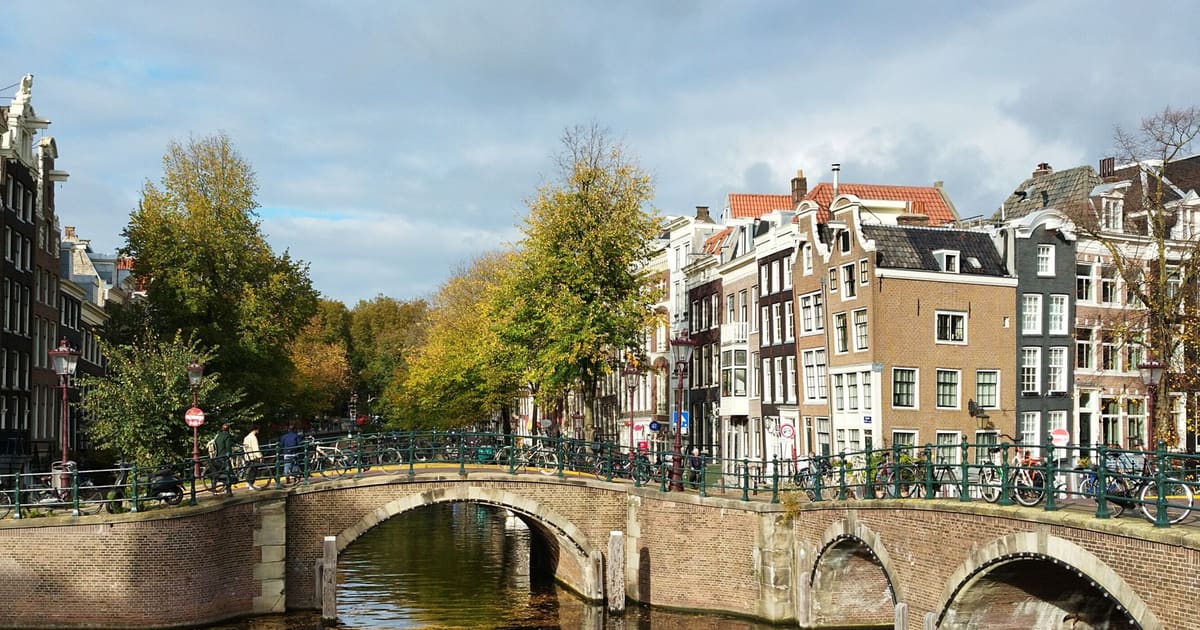
Amsterdam's canal ring is one of the great pieces of town planning anywhere, a half circle of water and merchant houses drawn up four hundred years ago and still lived in today. This walk follows it from north to south, starting at a market square on the Prinsengracht and ending in the noisy, cheerful Rembrandtplein, with a detour into the Jordaan for its hidden almshouse courtyards. Along the way you will see how a trading city spent its money, from the modest warehouses of the outer canal to the stone mansions of the Golden Bend. It is about three kilometers, completely flat, and one of the easiest self-guided walking tours in the city to stretch out over a slow morning.
Before you set off
Give yourself around two hours at a stroll, more if you stop for coffee, browse the shops of the Nine Streets or join the queue somewhere. The ground is flat the whole way, but the paving is a mix of brick, cobbles and narrow canal-side sidewalks, so wear comfortable shoes. The one real hazard here is not traffic but bicycles: the red-surfaced lanes belong to cyclists, they move fast and quietly, so look both ways before you step off any curb. Mornings are calmer along the canals, and the light on the water is lovely early and late in the day. Amsterdam weather changes quickly, so carry a light rain layer even in summer. There is little shade away from the trees that line the canals, but you are never more than a minute from a cafe. If you want to go inside the Anne Frank House, tickets are sold online in time slots and often go weeks ahead, so check before you go. Markets on the Noordermarkt run on certain days only, so look up the schedule if you would like to start with one.
Prinsengracht and Noordermarkt
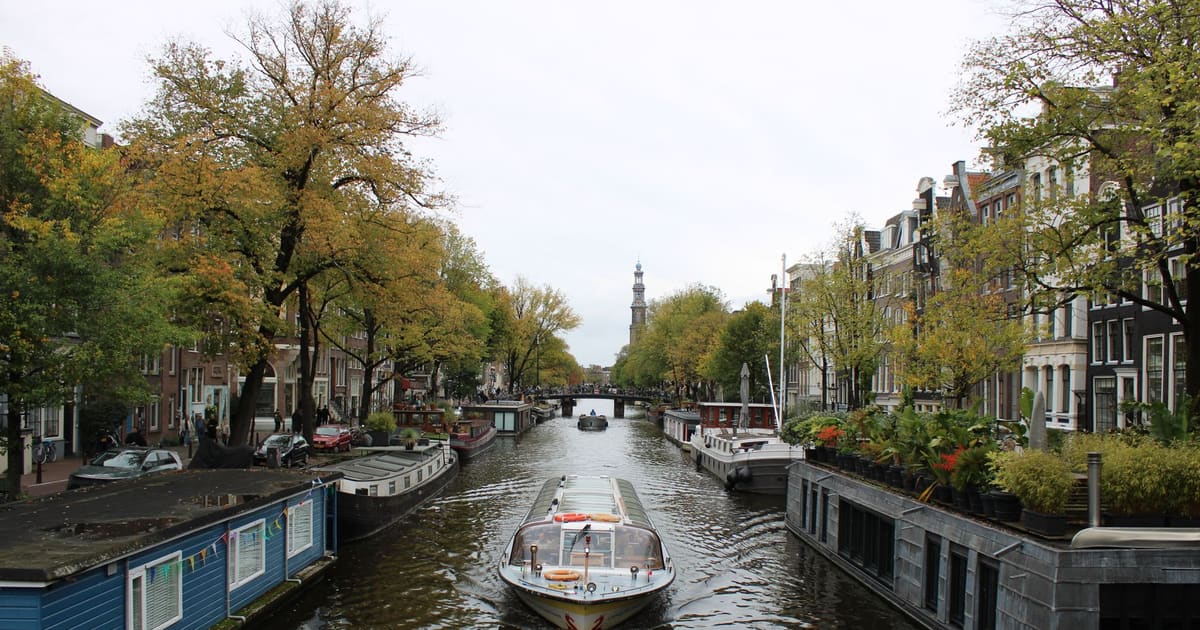
Start on the Noordermarkt, the square wrapped around the plain brick church in front of you, with the Prinsengracht running along its eastern side. The church is the Noorderkerk, built in the early 1620s for the working families who were filling the new streets of the Jordaan, and it has an unusual shape: four equal arms in the form of a cross, so the pulpit could sit in the middle with the congregation gathered around. On Monday mornings the square fills with a flea and fabric market, and on Saturdays with a farmers' market, and on either day it is one of the most local scenes in the center. Now turn to the water. The Prinsengracht, the Prince's Canal, is the outermost of the three great canals laid out from 1613 onward, when Amsterdam was growing so fast it had to plan a whole new city around the old one. The inner canals went to the richest merchants. Out here the houses are simpler, mixed with warehouses and workshops, and the canal is lined with houseboats, some with flowerpots and bicycles on the roof. To reach the next stop, walk south along the Prinsengracht with the water on your left. After about eight minutes the tall tower of the Westerkerk rises ahead; cross the canal to stand in front of it.
Westerkerk and the Anne Frank House Area
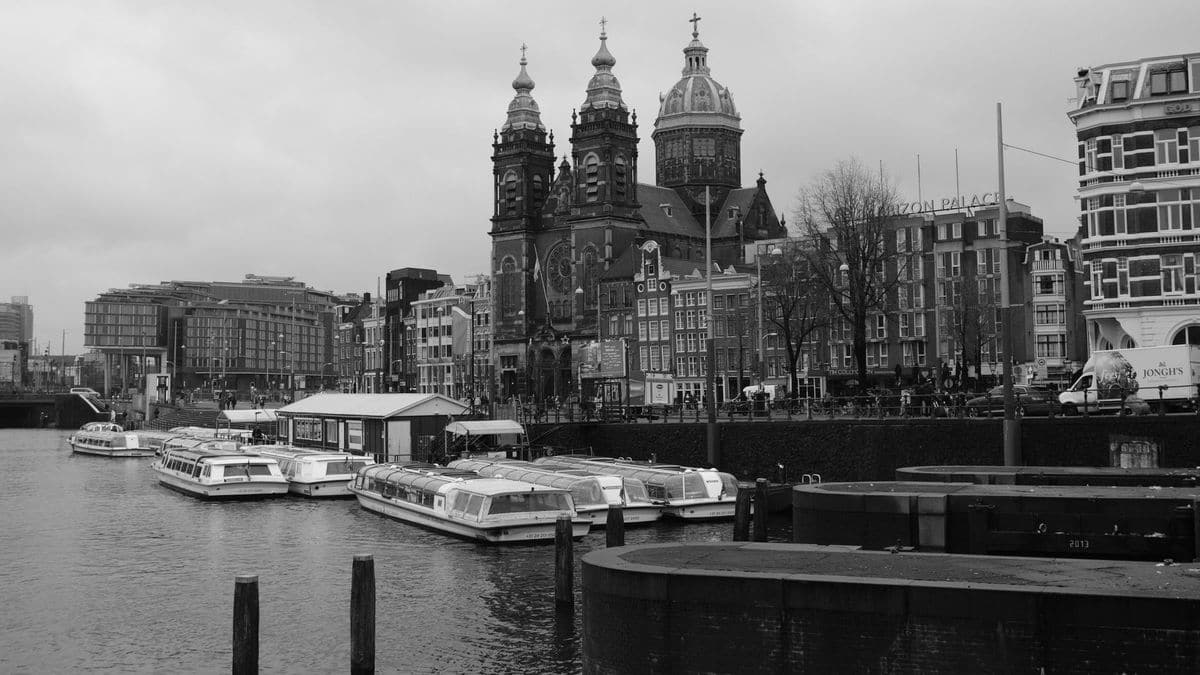 You are standing beneath the Westerkerk, the Western Church, and the tower above you is the tallest church tower in the city, at around eighty-five meters. Look right to the top and you will see a crown in blue, red and gold. That is the imperial crown of Maximilian of Austria, who in the late fifteenth century gave Amsterdam the right to put it on the city's coat of arms, a favor the city has never stopped showing off. The church was built in the 1620s as one of the first big churches for the new Protestant city, and its designer, Hendrick de Keyser, gave Amsterdam much of its early skyline. A few doors north along the Prinsengracht stands a narrow canal house where, from 1942 to 1944, Anne Frank, her family and four others hid in a secret annex at the back. The modern museum entrance is on the corner nearby, and there is usually a line. Take a moment to look at how ordinary the house is from the outside; that ordinariness is what kept them hidden for two years. On the far side of the church, by the Keizersgracht, three pink granite triangles set into the ground form the Homomonument, one of the first memorials anywhere to gay men and women persecuted for who they were. From here, cross back over the Prinsengracht and follow the broad street called Rozengracht west, away from the church, for about four minutes.
Jordaan District's Hidden Courtyards
You are now in the Jordaan, and the scale has dropped. The streets are narrower, the houses smaller, and the canals here are named after flowers and plants. The street you just walked was one of them, until it was filled in during the nineteenth century, and Rembrandt spent his last years in a house along it, poorer than he had ever been; a plaque marks the spot. The Jordaan was built at the same time as the grand canal ring, but as housing for the workers, craftsmen and refugees the city needed, and for centuries it was crowded and poor. Its hidden treasures are the hofjes, almshouse courtyards founded by wealthy citizens to give elderly women a free home. From the street you see only a plain door. Behind it a passage opens into a quiet garden ringed by little houses, sometimes with a pump or a bench in the middle. One of the oldest, the Sint Andrieshofje, lies a few minutes north of here on the Egelantiersgracht. People still live in these courtyards, and many are now closed to visitors or open only at set hours, so only step in where a door stands open and nothing says otherwise, and keep your voice low. Even a glimpse through a gate shows you the other side of Golden Age Amsterdam. When you are ready, walk back east along Rozengracht to the church, cross the Prinsengracht and the Keizersgracht, and turn right along the Keizersgracht for about eight minutes, until you reach the little shopping lanes that cross it.
The full tour continues in the app
- Distance
- 3.2 km
- Walking
- 44 min
- Steps
- ~4,400
- Narration
- 14 min
What's included
- All 7 stops, fully narrated
- Works offline once downloaded in the app
- Friends walk free one purchase covers everyone on your walk
Our tours are made to be meditative and immersive: you keep moving and simply listen. They're always better together, and the app plays the narration in sync, so you, your partner and your friends hear every stop at the same moment.
De Negen Straatjes (The Nine Streets)
Stand on one of the bridges over the Keizersgracht here and look both ways.
The rest of this stop is in the full audio tour.
Herengracht's Golden Bend
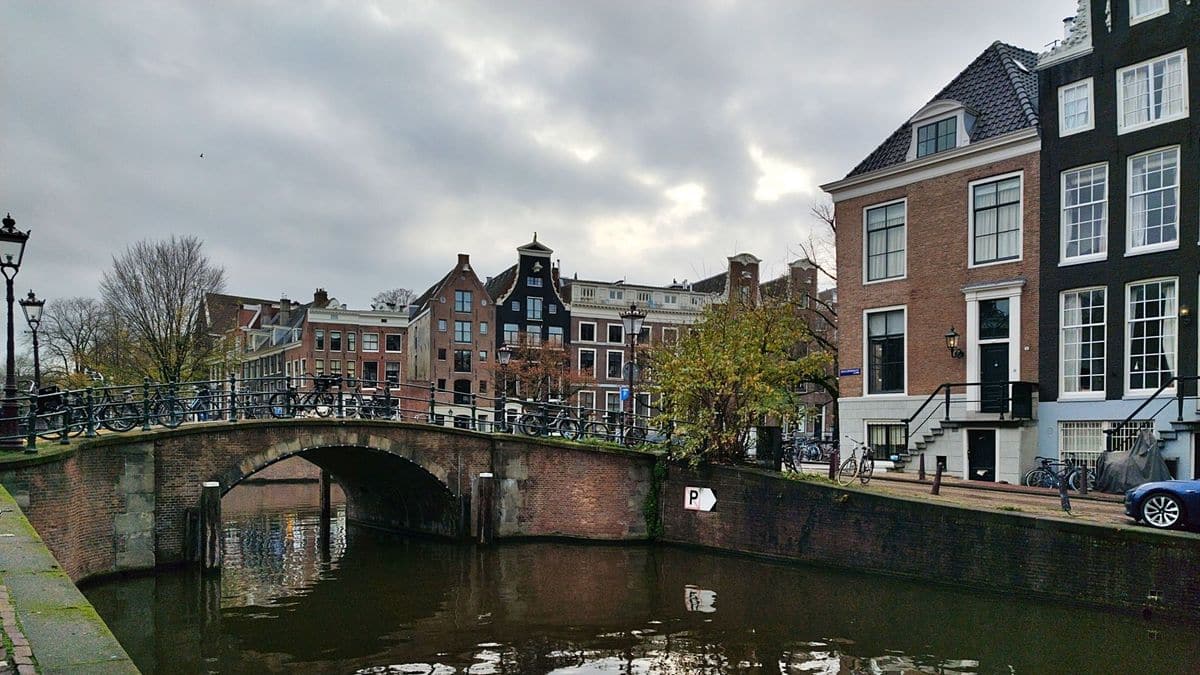
This curve of the Herengracht is the Golden Bend, and the houses tell you why.
The rest of this stop is in the full audio tour.
Bloemenmarkt (Floating Flower Market)
You have reached the Singel, the oldest canal on the walk. Until the canal ring was built it was the city's outer moat, and the line of stalls along its bank is the Bloemenmarkt, the flower market.
The rest of this stop is in the full audio tour.
Rembrandtplein and Reguliersdwarsstraat
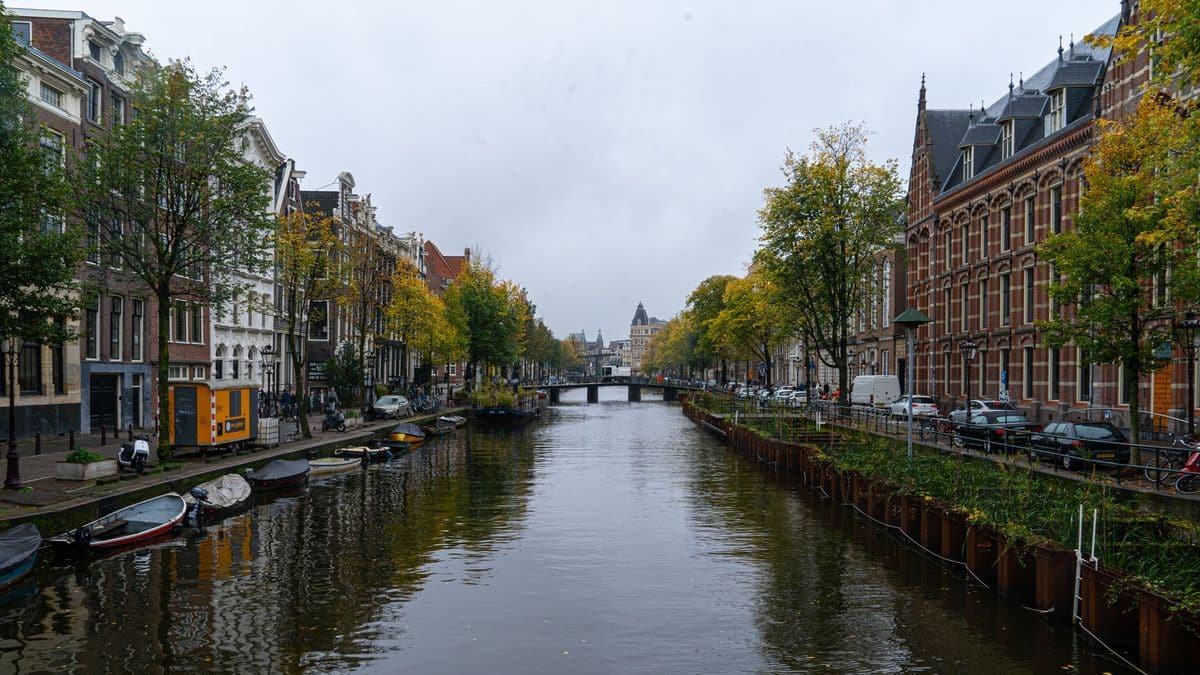
On the way here you passed the Tuschinski, a cinema of extraordinary Art Deco towers and tiles opened in 1921 by Abraham Tuschinski, a Polish Jewish immigrant who was later murdered at Auschwitz; it is still a working cinema, and its lobby is worth a…
The rest of this stop is in the full audio tour.
Do this walk with other people on the next scheduled tour.
About 3.2 km, roughly 44 minutes at an easy pace · 7 stops
Friends walk freeMore audio tours in Amsterdam
$16.99Famous Lives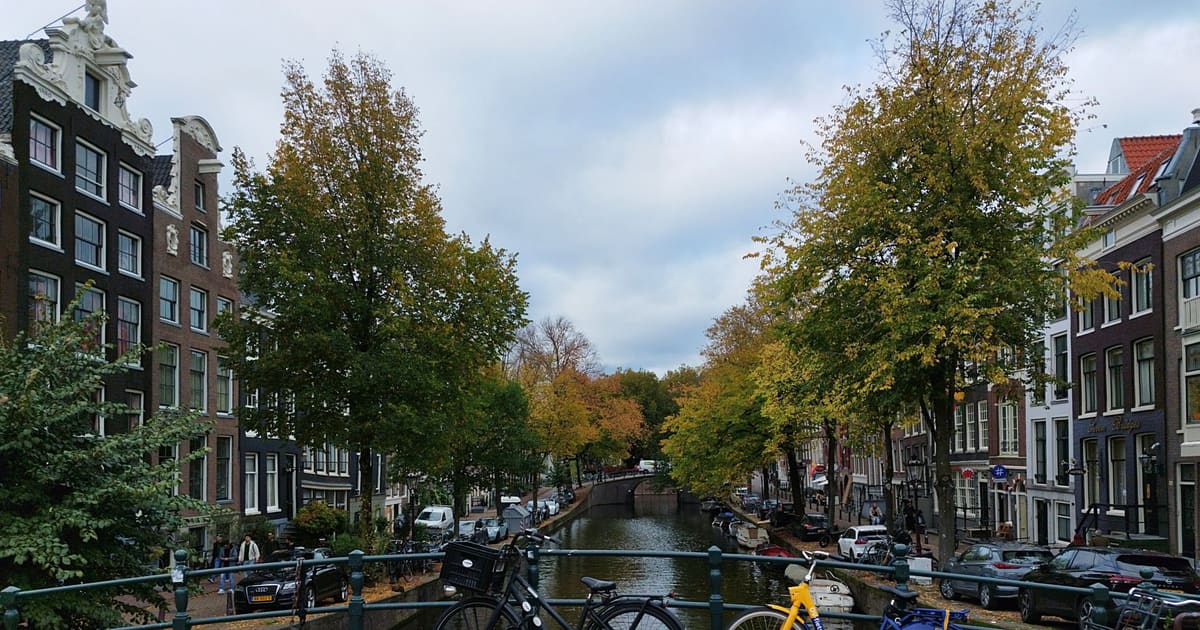 $15.99Film & Fiction
 $8.99City Highlights
 $8.99City Highlights