
 $16.99Turning Points
Berlin Walking Tour: From the Reichstag to the Hackesche Höfe
Choose how you'll do this walk in our app

 Friends walk free
Every tour also runs as a scheduled group walk you can join in the app.
More audio tours in Berlin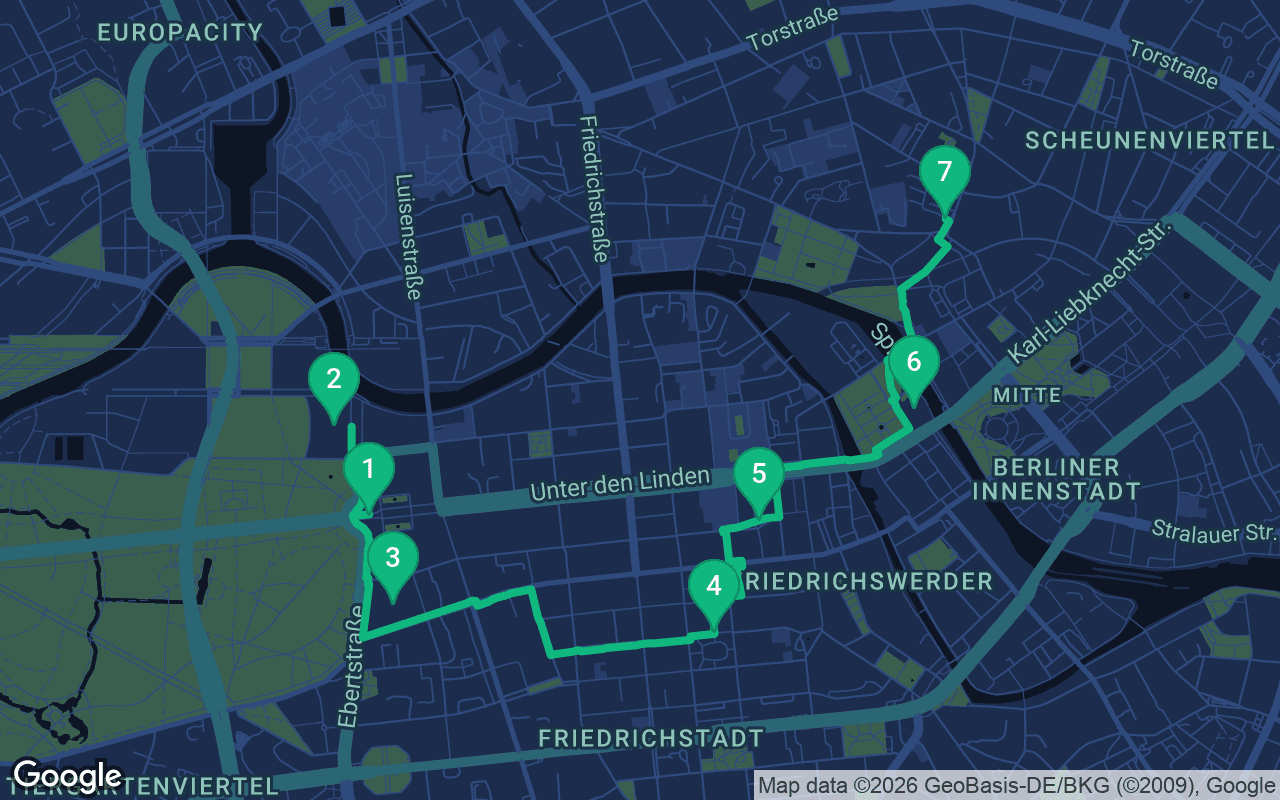
About 3.9 km, roughly 55 minutes at an easy pace.
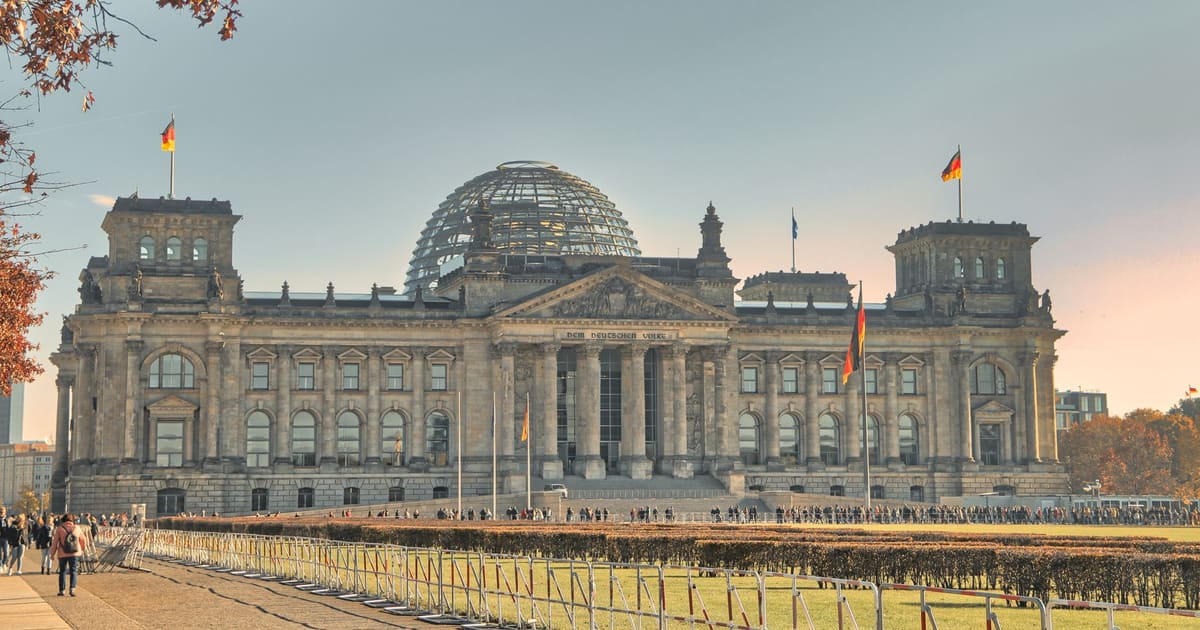
- 1Reichstag Building
- 2Brandenburg Gate
- 3Memorial to the Murdered Jews of Europe
- 4GendarmenmarktFull tour
- 5BebelplatzFull tour
- 6Berlin Cathedral~€10 · optionalOptional entry ticket, not includedFull tour
- 7Hackesche HöfeFull tour
Not included in the tour: ~€10 entry (optional)Average per person. Prices change, so check before you go.
This tour is narrated
Press play on the first 3 stops for a 30-second demo of the narration. In the app, the intro and those 3 stops play in full for free, each one chiming as you arrive. The whole narrated tour is yours for $9.99, a one-time purchase you keep for good.
Works with Garmin, Komoot, Strava, OS Maps and any GPX app.
Few places pack as much of the twentieth century into a short walk as Berlin's Mitte, the old center that spent four decades split by the Wall. This route starts at the parliament building, passes through the Brandenburg Gate and the great Holocaust memorial, then crosses into the elegant squares of old Prussian Berlin before finishing on Museum Island and in the art nouveau courtyards of the Hackesche Höfe. It covers a little over three kilometers on flat ground, and it is one of the most rewarding self-guided walking tours in Europe if you want to understand how a city lives with its own history. Some stops are heavy, some are light, and the walk is shaped to give you both.
Before you set off
Allow about two hours at an unhurried pace, more if you climb up into the Reichstag dome or the cathedral, or go down into the memorial's information center. Berlin is flat, and the route is entirely on paved streets and squares, though the cobbles around the older squares can be uneven. The city's sights are spread out and its streets are wide, so there is not much shade between them, and in summer a hat and water make a difference. In winter, the wind across the open spaces around the Reichstag and the Brandenburg Gate is bitter, so dress warmly. The Reichstag dome is free to visit but needs advance online registration, often several days ahead, so check before you go if you want to go up. Mornings are quieter around the gate and the memorial, while late afternoon light is lovely on Museum Island. Berlin has excellent public transport, so you can always skip a stretch on the U-Bahn or a tram if your feet need a break. The final stop is a good place to find lunch or a drink.
Reichstag Building
Stand on the big lawn in front of the Reichstag and look up at the words carved above the columns: Dem deutschen Volke, To the German People. The building opened in 1894 as the parliament of the new German Empire, and almost everything that could happen to a building has happened to this one. In February 1933, a month after Hitler became chancellor, it was set on fire, and the Nazis used the blaze as a pretext to suspend civil liberties and crush their opponents. In 1945 it was a battlefield, and the photograph of a Soviet soldier raising a flag on its roof became one of the most famous images of the war. During the Cold War it stood in West Berlin, a scarred shell right beside the Wall, with no parliament to house. Then, in 1995, the artists Christo and Jeanne-Claude wrapped the whole building in silver fabric for two weeks, and millions came to see it. After that it was rebuilt by the architect Norman Foster, who added the glass dome you see on top, and the German parliament moved in in 1999. Visitors walk up a spiral ramp inside the dome, above the debating chamber, the idea being that the people literally stand over their politicians. From here, walk south along Ebertstrasse, the road passing the building's eastern side, for about four minutes.
Brandenburg Gate
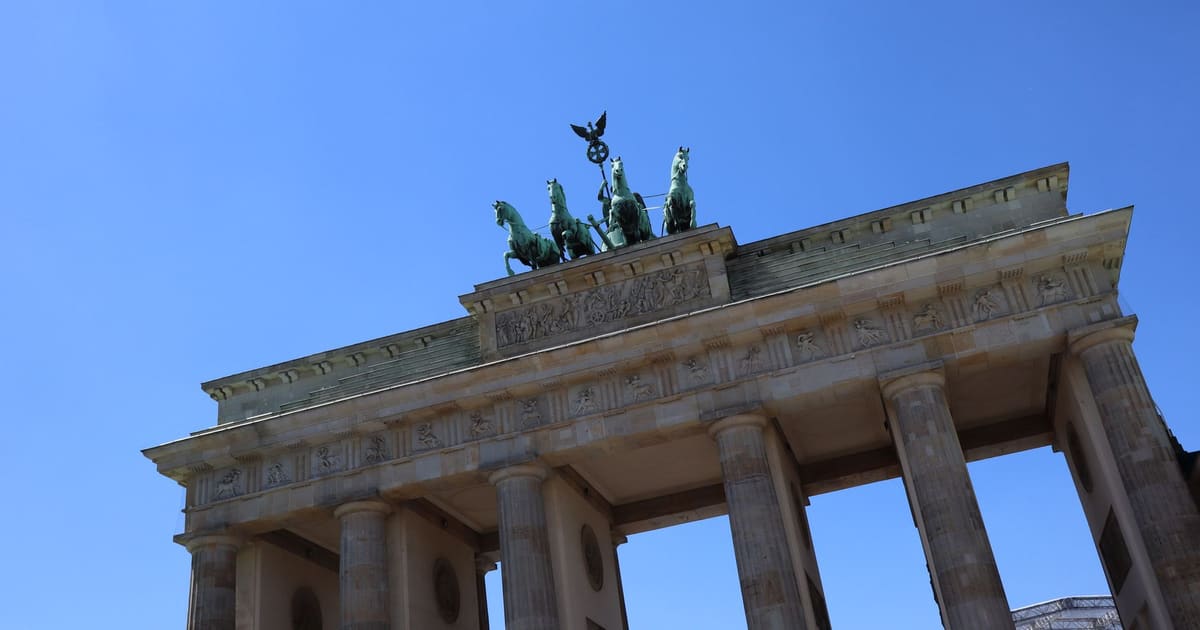
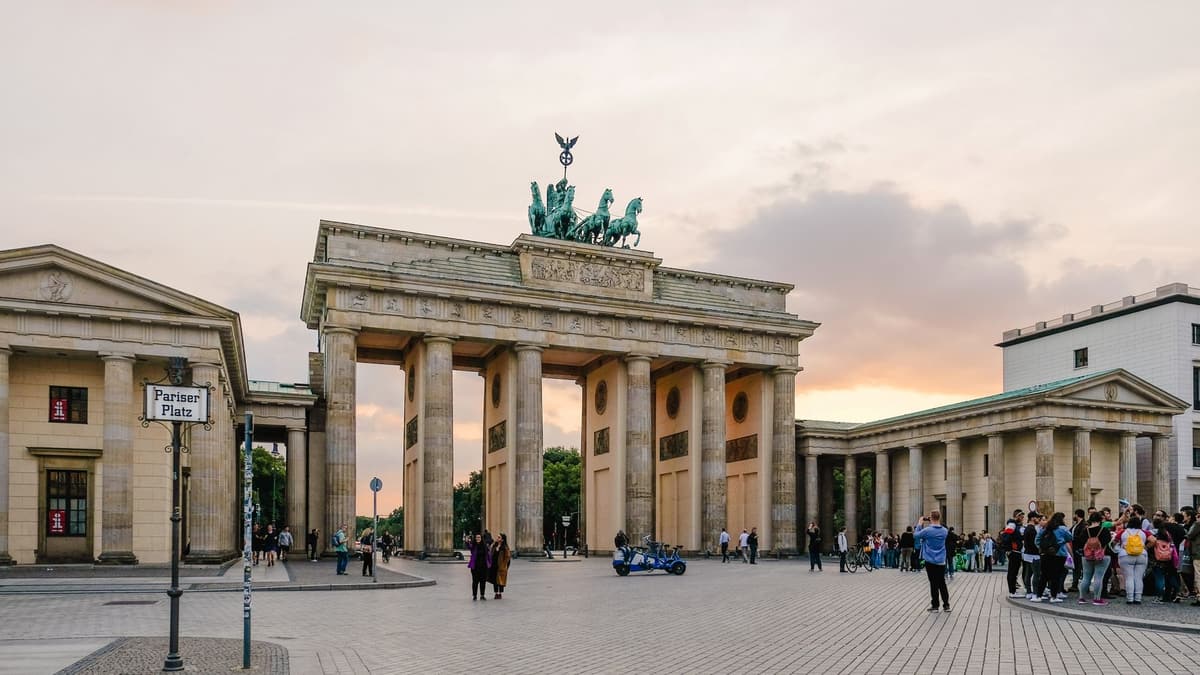 Here it is, the Brandenburg Gate, the symbol of Berlin and, for much of the last century, of a divided Europe. It was built between 1788 and 1791 as a grand entrance to the boulevard of Unter den Linden, modeled on the gateway to the Acropolis in Athens. On top rides the Quadriga, a goddess of victory in a chariot pulled by four horses. In 1806 Napoleon took the whole sculpture back to Paris as a trophy, and when it came home after his defeat it was given an Iron Cross and a Prussian eagle, so that the goddess now carries the symbols of the kingdom that won it back. Look down at your feet as you walk around: a double row of cobblestones set into the roads around here marks the line of the Berlin Wall. From 1961 the gate stood just inside East Berlin, cut off in a guarded zone where nobody could walk. In 1987 the American president Ronald Reagan stood on the western side and called on the Soviet leader to tear down this wall, and in December 1989, a few weeks after the Wall opened, the gate was opened to people walking through. Walk through it now to Pariser Platz on the eastern side, then come back through and walk south along Ebertstrasse for about three minutes; the field of grey slabs opens on your left.
Memorial to the Murdered Jews of Europe
Before you is the Memorial to the Murdered Jews of Europe, a field of 2,711 grey concrete slabs designed by the American architect Peter Eisenman and opened in 2005. At the edges the slabs are low enough to sit on, but walk in along any of the narrow aisles and the ground slopes down while the slabs rise above your head. Within a minute the city noise drops away, other people appear and vanish at the crossings, and you can feel alone and slightly lost in the middle of a capital. There are no names, no inscriptions and no single path, and Eisenman deliberately left the meaning open; each visitor makes of it what they will. Please walk it quietly, and do not climb or jump between the slabs. Beneath the eastern side is an information center, free to enter, where the abstraction gives way to the faces, letters and names of individual people and families, and it is one of the most moving rooms in Berlin; check opening times before you go. Nearby are memorials to other victims of the Nazis, including the gay men and lesbians persecuted under the regime, in the edge of the park across the street. When you are ready, leave on the eastern side, cross Wilhelmstrasse and keep heading east through the side streets for about twelve minutes. Once you cross Friedrichstrasse, the big shopping street, two domed towers appear a block ahead.
The full tour continues in the app
- Distance
- 3.9 km
- Walking
- 55 min
- Steps
- ~5,400
- Narration
- 14 min
What's included
- All 7 stops, fully narrated
- Works offline once downloaded in the app
- Friends walk free one purchase covers everyone on your walk
Our tours are made to be meditative and immersive: you keep moving and simply listen. They're always better together, and the app plays the narration in sync, so you, your partner and your friends hear every stop at the same moment.
Gendarmenmarkt
Welcome to Gendarmenmarkt, which many Berliners will tell you is the most beautiful square in the city.
The rest of this stop is in the full audio tour.
Bebelplatz
You are standing on Bebelplatz, part of the grand cultural quarter that Frederick the Great planned in the eighteenth century. The green dome on the corner belongs to St. Hedwig's Cathedral, a Catholic church modeled on the Pantheon in Rome.
The rest of this stop is in the full audio tour.
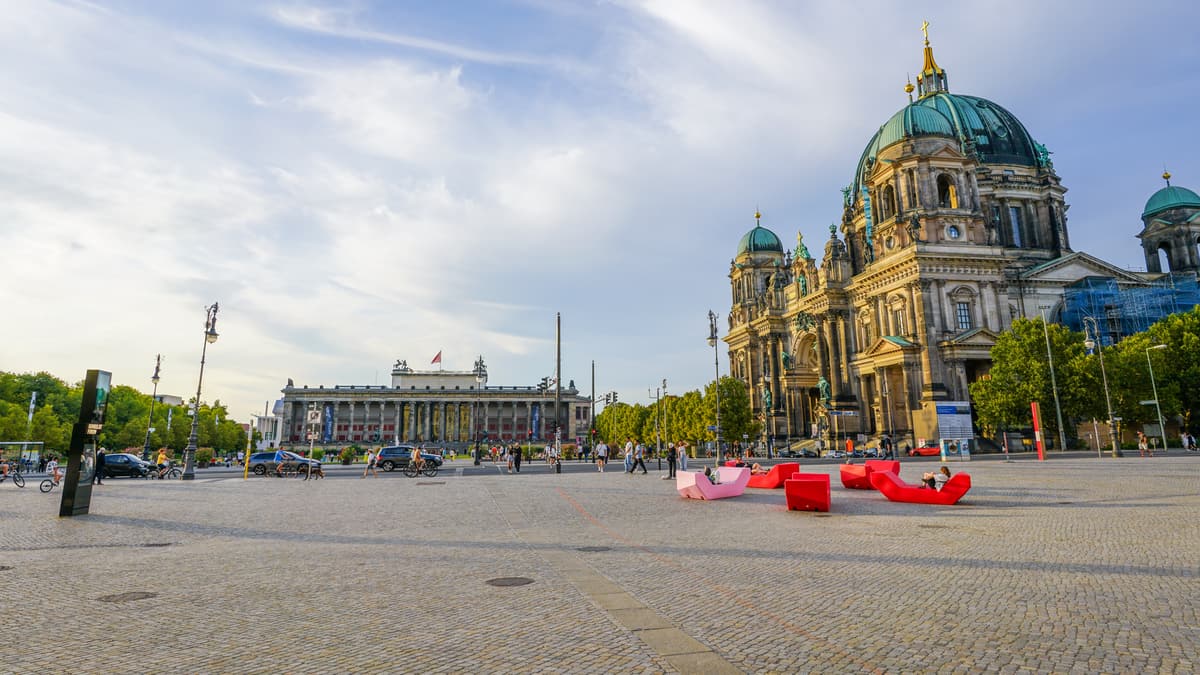
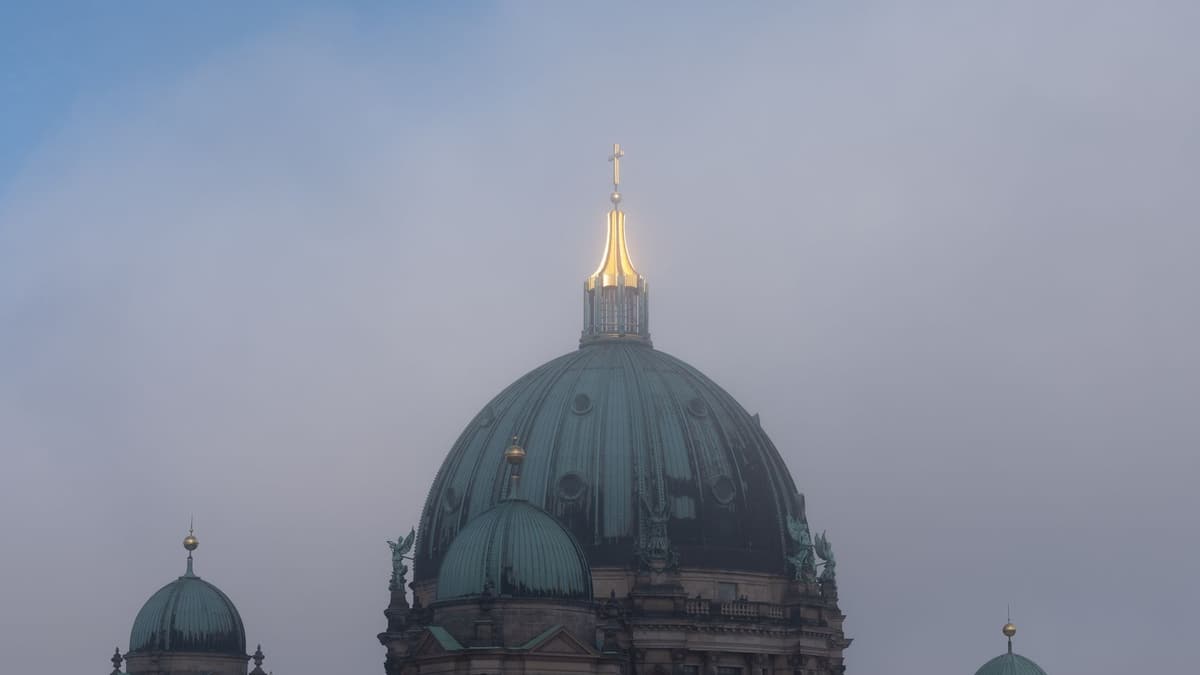
Berlin Cathedral
The enormous building in front of you, with its huge green dome, is the Berlin Cathedral, and it was built to impress.
The rest of this stop is in the full audio tour.
Hackesche Höfe
You finish at the Hackesche Höfe, a complex of eight connected courtyards running back from the street, and a very different face of Berlin from the palaces and memorials you have seen.
The rest of this stop is in the full audio tour.
Do this walk with other people on the next scheduled tour.
About 3.9 km, roughly 55 minutes at an easy pace · 7 stops
Friends walk freeMore audio tours in Berlin
$16.99Turning Points $15.99Turning Points
 $15.99Turning Points
 $7.99City Highlights