
 $17.99Turning Points
Budapest Walking Tour: Pest from Parliament to the Market Hall
Choose how you'll do this walk in our app

 Friends walk free
Every tour also runs as a scheduled group walk you can join in the app.
More audio tours in Budapest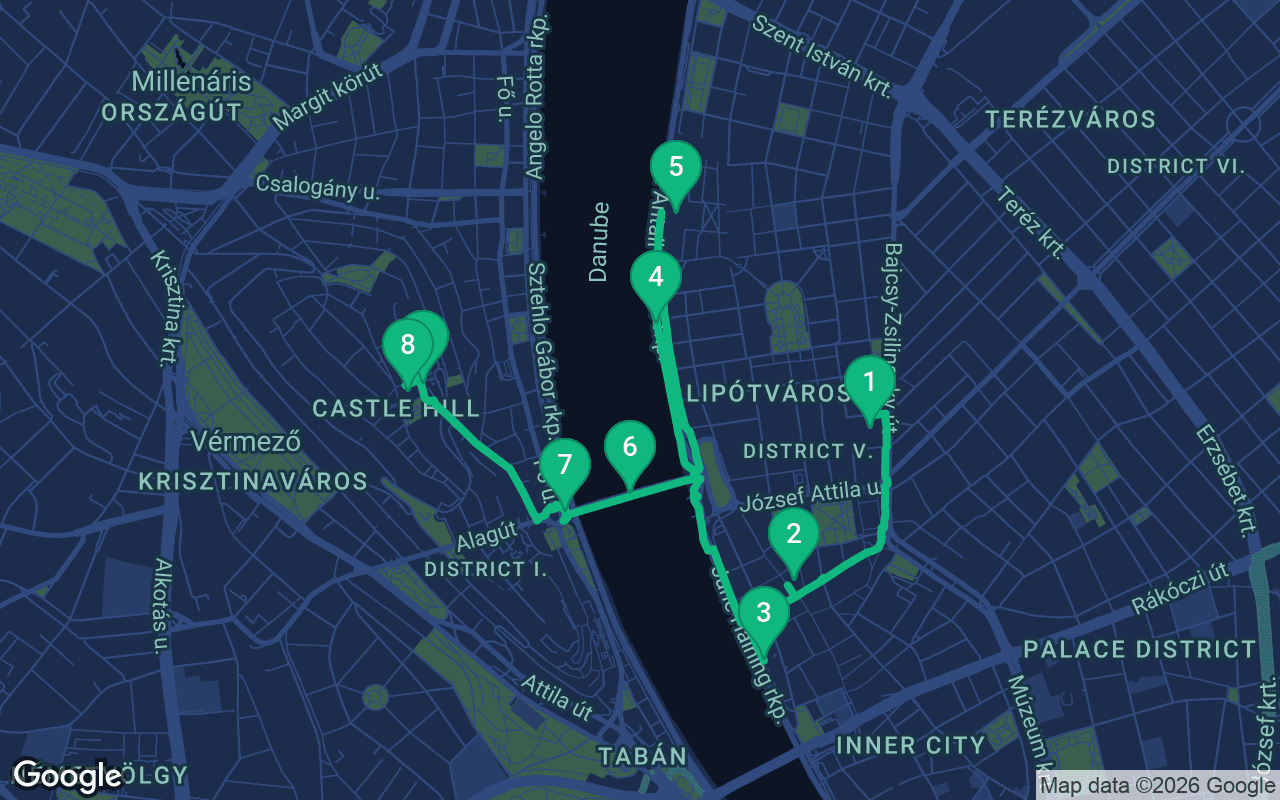
About 4.3 km, roughly 60 minutes at an easy pace.
- 1Hungarian Parliament Building
- 2Shoes on the Danube Bank
- 3Liberty Square
- 4St. Stephen's Basilica~HUF 5,000Entry ticket, not includedFull tour
- 5Széchenyi Square and Gresham PalaceFull tour
- 6Vörösmarty SquareFull tour
- 7Inner City Parish ChurchFull tour
- 8Central Market HallFull tour
Not included in the tour: ~HUF 5,000 entryAverage per person. Prices change, so check before you go.
This tour is narrated
Press play on the first 3 stops for a 30-second demo of the narration. In the app, the intro and those 3 stops play in full for free, each one chiming as you arrive. The whole narrated tour is yours for $10.99, a one-time purchase you keep for good.
Works with Garmin, Komoot, Strava, OS Maps and any GPX app.
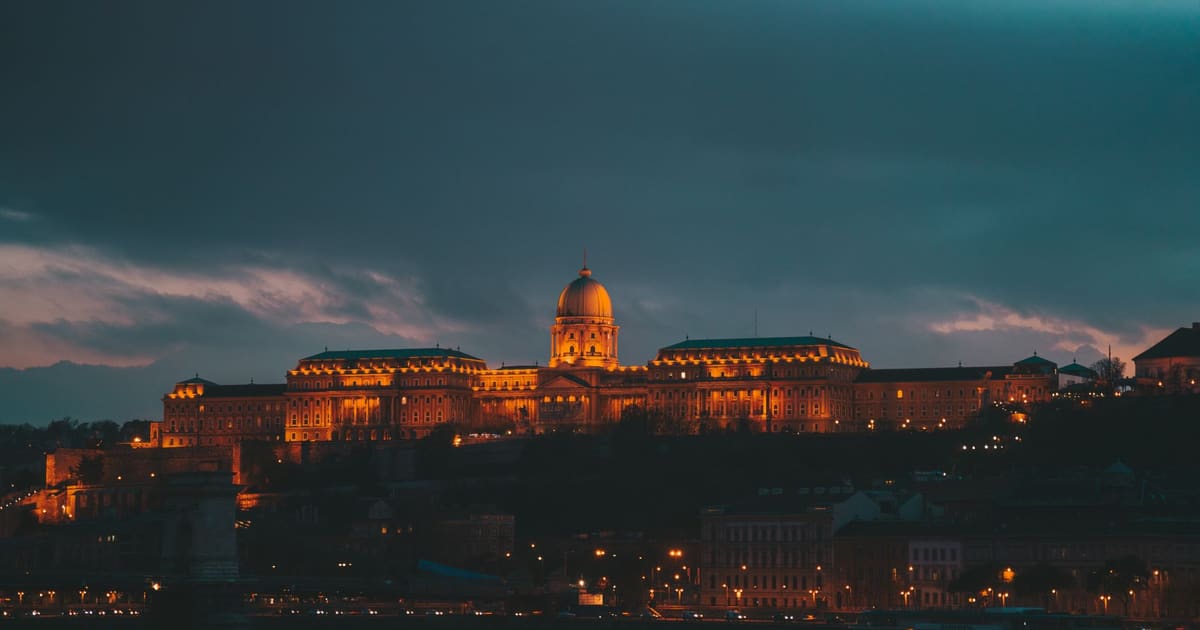
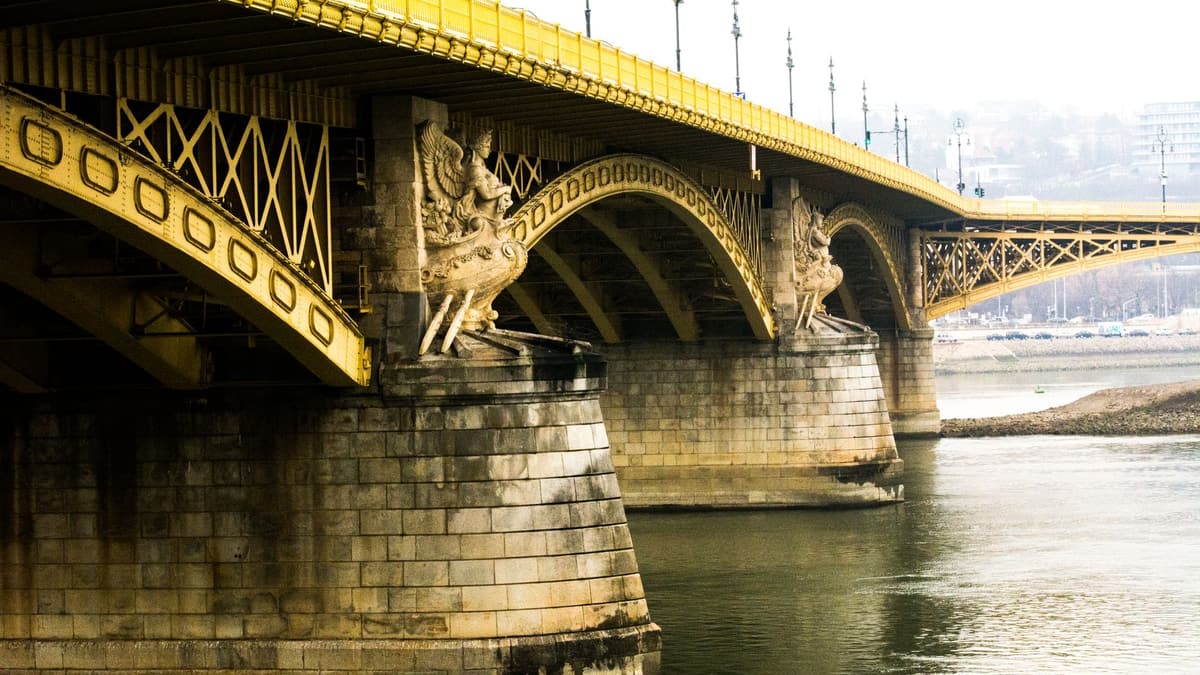
Budapest was three separate towns until they merged in 1873, and it still feels like two cities facing each other across the Danube. On the west bank, Buda climbs its hills with a castle on top. On the east bank, flat Pest spreads out in boulevards, coffee houses and grand nineteenth century buildings, the busy, working half of the capital. This walk is all Pest. It starts at the Parliament on the river, follows the embankment to one of Europe's most moving memorials, then cuts inland through Liberty Square to St. Stephen's Basilica, returns to the water at the Chain Bridge and runs down through the old inner city to the Central Market Hall. It is one of our self-guided walking tours that pairs well with its twin across the river, the Buda Castle walk. Here you cover a little over four kilometers, flat the whole way.
Before you set off
Allow about an hour of pure walking and two and a half to three hours in total with stops, longer if you take a guided tour of Parliament or climb to the Basilica's balcony. The route is flat, on wide sidewalks and pedestrian streets, and the riverside stretches are open to the wind, which can be sharp in winter. Summer days are hot, so start in the morning, when the low sun lights the Buda hills across the water and the Market Hall is at its liveliest. Parliament tours sell out, so book ahead if you want to go inside, and check opening times for the Basilica and the market, which keeps shorter hours on Saturdays and closes on Sundays. Trams run along the river for most of this route if your feet need a break. Keep a few small notes or a card handy for a coffee at the end of Váci Street or a snack upstairs in the Market Hall.
Hungarian Parliament Building
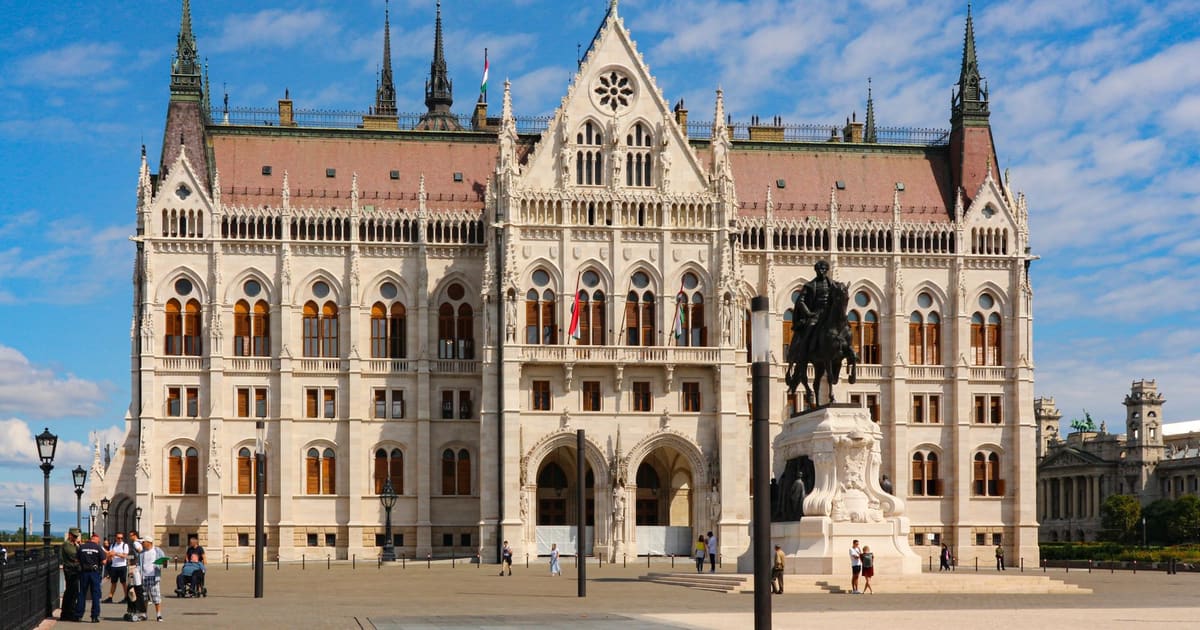
Stand in Kossuth Square, on the land side of the building, and take in the whole length of it. The Hungarian Parliament is the largest building in the country, a long neo-Gothic palace of white stone with pointed spires, flying buttresses and a great red dome in the middle. If it reminds you of the Houses of Parliament in London, that is no accident. Its architect, Imre Steindl, drew on the same Gothic revival style, though he combined it with a Renaissance dome. Building began in the 1880s and took nearly two decades, and Steindl died shortly before it was finished. The dome rises 96 meters, a number chosen on purpose. The Magyars are traditionally said to have arrived in the Carpathian Basin in the year 896, and the same height was given to St. Stephen's Basilica, which you will see shortly, so that no building could stand above either church or state. Under the dome lies the Holy Crown of Hungary, displayed here since 2000 and guarded day and night. Walk around to the river side to feel how long the facade really is. The classic postcard view of it is from the far bank, at Batthyány Square, where the Buda Castle walk ends. Then follow the embankment south, with the river on your right, to the memorial at the water's edge, about five minutes.
Shoes on the Danube Bank
Along the stone edge of the embankment, you will see them: sixty pairs of shoes, cast in iron, scattered as if their owners had just stepped out of them. There are men's work boots, women's heels and small children's shoes, some neatly paired, some lying on their sides. Walk slowly along them. In the winter of 1944 and 1945, members of the Arrow Cross, Hungary's fascist militia, brought Jewish men, women and children to the river here, ordered them to take off their shoes, which had value, and shot them so that their bodies fell into the Danube. Thousands of people died this way along the river. The memorial was created in 2005 by the film director Can Togay and the sculptor Gyula Pauer, and its power lies in how plain it is. There is no statue, no heroic figure, just the shoes, facing the water. People leave candles, stones and flowers in them, and you may find some of them filled with tiny tributes. Look across the river from here to the Buda bank and the Castle Hill above it, so close and so calm. Take a quiet moment before moving on. Then turn your back on the river and walk straight inland, heading east along the side street, to a large leafy square about eight minutes away.
Liberty Square
You are in Liberty Square, a broad, tree-shaded space that is one of the most interesting places in the city to read Hungary's complicated relationship with its own past. Start at the tall white obelisk topped with a gold star. It is a Soviet war memorial from 1946, honoring the Red Army soldiers who died taking the city, and it is one of the very few such memorials still standing in Budapest. It survives partly because of an agreement with Russia covering war graves and memorials. At the southern end stands a much newer monument, put up in 2014, showing an eagle swooping down on the archangel Gabriel, meant to depict the German occupation of 1944. Critics said it cast Hungary as an innocent victim and ignored its own role in the deportation of its Jews, and in front of it citizens have built a counter memorial of their own, with photographs, letters, suitcases and stones. Look up at the grand building on the west side, the old Budapest Stock Exchange, a palace of columns from the early 1900s. Nearby, the United States Embassy faces the square. Leave by the southeast corner, where the great dome of the Basilica shows above the rooftops, and follow it about five minutes.
The full tour continues in the app
- Distance
- 4.3 km
- Walking
- 60 min
- Steps
- ~6,000
- Narration
- 14 min
What's included
- All 8 stops, fully narrated
- Works offline once downloaded in the app
- Friends walk free one purchase covers everyone on your walk
Our tours are made to be meditative and immersive: you keep moving and simply listen. They're always better together, and the app plays the narration in sync, so you, your partner and your friends hear every stop at the same moment.
St. Stephen's Basilica
Walk into the open square in front of the Basilica and stand far enough back to see the twin bell towers and the huge dome between them.
The rest of this stop is in the full audio tour.
Széchenyi Square and Gresham Palace

The street opens onto Széchenyi Square, and suddenly you have one of the great views of Budapest.
The rest of this stop is in the full audio tour.
Vörösmarty Square
You are in Vörösmarty Square, the busy heart of inner Pest. The white marble statue in the middle is Mihály Vörösmarty, the poet whose verse many Hungarians learn at school, surrounded by a crowd of carved figures, the ordinary people his poems were written for.
The rest of this stop is in the full audio tour.
Inner City Parish Church
Look for the modest church beside the approach road to the Elisabeth Bridge, squeezed in so close that the traffic seems to brush its walls. This is the Inner City Parish Church, the oldest building in Pest.
The rest of this stop is in the full audio tour.
Central Market Hall
At the end of Váci Street rises the Central Market Hall, a vast hall of brick and iron with a roof of colorful glazed tiles that glints in the sun. It opened in 1897 and is the largest and oldest indoor market in Budapest.
The rest of this stop is in the full audio tour.
Do this walk with other people on the next scheduled tour.
About 4.3 km, roughly 60 minutes at an easy pace · 8 stops
Friends walk freeMore audio tours in Budapest
$17.99Turning Points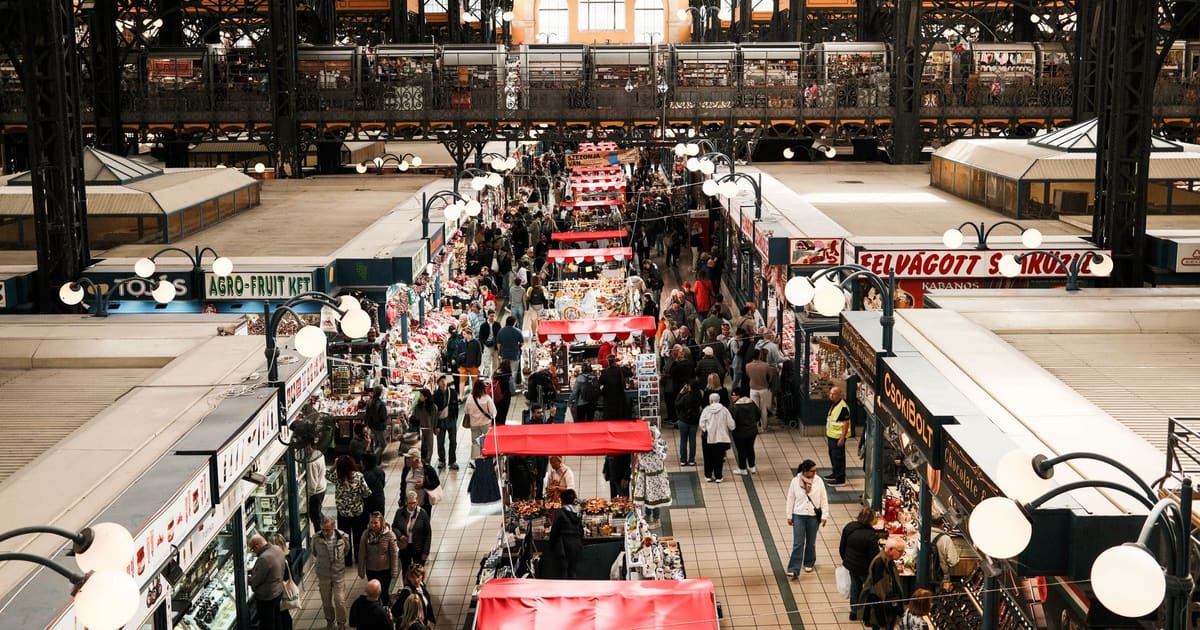 $15.99Food & Tastings
 $11.99City Highlights