
 $14.99Food & Tastings
Florence Oltrarno Walking Tour: Across the River and Up to the Views
Choose how you'll do this walk in our app

 Friends walk free
Every tour also runs as a scheduled group walk you can join in the app.
More audio tours in Florence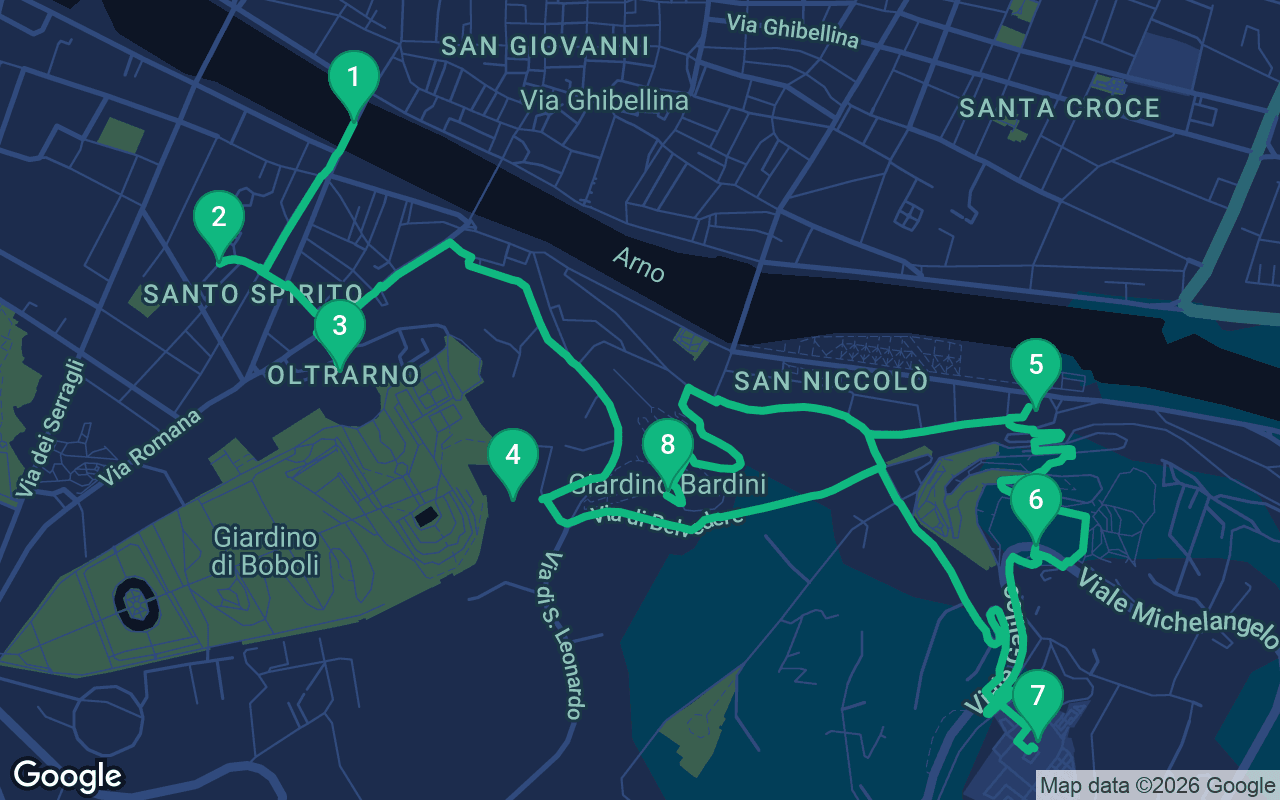
About 4.3 km, roughly 68 minutes at an easy pace.
- 1Ponte Santa Trinita
- 2Piazza Santo Spirito
- 3Palazzo Pitti~€16 · optionalOptional entry ticket, not included
- 4Forte di BelvedereFull tour
- 5Porta San MiniatoFull tour
- 6San Miniato al MonteFull tour
- 7Piazzale MichelangeloFull tour
- 8Porta San NiccolòFull tour
Not included in the tour: ~€16 entry (optional)Average per person. Prices change, so check before you go.
This tour is narrated
Press play on the first 3 stops for a 30-second demo of the narration. In the app, the intro and those 3 stops play in full for free, each one chiming as you arrive. The whole narrated tour is yours for $10.99, a one-time purchase you keep for good.
Works with Garmin, Komoot, Strava, OS Maps and any GPX app.
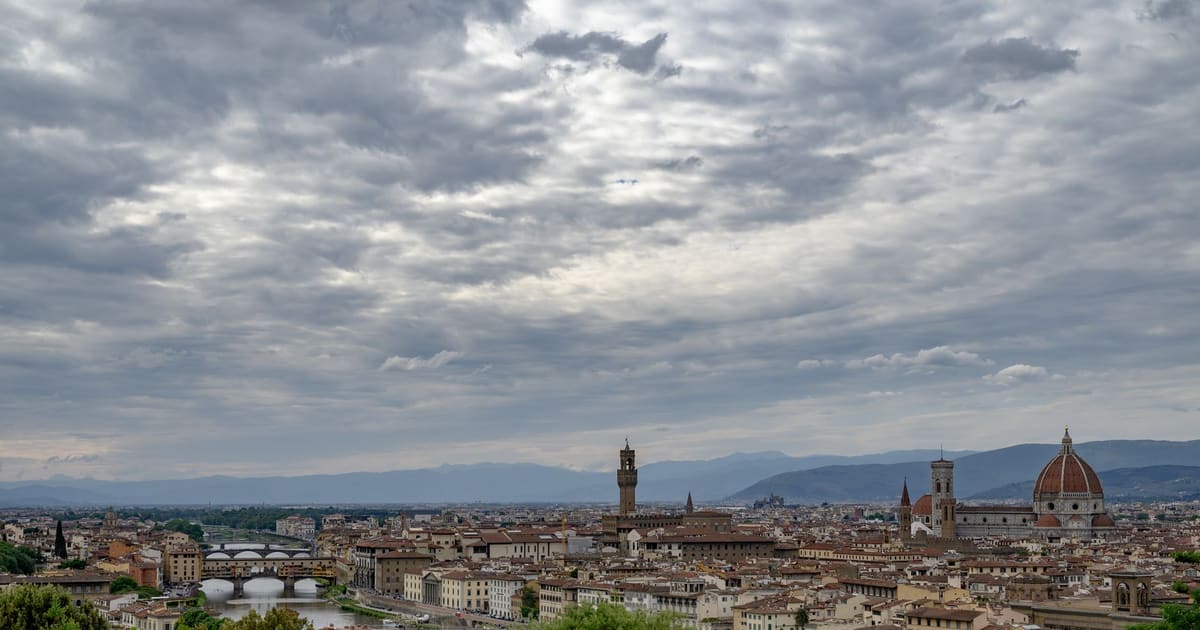
Oltrarno means "beyond the Arno", and this walk spends its whole time on the quieter side of the river, the side of craftsmen's workshops, neighborhood squares and green hills. You cross on the most graceful bridge in Florence, wander into Santo Spirito, pass the vast Pitti Palace, then climb once, up a steep old lane to a star-shaped fort, and follow the medieval city wall to the hilltop church of San Miniato and the great terrace of Piazzale Michelangelo. From there you come down once, on looping ramps, to an old gate tower by the river. It is about four and a half kilometers, and of all the self-guided walking tours in Florence it is the one that gives you the city from above.
Before you set off
Allow two and a half to three hours, more if you go into the Pitti or linger at the top, which you will. The first part is flat, then Costa San Giorgio climbs steeply for about ten minutes, and the stretch from the old wall up to San Miniato is another real climb, partly on steps. Take it slowly; there are walls to lean on and views to stop for. Wear shoes with a good grip, since the lanes are stone and some are worn smooth. The best time to start is the middle of the afternoon, so you reach San Miniato and the Piazzale in the evening light and come down to the river as the city lights up. The Forte di Belvedere opens mostly for summer exhibitions, and the Pitti and the church at San Miniato keep their own hours, so check before you go. There is shade on the old lanes and under the cypresses near the top, but the Piazzale itself is wide open, so carry water and a hat in summer.
Ponte Santa Trinita
Stop in the middle of the bridge and look upstream. That is the classic view of the Ponte Vecchio, its shops crowding the water, and you will not find a better one. Now look at the bridge you are standing on. Ponte Santa Trinita was built in the 1560s by Bartolomeo Ammannati for the Medici, and its three arches are so low and gently curved that engineers still argue about the exact shape. Some think Michelangelo had a hand in the design. At each corner stands a statue of one of the four seasons, added in the early 1600s for a Medici wedding. Here is the remarkable part. On a night in August 1944, retreating German troops blew up every bridge in Florence except the Ponte Vecchio, and this one went into the river. After the war, the city decided to rebuild it exactly as it had been. Divers and workers fished the original stones out of the Arno, new stone was cut from the same quarry in the Boboli Gardens, and the bridge reopened in 1958. One piece was still missing: the head of the statue of Spring. It was finally found in the riverbed in 1961, and you can see it back on her shoulders at the corner. To continue, cross to the far bank and keep straight on along Via Maggio, then take the narrow street on your right, Via de' Michelozzi, into a tree-lined square, about six minutes.
Piazza Santo Spirito
This is the living room of the Oltrarno. In the mornings a small market sets up under the trees, at lunch the benches fill with people from the workshops nearby, and in the evening the bars spill out across the square until late. Behind the fountain stands the church of Santo Spirito, with one of the plainest fronts in Italy, a smooth cream wall with a gentle curve on top. It was designed by Filippo Brunelleschi, but he died before it was built, and nobody ever got around to finishing the facade. Inside, if it is open, is one of the calmest and most perfectly proportioned spaces of the Renaissance, rows of gray stone columns marching toward the altar. It also holds a lovely story. As a teenager, Michelangelo was allowed by the prior of this convent to study the bodies of people who had died in its hospital, so he could learn how muscles and bones really worked. In thanks, the young sculptor carved a wooden crucifix for the church, and it hangs today in the sacristy, a slim and gentle Christ quite unlike the powerful figures he made later. Look around the square, too, at the doorways of the workshops in the lanes off it: furniture restorers, gilders, framers. To continue, leave the square at its southeastern corner along the short Via Mazzetta to Piazza San Felice, and bear left into the sloping square in front of a huge palace, about four minutes.
Palazzo Pitti
 Walk up the sloping square and stand back, because you need the space to take in a facade this long. The rough stone blocks are enormous, and the effect is of a fortress rather than a home. That was the point. The palace was begun in the middle of the 1400s for Luca Pitti, a banker and a rival of the Medici, and the story goes that he wanted its windows to be as big as the doors of the Medici palace across the river. If that was the plan, it backfired. A century later, the Pitti family's fortunes had faded, and in 1550 the palace was bought by Eleonora di Toledo, the wife of Duke Cosimo I de' Medici. The Medici moved in, made it much larger, and laid out the Boboli Gardens on the hill behind it, which you can visit with a ticket and which rise toward the fort you will reach shortly. Today the palace holds several museums, including a gallery of paintings hung frame to frame on the walls in the old princely style. Before you leave, look for the plaque on a house across the square. The Russian novelist Fyodor Dostoevsky lived there in 1868 and 1869 and finished The Idiot while in Florence. To continue, walk down Via Guicciardini toward the river to the small Piazza di Santa Felicita, turn right up the steep lane of Costa San Giorgio, and climb for about fifteen minutes to the old city gate at the top.
The full tour continues in the app
- Distance
- 4.3 km
- Walking
- 68 min
- Steps
- ~6,000
- Narration
- 15 min
What's included
- All 8 stops, fully narrated
- Works offline once downloaded in the app
- Friends walk free one purchase covers everyone on your walk
Our tours are made to be meditative and immersive: you keep moving and simply listen. They're always better together, and the app plays the narration in sync, so you, your partner and your friends hear every stop at the same moment.
Forte di Belvedere
You climbed Costa San Giorgio, one of the steepest streets in central Florence, and on the way you passed a house with a plaque recording that Galileo lived there.
The rest of this stop is in the full audio tour.
Porta San Miniato
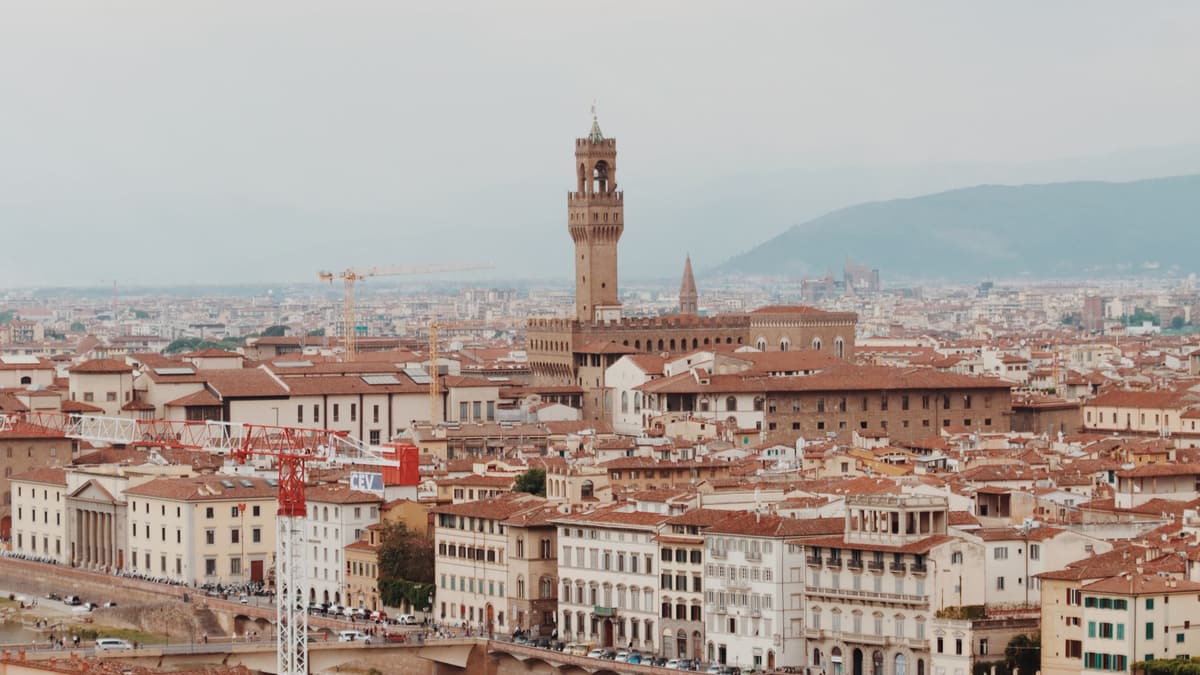
As you came down Via di Belvedere, the wall beside you was the real thing: the city's fourteenth-century defensive wall, finished in the 1330s, still standing to its full height along this hillside with olive groves on the far side.
The rest of this stop is in the full audio tour.
San Miniato al Monte
Catch your breath on the terrace and turn around, because the view is superb, and then turn back to the church.
The rest of this stop is in the full audio tour.
Piazzale Michelangelo
Go to the balustrade. This is the view of Florence that ends up on every postcard, and it deserves its fame.
The rest of this stop is in the full audio tour.
Porta San Niccolò
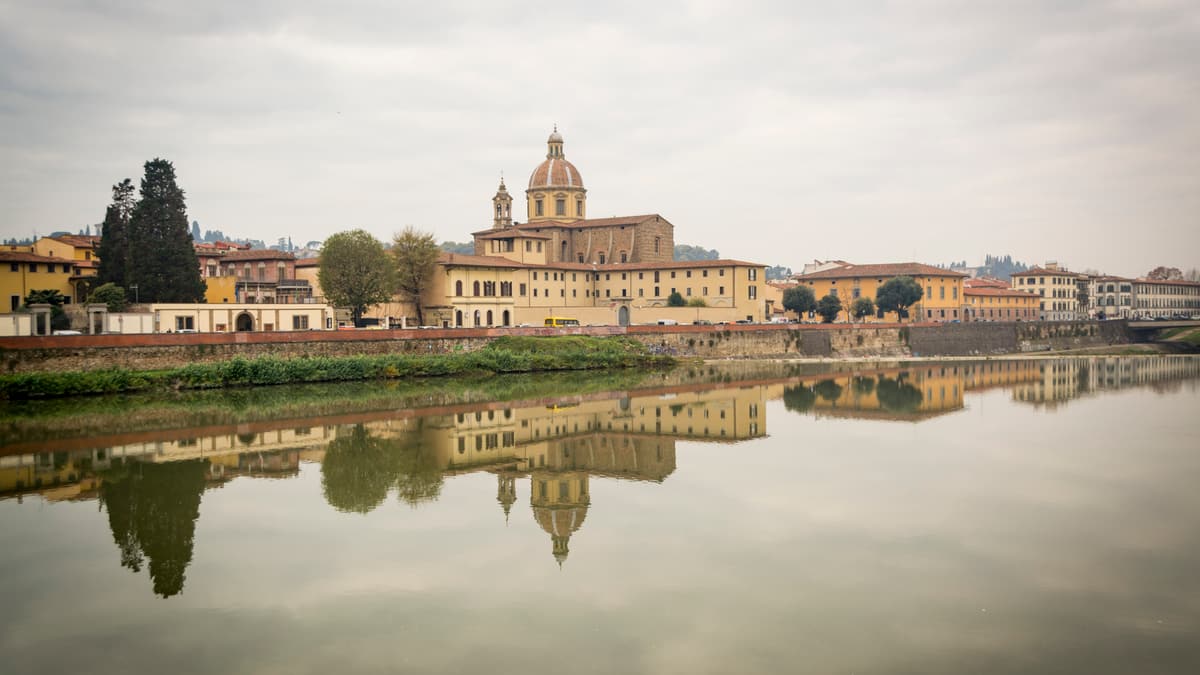
You finish beside the river at Porta San Niccolò, a tall, square stone tower standing on its own in a small square.
The rest of this stop is in the full audio tour.
Do this walk with other people on the next scheduled tour.
About 4.3 km, roughly 68 minutes at an easy pace · 8 stops
Friends walk freeMore audio tours in Florence
$14.99Food & Tastings $14.99Film & Fiction
 $15.99Games IRL
 $6.99City Highlights