
 $14.99Food & Tastings
Florence Renaissance Walking Tour: Duomo to Ponte Vecchio
Choose how you'll do this walk in our app

 Friends walk free
Every tour also runs as a scheduled group walk you can join in the app.
More audio tours in Florence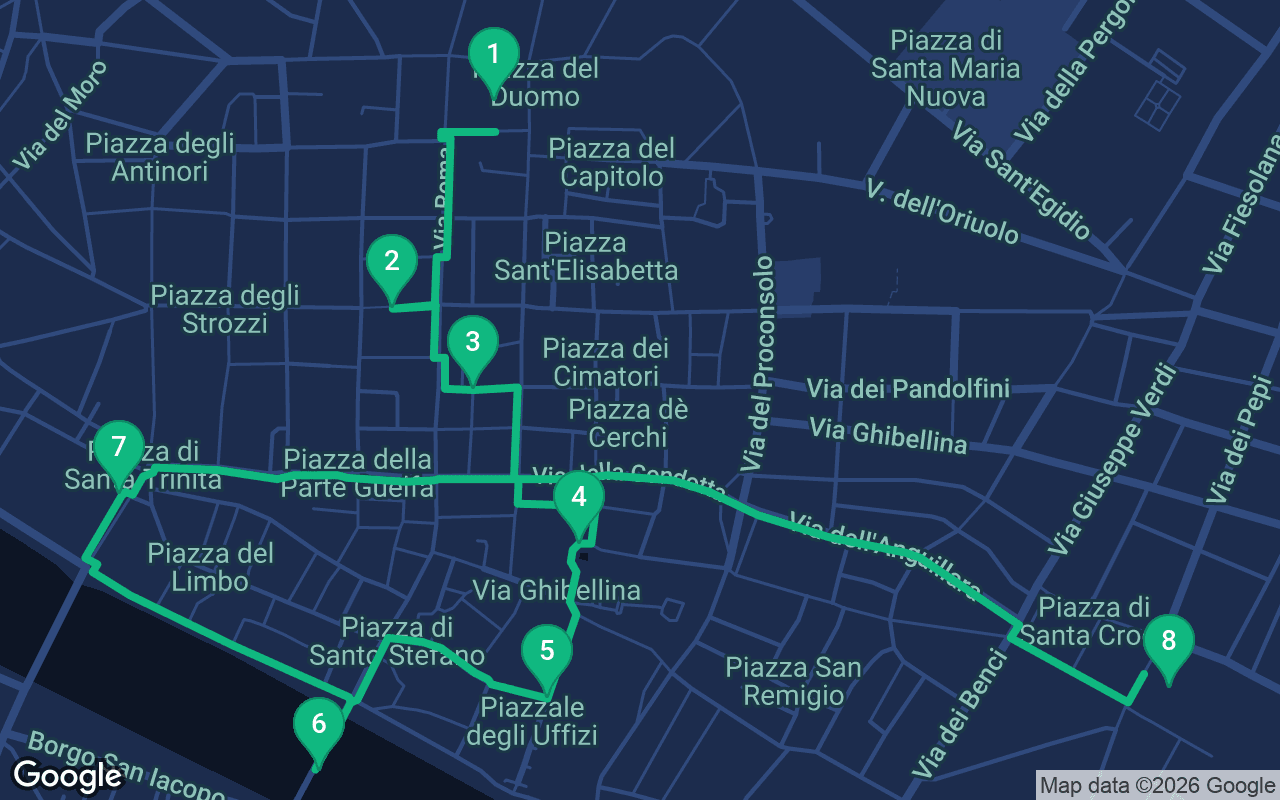
About 1.1 km, roughly 14 minutes at an easy pace.
- 1Florence Cathedral and Baptistery
- 2Piazza della Repubblica
- 3Orsanmichele
- 4Piazza della SignoriaFull tour
- 5Uffizi LoggiaFull tour
- 6Ponte VecchioFull tour
This tour is narrated
Press play on the first 3 stops for a 30-second demo of the narration. In the app, the intro and those 3 stops play in full for free, each one chiming as you arrive. The whole narrated tour is yours for $6.99, a one-time purchase you keep for good.
Works with Garmin, Komoot, Strava, OS Maps and any GPX app.
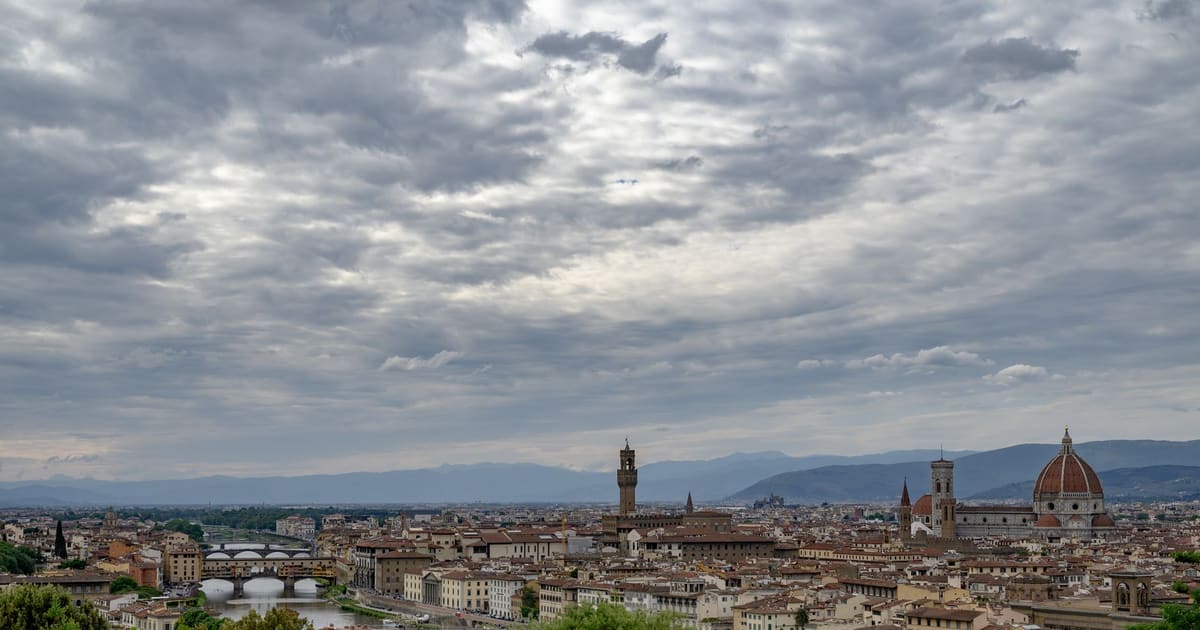
The Renaissance was paid for by merchants. Bankers, wool traders and silk dealers made Florence rich, and then they competed, guild against guild and family against family, to cover their city in the best art money could buy. This short walk follows that money through the heart of the old town, from the cathedral and its baptistery down the main street to the town hall square, through the courtyard of the Uffizi and out onto the Ponte Vecchio. It is barely a kilometer, flat the whole way, and it packs in more masterpieces per step than any of the self-guided walking tours we know, so the trick is to go slowly and keep looking up.
Before you set off
The walking itself takes twenty minutes, but give it an hour and a half to two hours to look properly, longer if you climb the dome or go into a museum. The streets are flat and paved with big stone slabs, smooth but hard, so comfortable shoes matter more than grip. The cathedral square, the Signoria and the Ponte Vecchio are packed from late morning in the busy months, so start early, ideally before nine, when the light is soft and the stone is pale gold. Climbing the dome or the bell tower and visiting the Uffizi all need tickets, usually booked for a set time, and the Uffizi closes one day a week, so check opening days and book ahead before you go. Churches ask for covered shoulders and knees. There is very little shade in the big squares, so carry water in summer; Florence gets hot and close in July and August. And save some time for the small things: a coat of arms over a doorway, a carved saint in a street corner, a gelato eaten standing up.
Florence Cathedral and Baptistery
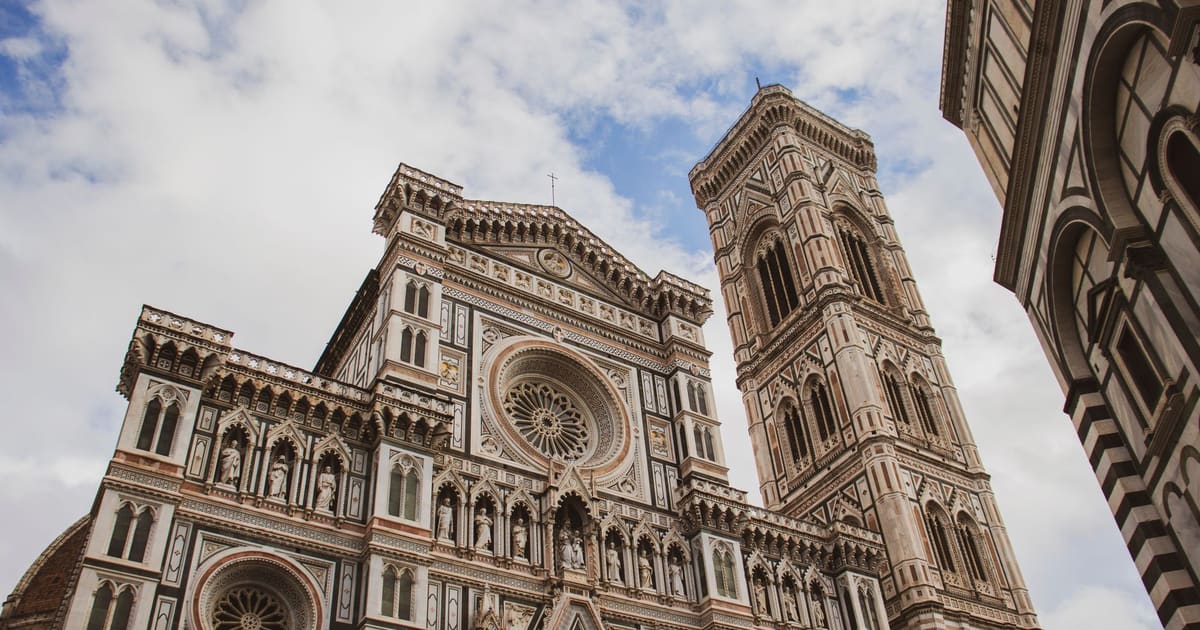
Stand between the two buildings, with the small eight-sided baptistery on one side and the great striped cathedral on the other. The baptistery is the older of the two, and for centuries every child born in Florence was baptized here, the poet Dante among them. In 1401 the cloth merchants' guild, which paid for its upkeep, held a competition for a new set of bronze doors, and the city's best young goldsmiths entered. The final came down to two men, Lorenzo Ghiberti and Filippo Brunelleschi, and Ghiberti won. He spent more than twenty years on those doors, then another quarter of a century on a second pair, the ones facing the cathedral, so beautiful that Michelangelo is said to have called them the Gates of Paradise. What you see today are copies; the originals are safe in the cathedral museum. Now look up at the dome. The losing finalist, Brunelleschi, turned to architecture, and when the city could not work out how to roof the enormous gap left at the end of its cathedral, he won that contest instead. He built the dome in two shells, one inside the other, laying the bricks in a herringbone pattern so they held themselves up as they rose, without the forest of wooden scaffolding everyone thought was needed. It was finished in 1436 and it is still the largest brick dome ever built. When you are ready, walk away from the cathedral along Via Roma, the straight street heading south from the baptistery, and in about three minutes it opens into a wide square.
Piazza della Repubblica
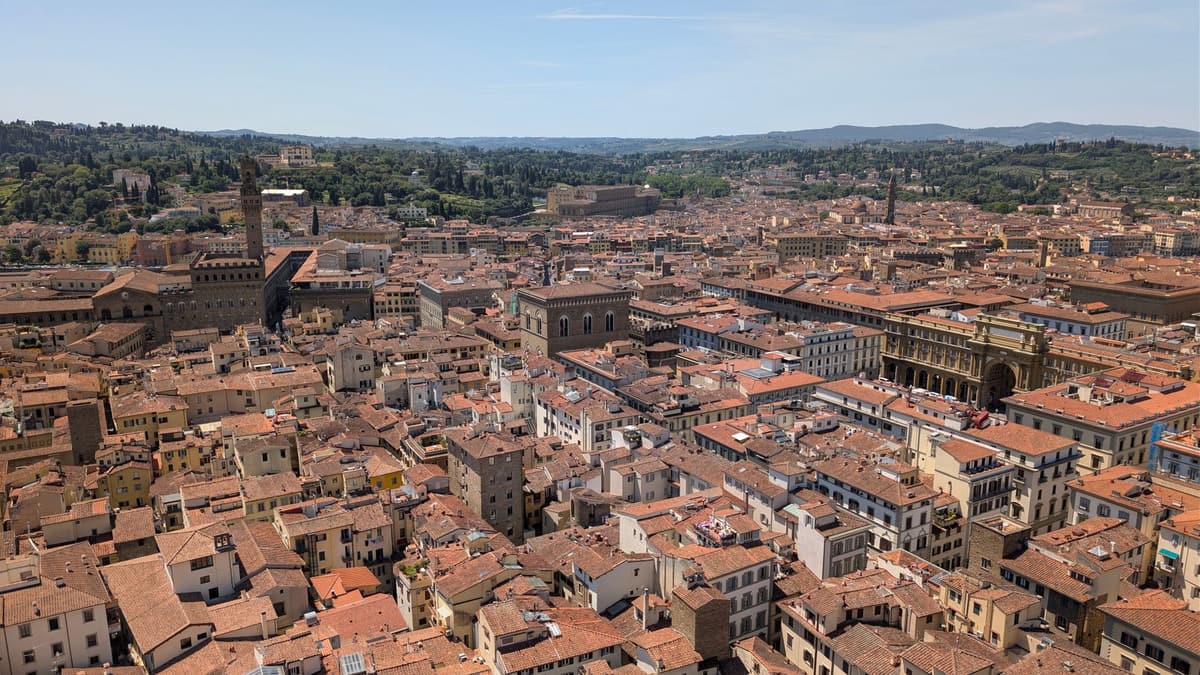 You have walked out of the Middle Ages and into the nineteenth century. This big, open square, with its grand arch and its café terraces, feels different from everything around it, and there is a reason. This was the very center of the Roman town of Florentia, where its two main streets crossed. The tall column in the square marks the spot, topped by a figure of Abundance. For most of the city's history this was its old market, a crowded warren of stalls, towers, churches and, from the sixteenth century, the Jewish ghetto. Then, in the 1860s, Florence briefly became the capital of the new Kingdom of Italy, and in the years that followed the city decided to modernize. The whole old market quarter was torn down and replaced by the square you see now. Walk over to the triumphal arch on the west side and read the inscription high on it, which declares that the ancient center of the city had been restored from centuries of squalor to new life. Not everyone agreed. Writers and artists, many of them foreigners living in Florence, protested bitterly at the loss of the medieval center, and the debate still comes up today. Some of the cafés around the square have been here since that rebuilding, and one of them was the meeting place of the Futurist artists in the early twentieth century. To continue, take the street leading east from the square, Via degli Speziali, to the broad pedestrian Via dei Calzaiuoli, and turn right. The tall stone block on your right, about three minutes away, is the next stop.
Orsanmichele
This tall, square building does not look like a church, because it was not built as one. It began as a grain market, an open loggia on the ground floor with storerooms above to keep the city's emergency supply of grain. The arches were later filled in and it became a church, but if you go inside you can still see the openings in the pillars where grain was poured down from the floors above. The real show is on the outside. Walk slowly around the building and look at the niches set into its walls, each one with a statue in it. Each niche belonged to one of the city's guilds, the associations of merchants and craftsmen who ran Florence's economy and its government. Each guild paid for its own patron saint, and the competition between them was fierce. A bronze statue cost far more than a marble one, so a bronze was a way of showing off. Look for Saint George, a young knight standing firm with his shield, made by Donatello for the armorers' guild; Ghiberti's John the Baptist, among the first life-size bronzes of the age, paid for by the cloth merchants; and Verrocchio's Doubting Thomas, reaching toward Christ's wound. Most of what you see outside are copies, and the originals are kept in the museum upstairs. Look too for the colorful glazed roundels above some niches, the badges of the guilds. To continue, carry on south down Via dei Calzaiuoli for about two minutes, and the street opens into the main square of the city.
The full tour continues in the app
- Distance
- 1.1 km
- Walking
- 14 min
- Steps
- ~1,500
- Narration
- 13 min
What's included
- All 6 stops, fully narrated
- Works offline once downloaded in the app
- Friends walk free one purchase covers everyone on your walk
Our tours are made to be meditative and immersive: you keep moving and simply listen. They're always better together, and the app plays the narration in sync, so you, your partner and your friends hear every stop at the same moment.
Piazza della Signoria
This was the stage of Florentine politics, and it still feels like one. The fortress with the tall tower is the Palazzo Vecchio, the town hall, begun around 1300 and still the seat of the city council.
The rest of this stop is in the full audio tour.
Uffizi Loggia
You are standing in a stone canyon. The two long wings of the Uffizi run down toward the river, joined at the far end by an arch, and the open courtyard between them is free to walk through.
The rest of this stop is in the full audio tour.
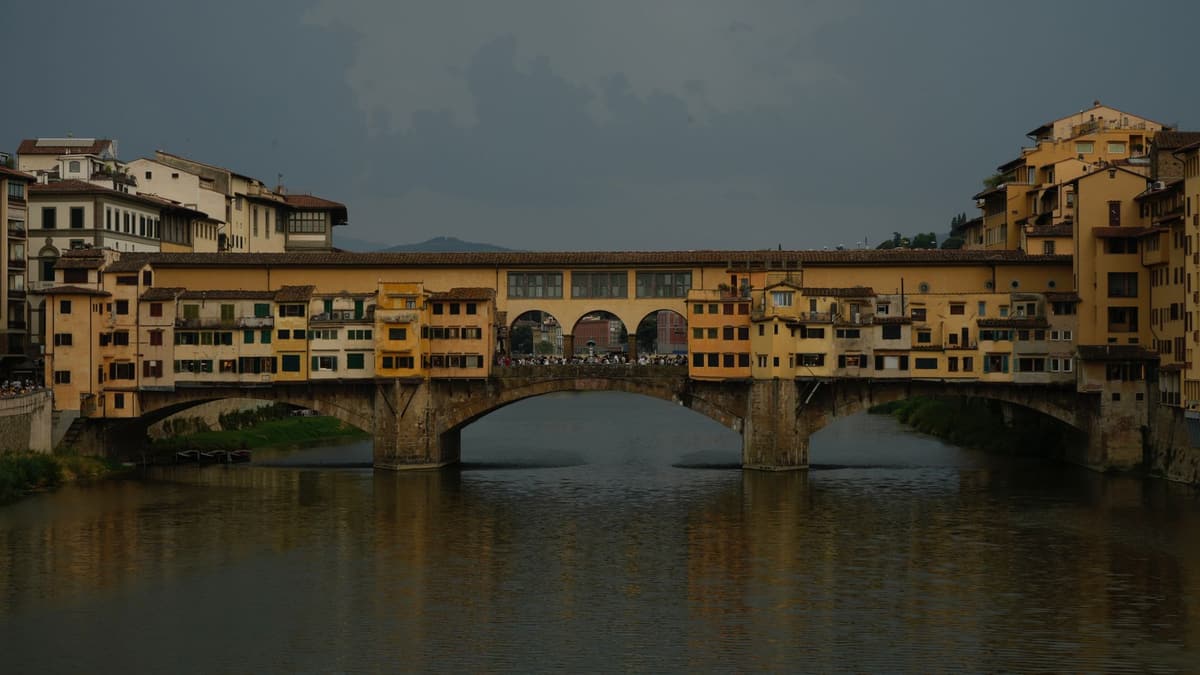
Ponte Vecchio
You end on the oldest bridge in Florence, and the only one in the city with houses on it. The present bridge was built in 1345, after a flood destroyed the one before it, and it has been lined with shops ever since.
The rest of this stop is in the full audio tour.
Do this walk with other people on the next scheduled tour.
About 1.1 km, roughly 14 minutes at an easy pace · 6 stops
Friends walk freeMore audio tours in Florence
$14.99Food & Tastings $14.99Film & Fiction
 $15.99Games IRL
 $10.99City Highlights