




 $8.99City Highlights
Hamburg Audio Walking Tours
Self-guided, narrated walks through Hamburg. Buy a tour once, download it, and hear the story at each stop while you walk at your own pace.
Tours from $8.99
Friends walk free. One purchase covers everyone on your walk. Start the tour, invite your friends to join, and it plays on every phone in your group.
5.0 on Google Play
Hamburg audio tours
Each tour is a mapped route with narration at every stop. Buy it once and it is yours to keep, no subscription.
$8.99City Highlights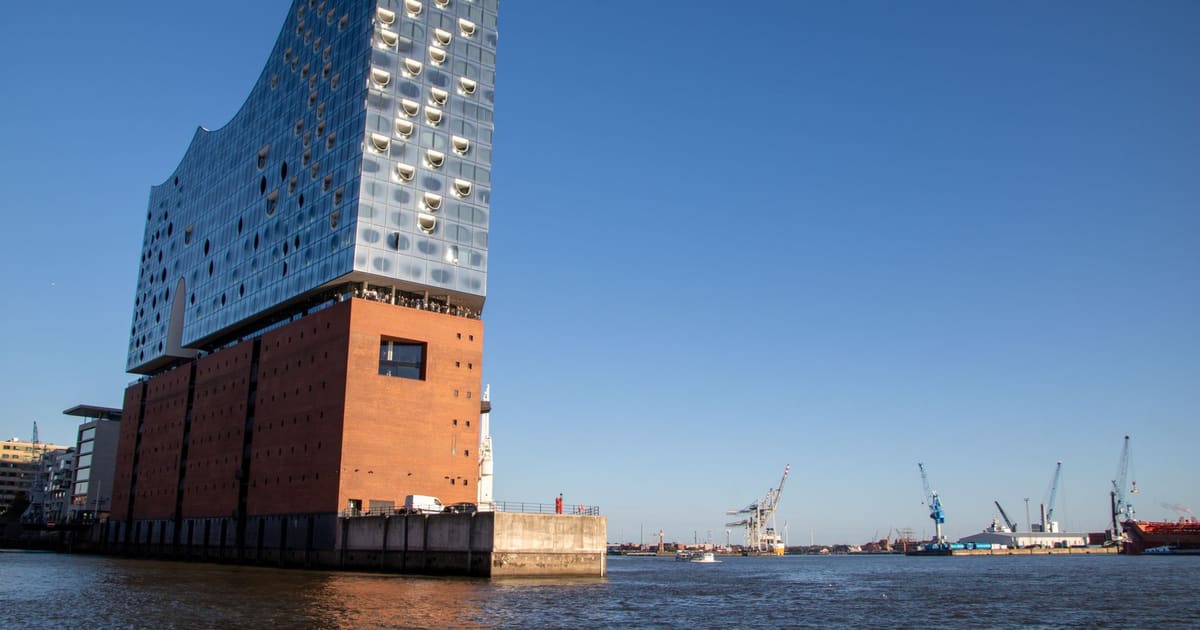 $9.99City Highlights
What to expect on a Hamburg audio walking tour
A Hamburg audio walk crosses eight centuries of a merchant republic, from the church sailors call the Michel to the Alster lake and grand City Hall, or follows the water itself, through a tiled tunnel under the Elbe to the red-brick Speicherstadt.
The Old Town and Alster Walk starts at St. Michael's, the great brick church the whole city calls the Michel, and drops through the old merchant street of Deichstrasse to the bombed spire of St. Nikolai, 3.5 kilometers, about 48 minutes in all.
From there it crosses the square in front of Hamburg City Hall, with its 647 rooms, and finishes on the shining Alster lake at the Hamburger Kunsthalle, one of Germany's finest art museums.
The Harbor Walk follows the water instead, 4.1 kilometers, about 59 minutes, from the tiled Old Elbe Tunnel past the piers, a museum cargo ship and the glass crown of the Elbphilharmonie, into the red-brick Speicherstadt and on to the dark, rippling brick of the Chilehaus.
Where to walk in Hamburg
A few of the stops you will pass, and why they are worth slowing down for.
Hamburg City Hall
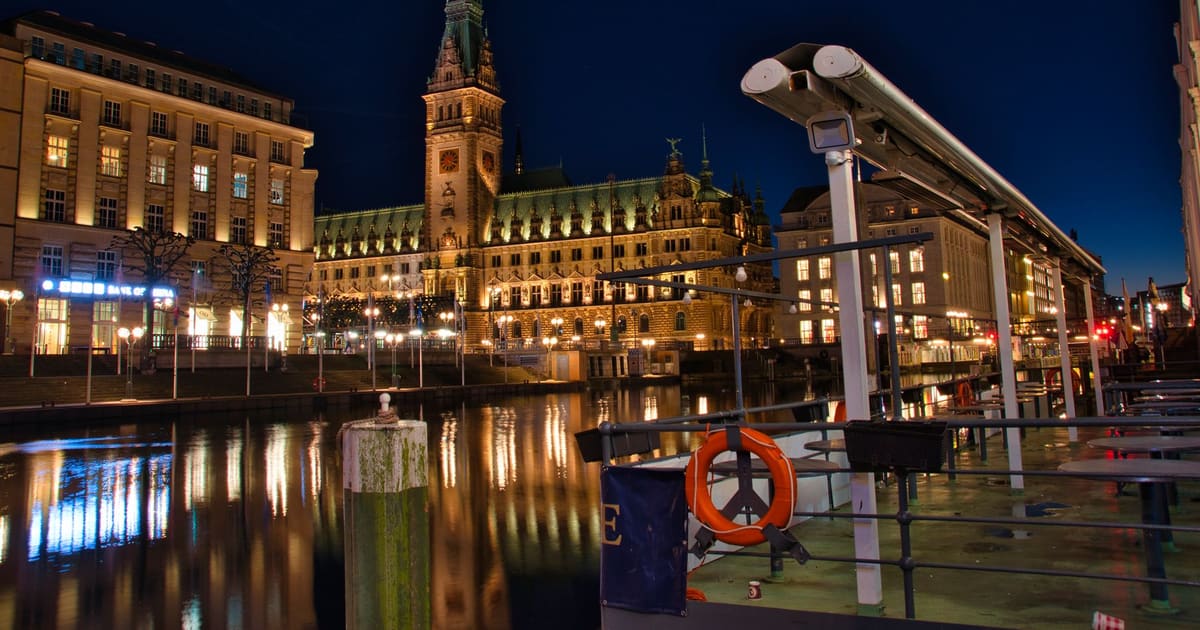
Hamburg City Hall, the Rathaus, went up between 1886 and 1897 in a lavish neo-Renaissance style, its tower rising over a hundred meters above a facade lined with statues of emperors. Inside are 647 rooms, enough for the city's government and its parliament both, since Hamburg is itself one of Germany's sixteen states. At night the facade lights up and reflects in the water of the Kleine Alster in front of it, lamps and flagpoles doubled in the still surface. An old Hanseatic custom has the mayor greet visiting monarchs at the top of the stairs rather than going down to meet them, a nod to the city's pride in never bowing to royalty.
Deichstrasse and the Old Canal
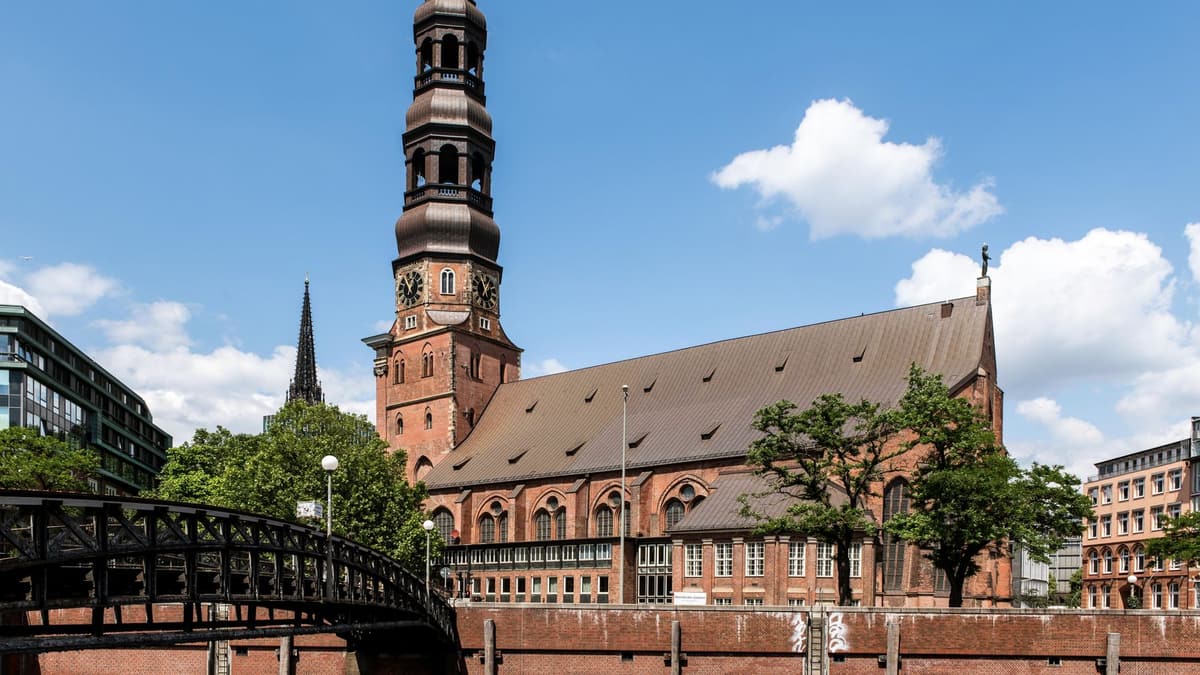
Deichstrasse takes its name from the dike it was first built along in the fourteenth century, and its narrow merchant houses, steep gables and timber frames, show what Hamburg looked like before the modern city arrived. The houses back directly onto the canal, so barges could once unload goods straight into the storerooms by hoist. A fire that started in a cigar maker's warehouse here in 1842 burned for three days and destroyed a quarter of the old city, yet part of Deichstrasse survived, which is why you can still walk it today. The red brick tower and canal bridge nearby are classic Hamburg Altstadt, water and old merchant architecture side by side.
The Elbphilharmonie
The Elbphilharmonie sits on a plain 1960s warehouse, Kaispeicher A, with a crown of glass rising above it in peaks and troughs like waves, made from more than a thousand curved panels. It opened in 2017, years late and well over budget, but most of Hamburg has forgiven it, partly for how good the concert hall inside actually sounds. You don't need a ticket to enjoy the building, since an escalator carries visitors up through the old warehouse to a public plaza wrapping around it, with views over the river, the cranes and the rooftops. From the water, the glass crown catches the light differently as the weather changes.
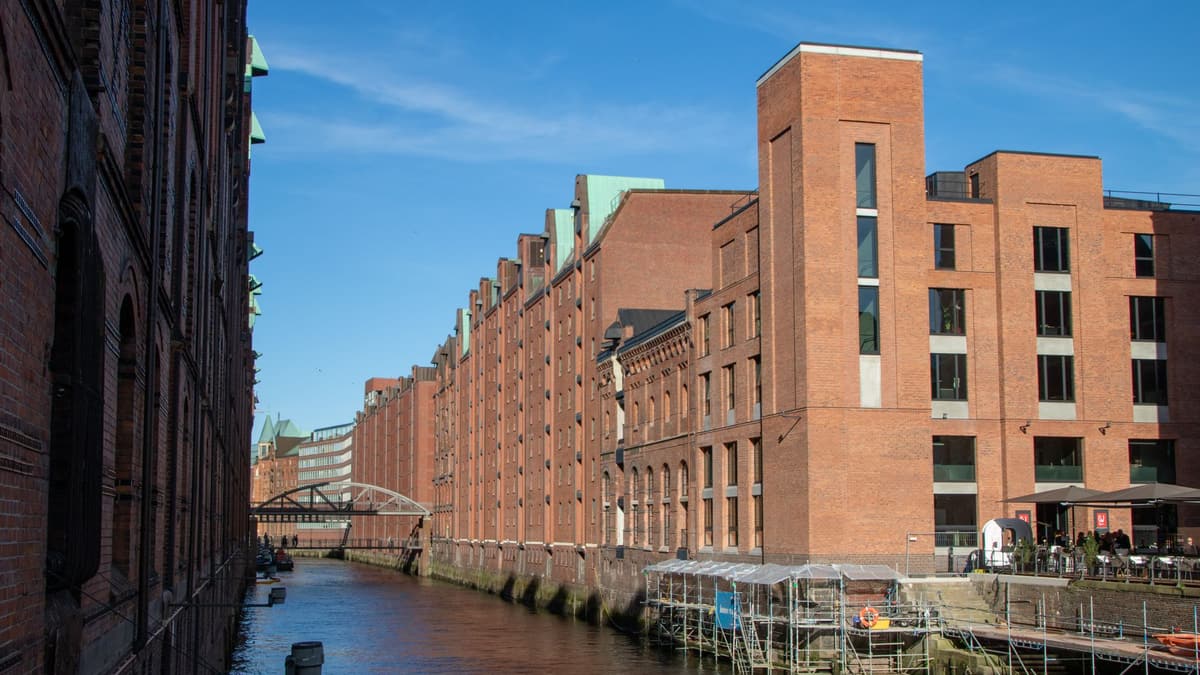
The Speicherstadt
The Speicherstadt is a district of red-brick warehouses built from 1883, after Hamburg joined the German customs union but kept a free port where goods could be stored without paying duty. The warehouses stand on thousands of timber piles driven into marshy ground, and for a century they held coffee, tea, spices and tobacco, some of which is still traded here today. Walking the canals between the buildings, their gabled fronts rise straight out of the water, each one with a beam and hoist above a column of loading doors, one for every floor. It's now a UNESCO World Heritage Site, and it shows once you're standing among the warehouses.
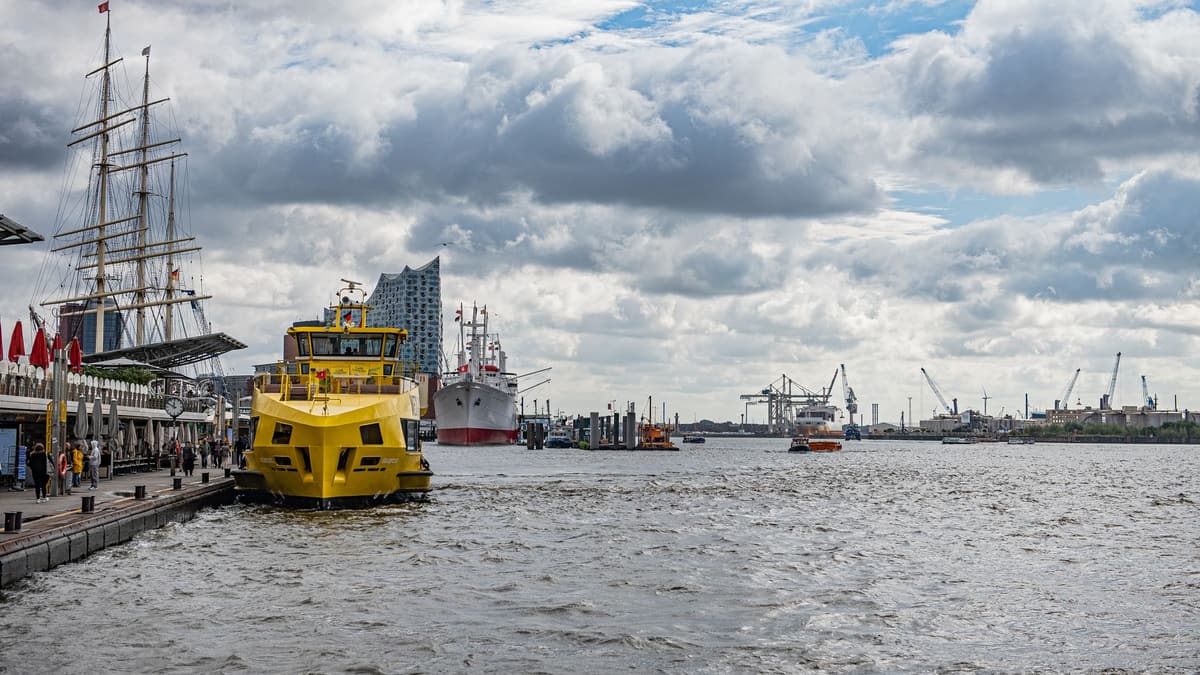
St. Pauli Landungsbrücken
The Landungsbrücken are Hamburg's harbor piers, floating pontoons joined to shore by hinged bridges that tilt with the Elbe's tide, which rises and falls by several meters twice a day. Harbor ferries leave from here as part of the city's ordinary public transport, and riding one downstream past the container terminals is one of the better cheap thrills in the city. A green-hulled sailing ship and a cargo liner sit moored nearby as museum ships, a reminder of the working harbor this once was and largely still is. Look past the masts and cranes and you can usually make out the Elbphilharmonie's glass crown further along the waterfront.
Get the Audio Tour in 3 Simple Steps
All in the free Walk With Me app, and the first stops of every tour are free to try.
Tap the Gold Headphones and Pick a Tour


01
Walk It Solo or Invite Someone


02
Press Play and Walk


03
Handcrafted for Your Time in the City
These tours aren't a checklist of sights. They're made to be walked slowly, headphones on, eyes on the city.
Meditative and Immersive
Each story is told where it happened. The app chimes when you reach a stop, one tap starts the story, and the stretch between stops is yours to take in at your own pace.
Handcrafted With Care
We choose every route and every stop ourselves and shape each story with care, so the time you have in the city goes to the places most worth seeing.
Better With Someone
Every walk is better with someone beside you, so if you can bring a friend, we really hope you do. That's why one purchase covers everyone you invite: they join your tour free.