
October 11, 2026 · 9 min read
Amsterdam Anne Frank Walking Tour
From the Hollandsche Schouwburg through the old Jewish Quarter, past the Dockworker and the Dam, to the Anne Frank House on the Prinsengracht.
589

October 9, 2026 · 10 min read

 Friends walk free
Every tour also runs as a scheduled group walk you can join in the app.
More audio tours in Verona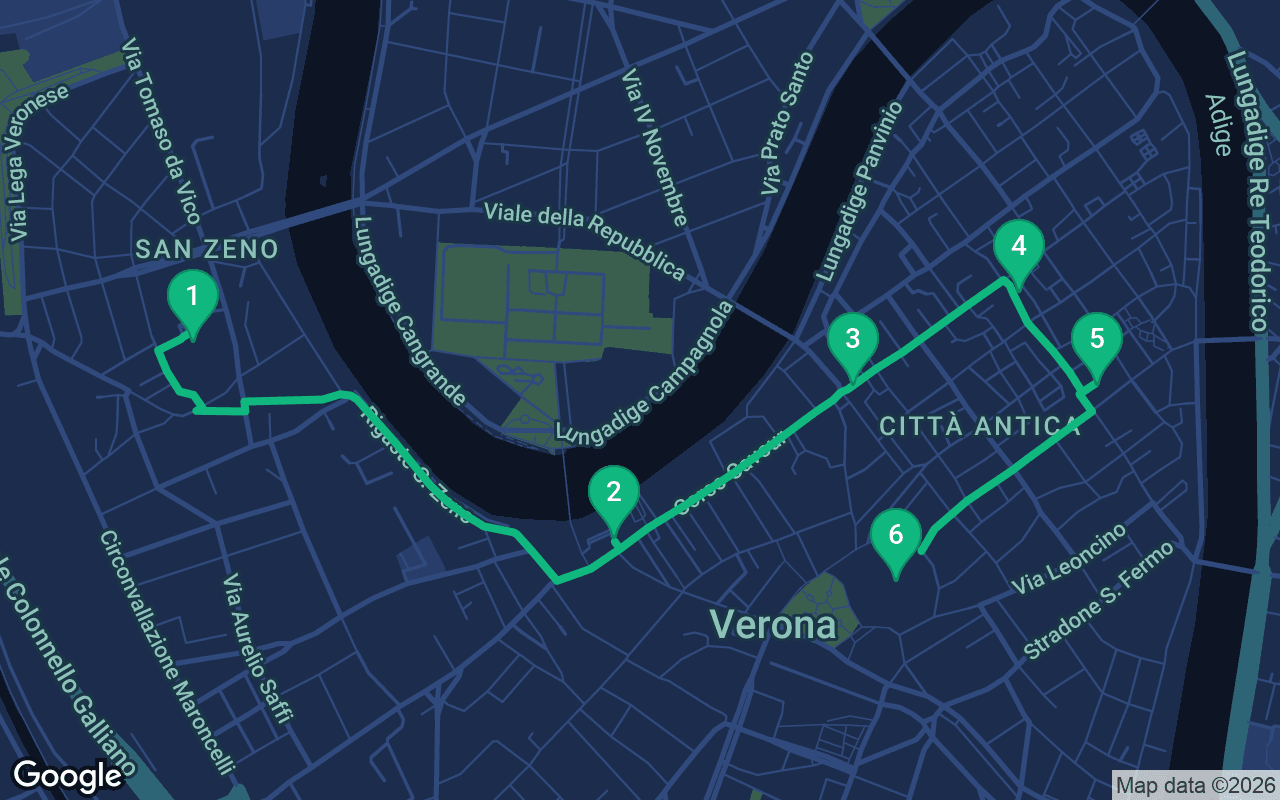
About 2.6 km, roughly 35 minutes at an easy pace.
This tour is narrated
Press play on the first 3 stops for a 30-second demo of the narration. In the app, the intro and those 3 stops play in full for free, each one chiming as you arrive. The whole narrated tour is yours for $7.99, a one-time purchase you keep for good.
Works with Garmin, Komoot, Strava, OS Maps and any GPX app.
Verona packs two thousand years into a small, walkable bend of the river Adige, and this route runs through all of them in one easy line. It begins at the Basilica di San Zeno, one of the finest Romanesque churches in northern Italy, follows the river to the red brick castle of the Scaliger lords, then passes through a Roman gate onto the old Roman high street and into the market square that was once the forum. From there it is a short step to the courtyard of Juliet's balcony and a longer stroll down the city's favorite shopping street to the Roman Arena on Piazza Bra. It is about two and a half kilometers, flat the whole way, and one of the most complete self-guided walking tours you can take in a single morning.
Plan on about two hours at a relaxed pace, and longer if you go inside San Zeno, the castle museum or the Arena, each of which deserves time of its own. The route is flat and paved, mostly on pedestrian streets, with one longer stretch along the riverside at the start. Verona is busy from late morning, especially around Juliet's House and Piazza delle Erbe, so an early start gives you the quiet beginning at San Zeno and the market as it sets up. Summers are hot, and the riverside stretch has some shade but the squares have little, so carry water and a hat. In summer the Arena hosts its opera festival in the evenings, which can change access to the amphitheatre during the day. Opening hours and ticket arrangements for the churches and museums change, so check before you go. Verona also sells a city card covering many of the sights, worth a look if you plan to go inside several.
Stand in the wide square and take in the front of the church, striped in bands of pale stone and pink brick, with a great round window high in the middle. That window is called the Wheel of Fortune. Look closely and you can see little carved figures around its rim, rising on one side and tumbling down the other, a medieval reminder that luck turns for everyone. Most of what you see was rebuilt in the twelfth century, after a severe earthquake in 1117 shook much of northern Italy. The church honors Zeno, a fourth-century bishop of Verona who came from North Africa and became the city's patron saint, and he is often shown holding a fishing rod with a fish dangling from the line. Under the porch, look at the doors. They are covered with dozens of bronze panels showing Bible stories and scenes from the saint's life, made around nine hundred years ago, wonderfully direct and a little rough, like a comic strip in metal. Inside, if you go in, look for Andrea Mantegna's glowing altarpiece on the high altar. Napoleon's troops carried it off to France in 1797, and while the main panels came back, the small scenes beneath them stayed in French museums and are replaced here by copies. Inside too is a painted statue of the saint known as San Zeno who laughs, for his broad smile. When you are ready, leave the square heading east, bear left to the river, then turn right along the riverside road with the water on your left, about fifteen minutes to the castle.
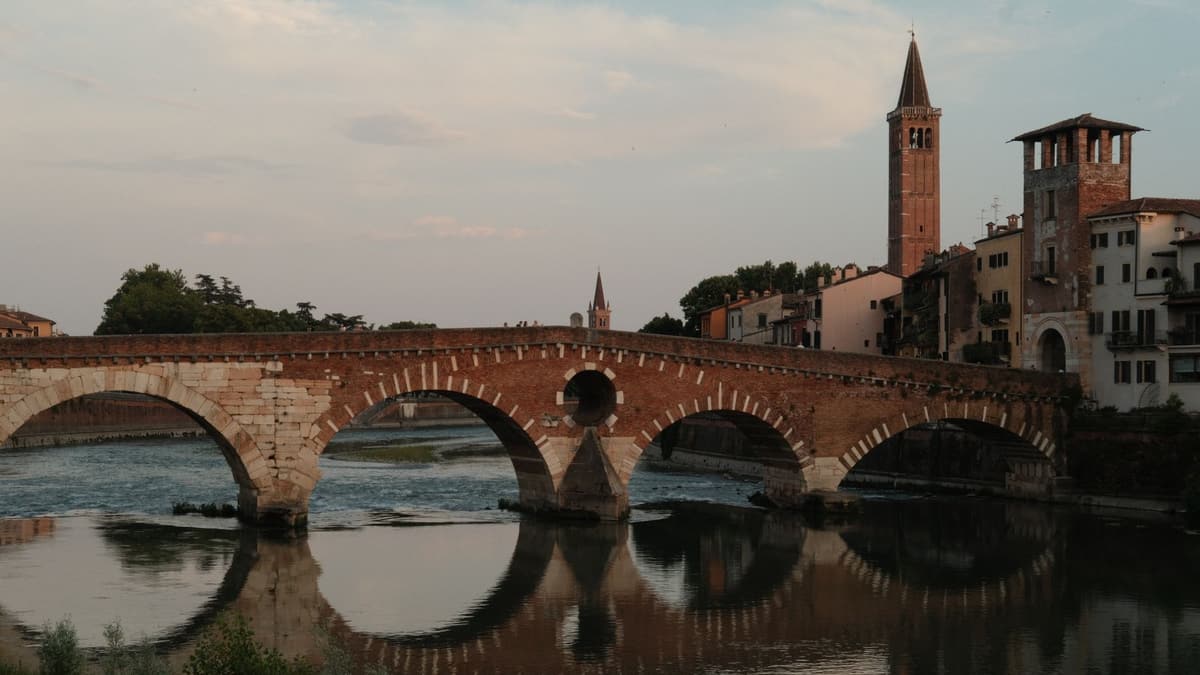
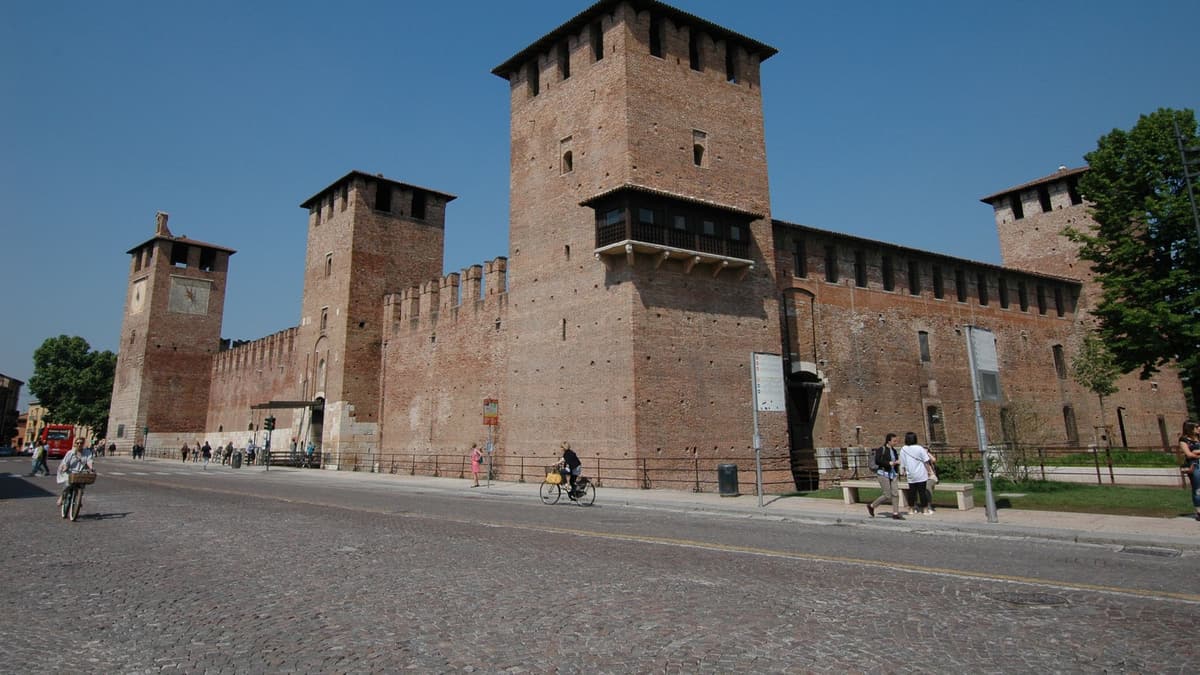
The red brick walls and swallowtail battlements ahead belong to Castelvecchio, the old castle, built in the 1350s by Cangrande II della Scala. The Della Scala family, also called the Scaligeri, ruled Verona in the thirteenth and fourteenth centuries, and the fortress tells you how little Cangrande trusted his own people. Walk out onto the bridge beside it. The castle and bridge were built together, and the bridge was a private escape route, crossing the river toward the north and the roads to allied lands in the Alps, so the lord could slip away if the city rose against him. His fears were not entirely misplaced. A few years later he was murdered in the street by his own brother. The bridge you are standing on is a careful reconstruction, rebuilt after it was destroyed at the end of the Second World War. Inside the castle is the city's art museum, redesigned from the late 1950s by the architect Carlo Scarpa, whose mix of old stone, concrete and steel is studied by architects from around the world. His boldest touch is the medieval equestrian statue of Cangrande I, the family's greatest lord, set on a high concrete platform where you suddenly meet him in midair. In 2015 armed thieves stole seventeen paintings from the museum, and to the city's relief they were recovered in Ukraine the following year. Glance at the small white Roman arch standing beside the castle, the Arco dei Gavi, then walk east along the straight street of Corso Cavour to the gate standing across the street ahead, about six minutes.
In front of you, across the street, stands a wall of pale stone pierced by two arches and topped with two rows of little arched windows. This is Porta Borsari, the main gate of Roman Verona, and you are on the line of the ancient road that came into town through it. Only the outer face of the gate survives, and it has stood here since the first century. Look at the band of Latin letters running across the top. The inscription records the building of new city walls in the year 265, under the emperor Gallienus, and it boasts that they went up in a matter of months, a rush that probably tells you how nervous Rome was about invaders from the north. The name Borsari comes much later. In the Middle Ages the bishop's toll collectors, the bursarii, stood here taking duties from goods entering the city, so the gate took its name from the purse. The houses on either side lean right up against the stone, as they have done for centuries, and the arches still carry the city's foot traffic under them. Walk through the arches and keep straight on along Corso Porta Borsari, the old Roman main street, to the market square at its end, about four minutes.
What's included
Our tours are made to be meditative and immersive: you keep moving and simply listen. They're always better together, and the app plays the narration in sync, so you, your partner and your friends hear every stop at the same moment.
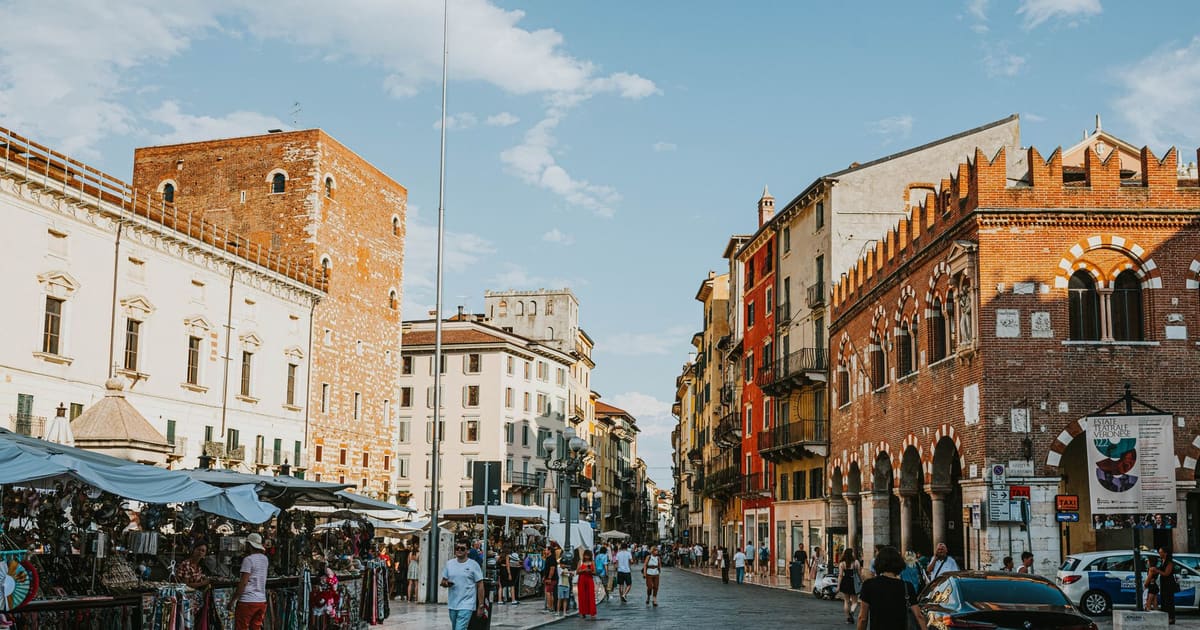
You have arrived in the old Roman forum, though today it is Piazza delle Erbe, the square of herbs, a long, busy market place surrounded by tall houses painted in faded frescoes. Look along its length.
The rest of this stop is in the full audio tour.
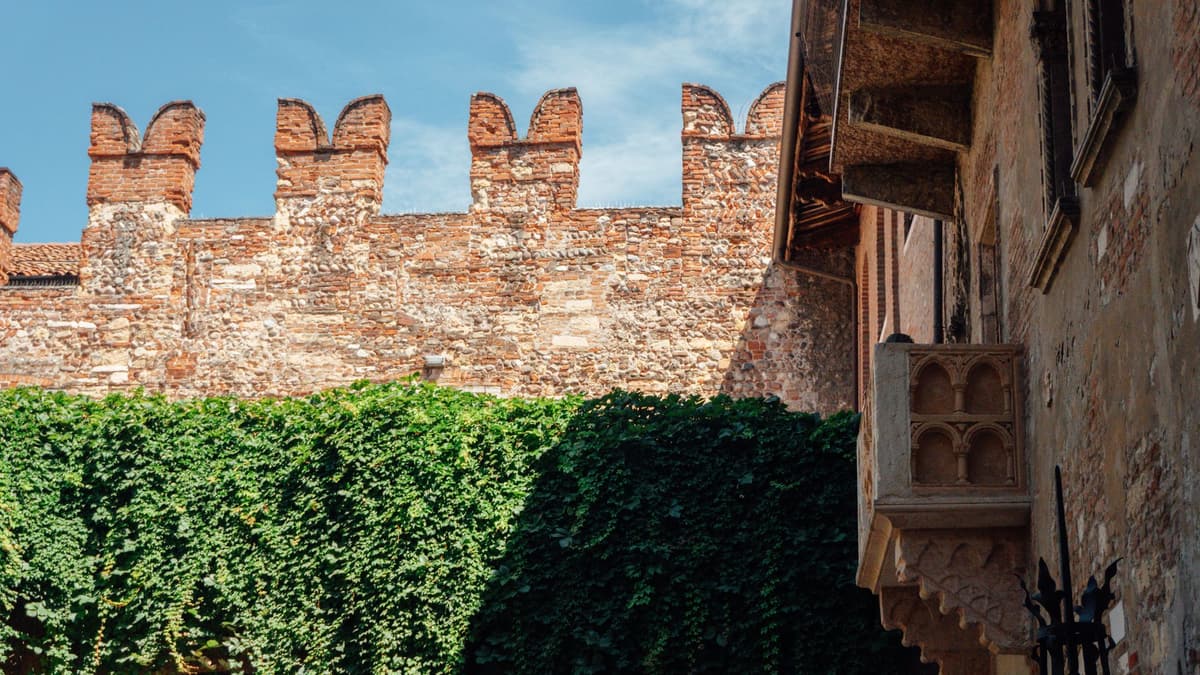
Step through the arched passage into the small courtyard, and look up. Above you is surely one of the most photographed balconies in Italy, and below it the bronze statue of Juliet, polished bright by visitors.
The rest of this stop is in the full audio tour.
Via Mazzini spills you out onto Piazza Bra, the biggest square in Verona, and there it is, filling one side of the square: the Arena, a Roman amphitheatre of pink and white stone, still standing and still in use.
The rest of this stop is in the full audio tour.
Do this walk with other people on the next scheduled tour.
About 2.6 km, roughly 35 minutes at an easy pace · 6 stops
Friends walk freeOctober 11, 2026 · 9 min read
From the Hollandsche Schouwburg through the old Jewish Quarter, past the Dockworker and the Dam, to the Anne Frank House on the Prinsengracht.
October 11, 2026 · 11 min read
From Van Houten's street by the Vondelpark past Leidseplein, the Rijksmuseum passage and the famous canal bench to the Anne Frank House.

October 11, 2026 · 10 min read
Follow the last days of April and May 1945 from the Anhalter Bahnhof ruin past the Gestapo site and Brandenburg Gate to the Moltke Bridge and the Reichstag.
