
 $7.99City Highlights
Montreal Mount Royal Audio Walking Tour (Self-Guided)
Choose how you'll do this walk in our app

 Friends walk free
Every tour also runs as a scheduled group walk you can join in the app.
More audio tours in Montreal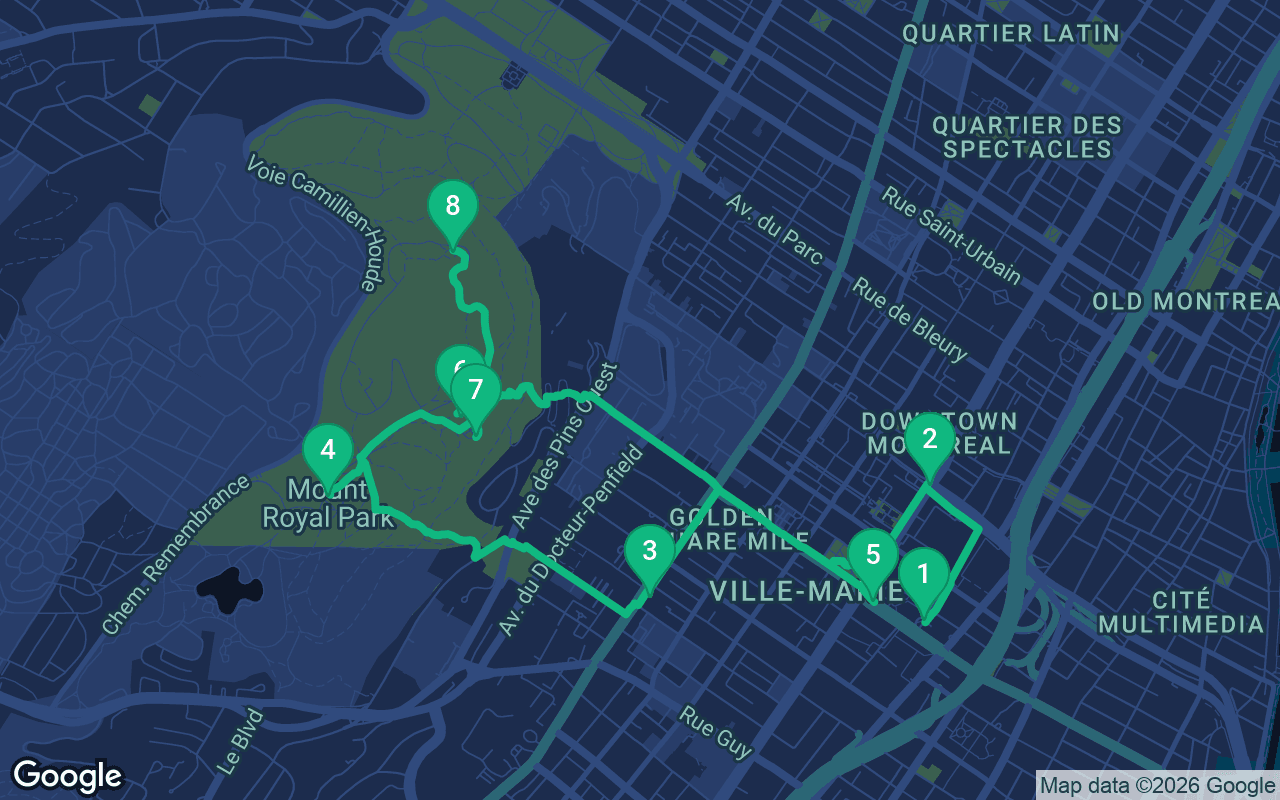
About 4.1 km, roughly 68 minutes at an easy pace.
- 1Place Ville Marie
- 2McGill University Roddick Gates
- 3Peel Street Stairs
- 4Kondiaronk BelvedereFull tour
- 5Mount Royal CrossFull tour
- 6Sir George-Étienne Cartier MonumentFull tour
This tour is narrated
Press play on the first 3 stops for a 30-second demo of the narration. In the app, the intro and those 3 stops play in full for free, each one chiming as you arrive. The whole narrated tour is yours for $10.99, a one-time purchase you keep for good.
Works with Garmin, Komoot, Strava, OS Maps and any GPX app.
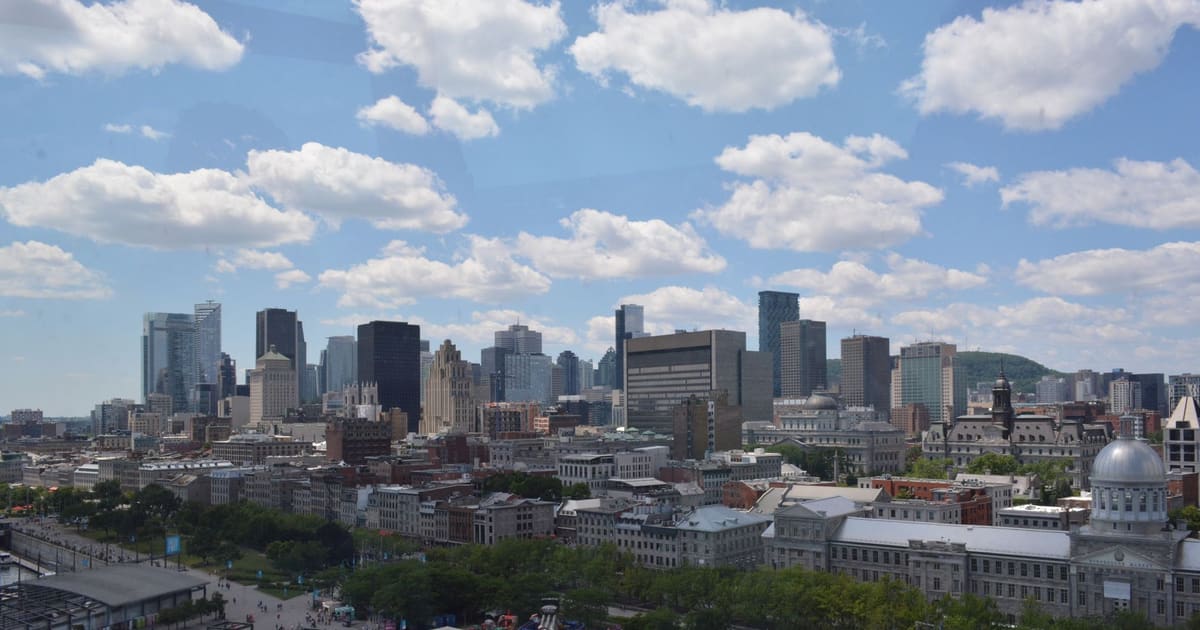
Montreal is named for its mountain, and from almost anywhere downtown you can see it, a green, wooded hump rising behind the towers with a cross on top. This walk takes you straight there and over it. You start on the plaza of Place Ville Marie, in the middle of the business district, walk up the avenue that frames the mountain, through the gates of McGill, and then climb through the woods to the city's great lookout and the summit cross, before coming down the far side to the monument where the drums play on Sundays. It is about four kilometers, with a proper climb in the middle, and it is one of the most satisfying self-guided walking tours in Canada because you can feel the city fall away beneath you as you go.
Before you set off
Be ready for a real climb. The first part, through downtown and the campus, is an easy uphill stroll, but from Pine Avenue the route goes up long flights of wooden and stone stairs through the woods, and it is steep enough that most people stop on the landings to catch their breath. Take it slowly and there is no shame in pausing; the views between the trees are the excuse. If stairs are hard for you, the wide gravel carriage road winds up the mountain at a gentle grade instead, though it adds a fair distance. The walking time is a little over an hour, but allow two and a half to three hours with the lookout, the summit and a rest. Wear shoes with grip, carry water, and bring a layer, because the summit is cooler and breezier than downtown. In winter the stairs can be icy, and many locals add spikes or cleats to their boots. The chalet at the top usually has washrooms and somewhere to sit; check its hours before you go. The lookout faces the city, so late afternoon puts a warm light on the towers. The second half is all downhill, which your knees will notice. If you can, walk it on a Sunday in the warm months, so the drums are playing when you arrive at the end.
Place Ville Marie
Stand on the wide raised plaza of Place Ville Marie and turn so the cross-shaped tower is behind you. In front of you, McGill College Avenue runs straight up the slope, and at the end of it, filling the view, is the mountain. That framing is no accident. Place Ville Marie opened in 1962, designed by the office of the architect I. M. Pei, and its cruciform tower, with four arms reaching out from a central core, was a statement that Montreal intended to be a modern city. Montrealers like to point out that the shape answers the cross on the summit you are about to visit. At night a rotating beacon on the roof sweeps the sky. Beneath your feet the building did something just as important: it was the start of the underground city, the network of passages, malls and metro stations that lets people cross much of downtown in winter without stepping outside. The avenue in front of you has its own story. In the 1980s, plans that would have closed off this view met strong public opposition, and the avenue stayed open, so the mountain still sits at the end of it like a painting. Now walk up McGill College Avenue toward the trees. It is a gentle uphill of about six minutes. Watch along the way for a sculpture of a crowd of pale figures, The Illuminated Crowd, and keep going until you reach a pair of stone gates across Sherbrooke Street.
McGill University Roddick Gates
 You are standing at the Roddick Gates, the main entrance to McGill University, with Sherbrooke Street at your back and the campus opening up ahead. The gates went up in 1925 in memory of Sir Thomas Roddick, a surgeon and dean of medicine, given by his widow, and if you look at the stone pillars you will find clock faces set into them. McGill itself began with a bequest. James McGill, a Scottish-born merchant who made his fortune in the fur trade, left land and money in his will for a college, and the university received its charter in 1821. Look straight up the avenue to the domed stone building at the top: that is the Arts Building, the oldest on campus, and James McGill's remains lie in front of it. To your sides spreads the lower field, the big lawn where students study, throw frisbees and lie in the sun in the warm months. Behind the old grey stone buildings, the mountain looms closer now, its trees right above the rooftops. This is a working university, so keep to the paths and be quiet near the buildings. When you are ready, walk up the main avenue and bear left, west, across the campus, heading for the far side. Come out on Peel Street and climb its steep top end to Pine Avenue, where the city stops and the woods begin. It is about eight or ten minutes, and it gets steeper as you go.
Peel Street Stairs
This is the edge of the city. Behind you, Peel Street drops down toward the towers; in front of you, across Pine Avenue, the forest starts and the stairs climb into it. Cross Pine with care, because the traffic is quick here, and stand at the foot of the stairs for a moment. Mount Royal Park opened in 1876, and it was laid out by Frederick Law Olmsted, the landscape architect who designed Central Park in New York. Olmsted wanted the mountain to feel wild, and he designed a broad carriage road that would wind up the slopes gently, revealing the views a little at a time. The stairs are the opposite idea, the local shortcut straight up the hill, and on summer evenings you will see Montrealers running them for exercise while everyone else plods. The mountain itself is the worn-down core of ancient molten rock that pushed up underground and hardened, one of a chain of similar hills scattered across the plain south and east of the city. Its woods are maple, oak and birch, glorious in October and quiet under snow in winter. Take a breath, and start climbing. Follow the signs for the chalet and the lookout: the first flights bring you up to the gravel carriage road, and from there a long wooden staircase continues up through the trees, finishing just below the lookout terrace. Allow fifteen to twenty minutes, take the landings slowly, and turn around now and then to see the city between the leaves.
The full tour continues in the app
- Distance
- 4.1 km
- Walking
- 68 min
- Steps
- ~5,700
- Narration
- 13 min
What's included
- All 6 stops, fully narrated
- Works offline once downloaded in the app
- Friends walk free one purchase covers everyone on your walk
Our tours are made to be meditative and immersive: you keep moving and simply listen. They're always better together, and the app plays the narration in sync, so you, your partner and your friends hear every stop at the same moment.
Kondiaronk Belvedere
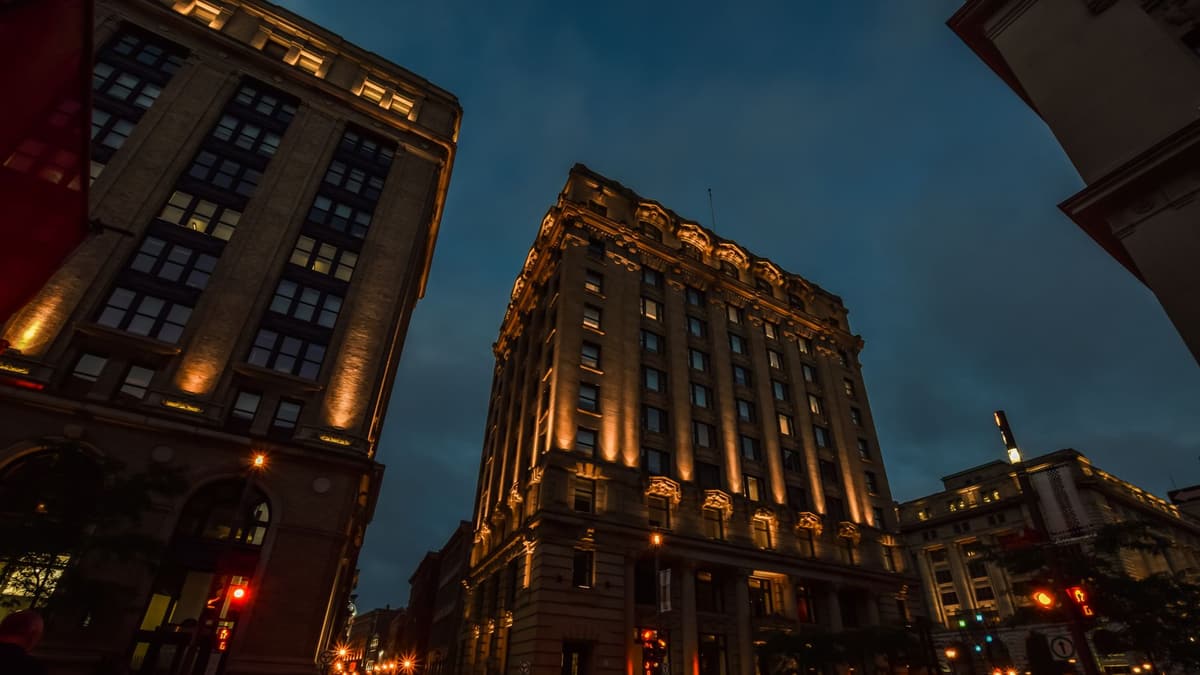
You made it. Walk out to the stone balustrade of the terrace and let the view do its work.
The rest of this stop is in the full audio tour.
Mount Royal Cross
Through the trees, the steel lattice of the cross rises above you, more than thirty meters tall at the top of the mountain. The story behind it goes back to the first winter of the colony.
The rest of this stop is in the full audio tour.
Sir George-Étienne Cartier Monument

You come out of the woods at the foot of the mountain, by Park Avenue, and in front of you stands a tall stone monument crowned by a bronze winged figure high above the trees. Everyone calls her the angel.
The rest of this stop is in the full audio tour.
Do this walk with other people on the next scheduled tour.
About 4.1 km, roughly 68 minutes at an easy pace · 6 stops
Friends walk freeMore audio tours in Montreal
$7.99City Highlights