
 $10.99City Highlights
Old Montreal Walking Tour: From Square Victoria to the Old Port
Choose how you'll do this walk in our app

 Friends walk free
Every tour also runs as a scheduled group walk you can join in the app.
More audio tours in Montreal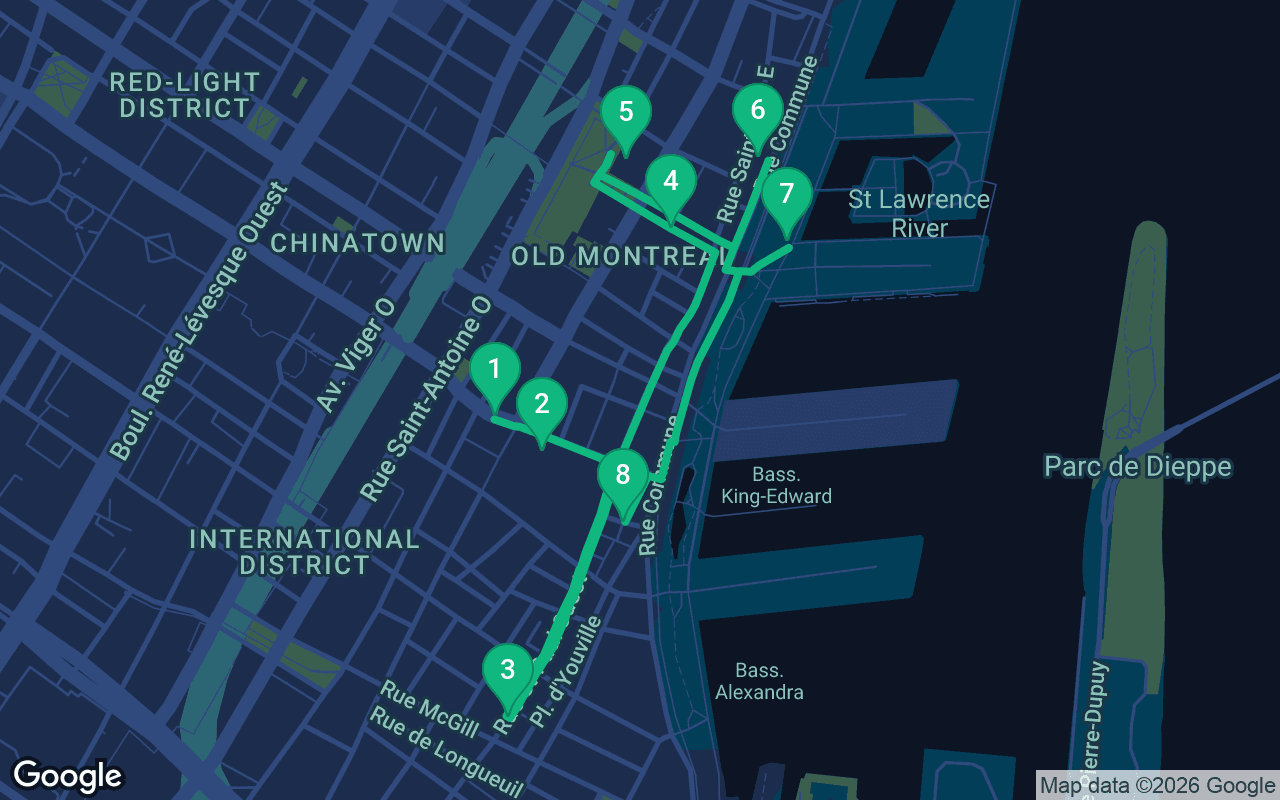
About 2.8 km, roughly 38 minutes at an easy pace.
- 1Square Victoria
- 2Notre-Dame Basilica and Place d'Armes~CA$12Entry ticket, not included
- 3Pointe-à-Callière~CA$24Entry ticket, not included
- 4Rue Saint-PaulFull tour
- 5Place Jacques-Cartier and City HallFull tour
- 6Notre-Dame-de-Bon-Secours Chapel~CA$13Entry ticket, not includedFull tour
- 7Clock Tower QuayFull tour
Not included in the tour: ~CA$49 entryAverage per person. Prices change, so check before you go.
This tour is narrated
Press play on the first 3 stops for a 30-second demo of the narration. In the app, the intro and those 3 stops play in full for free, each one chiming as you arrive. The whole narrated tour is yours for $7.99, a one-time purchase you keep for good.
Works with Garmin, Komoot, Strava, OS Maps and any GPX app.
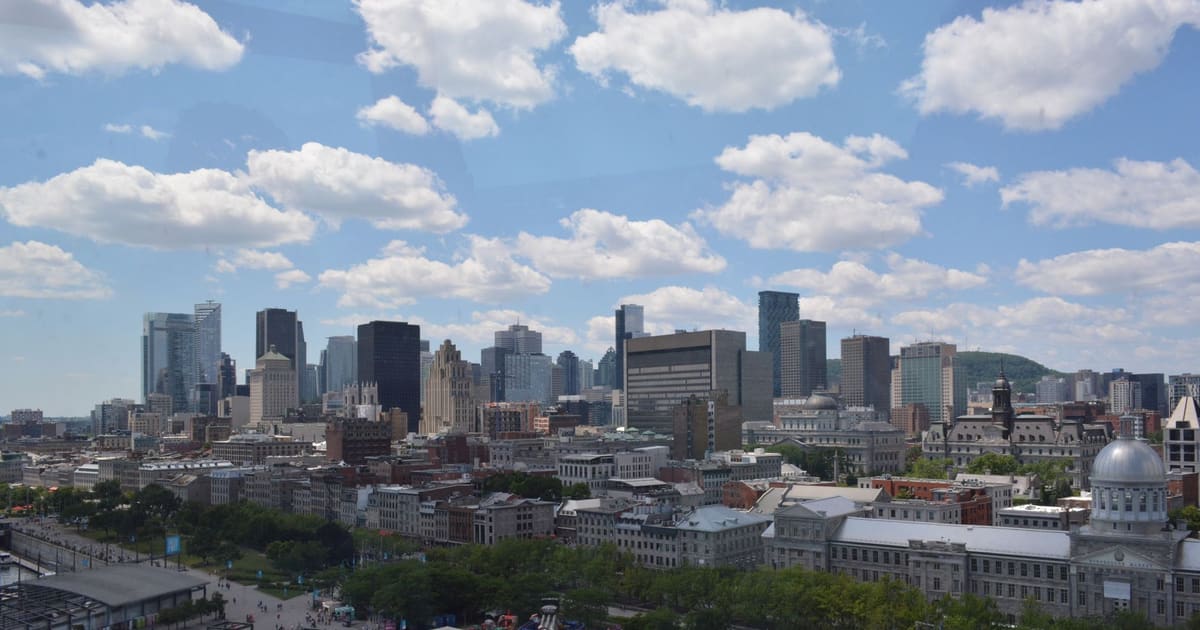
Old Montreal is where the city began, on a low point of land by the St. Lawrence River in 1642, and it still feels like a separate town tucked between the downtown towers and the water. Grey stone warehouses, French street names, cobbles underfoot and church bells overhead make it the most European corner of North America. This walk runs in one line from west to east, starting at Square Victoria on the edge of the old city and finishing at the Clock Tower at the end of a pier on the Old Port. On the way you pass the blue and gold interior of Notre-Dame Basilica, the exact spot where Montreal was founded, the oldest street in the city and the balcony where a French president caused a diplomatic storm. It is under three kilometers, mostly gently downhill, and among the easiest self-guided walking tours in Canada to fit into a single afternoon.
Before you set off
The walking itself takes about forty minutes, but plan on two to three hours, because the basilica deserves a slow look and the archaeology museum at Pointe-à-Callière can easily fill an hour on its own. The ground tilts gently down toward the river, so the walk is easy, but many streets are cobbled and uneven, so wear comfortable shoes with some grip. Summer and early autumn are lovely and busy, with terraces spilling onto the squares; winter is cold and can be icy underfoot, though the stone streets look wonderful under fresh snow. The basilica charges for visits and closes to sightseers during services, and the museums keep their own hours, so check before you go. Evenings have their own charm, when the old buildings are lit up and the crowds thin. Almost everything on the route is within a block or two of everything else, so feel free to follow a side street that catches your eye; you will never be far from the river or the next stop.
Square Victoria
Stand by the curving green entrance to the metro station, with its cast-iron stems, its pair of glowing lamps and the word Métropolitain written across the top in flowing letters. If it reminds you of Paris, it should. This is a genuine Art Nouveau entrance by Hector Guimard, the architect who designed the famous gateways of the Paris Métro around 1900, and it was given to Montreal by Paris in the 1960s, when French engineers had helped the city build its own metro. It is one of the most charming gifts any city has received, and it fits here perfectly. Look around the square. A statue of Queen Victoria stands on its pedestal, and the dark tower of the old stock exchange rises nearby. This was once a hay market on the western edge of the old town, and later the gateway to the business district. Today the streets around it hold international organizations, including the headquarters of the United Nations agency for civil aviation. Old Montreal begins just to the east. To get there, walk northeast along Rue Saint-Jacques, the street that was once called the Wall Street of Canada. Look at the grand bank buildings as you pass, with their columns and bronze doors, including the tall Royal Bank tower, which was once one of the tallest buildings in the British Empire. After about eight minutes the street opens onto a square with a great twin-towered church.
Notre-Dame Basilica and Place d'Armes
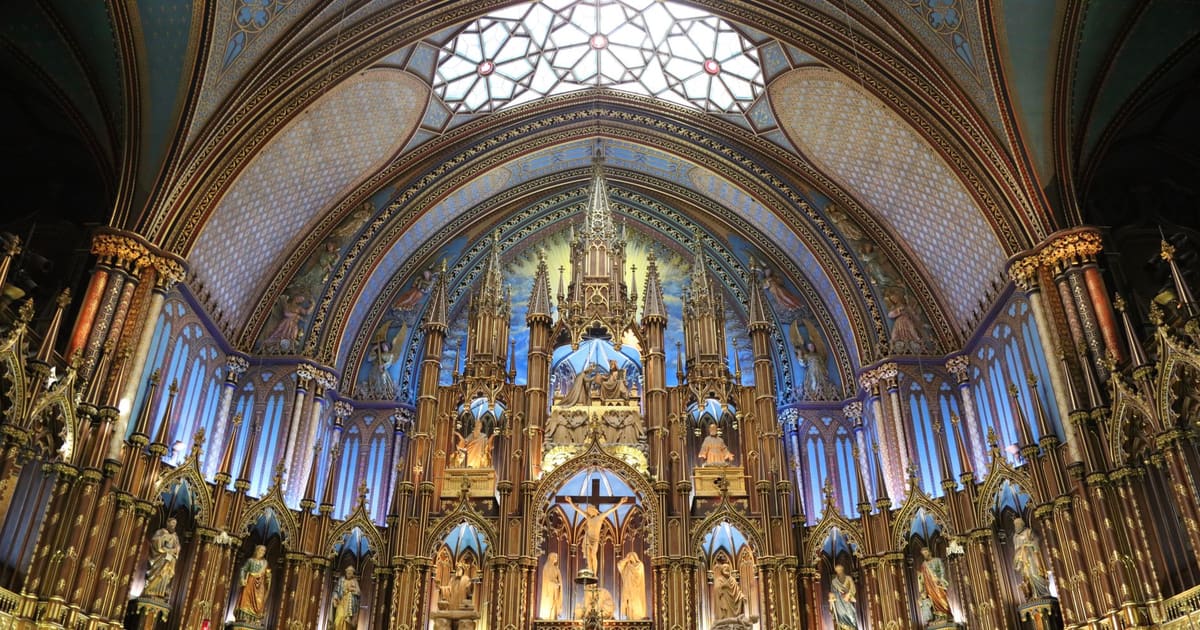
 You are in Place d'Armes, the old parade ground of the French town and still its grandest square. In the middle stands Maisonneuve, the founder of Montreal, on a tall pedestal surrounded by four figures: Jeanne Mance, who founded the city's first hospital; the soldier Lambert Closse with his dog Pilote; the settler Charles Le Moyne; and an Iroquois warrior. Facing it across the square is Notre-Dame Basilica, its twin towers rising over the stone front. It was built in the late 1820s to a design by James O'Donnell, an Irish-born Protestant architect from New York. He became so attached to the church that he converted to Catholicism before he died, and he is buried in its crypt. If you can, go inside, because nothing about the plain grey facade prepares you for it. The vaulted ceiling is a deep blue scattered with gold stars, the altar glows with gilt and carved wood, and the stained glass windows tell the history of Montreal itself rather than stories from the Bible. Behind you, across the square, the Bank of Montreal's domed headquarters belongs to the oldest bank in Canada, founded in 1817. Next, walk down Rue Saint-Sulpice, the narrow street that runs down the left-hand side of the basilica as you face it, toward the river. At Rue Saint-Paul, jog left and then right into Place Royale, a small sloping square, and walk down to the modern building with a pointed prow at the bottom. It takes about five minutes.
Pointe-à-Callière
Stand at the foot of Place Royale, near the prow of the museum building, and imagine away almost everything you see. In May 1642 a small group of French settlers, led by Paul de Chomedey de Maisonneuve and the nurse Jeanne Mance, came ashore near this point of land, where a little river once flowed into the St. Lawrence. They named their settlement Ville-Marie and built a wooden fort, a few dozen people at the edge of a vast forest and a long way from France. Long before them, Iroquoian peoples had lived on this island, and the explorer Jacques Cartier had visited their village of Hochelaga in 1535. The point takes its name from Louis-Hector de Callière, a later governor whose house stood here. The small river is still here too, though you cannot see it; it was channeled underground in the nineteenth century. The museum in front of you, Pointe-à-Callière, opened in 1992 for the city's 350th birthday, and it is built over the real remains, so you can go down among old foundations, the first Catholic cemetery and a vaulted stone sewer that once carried that buried river. The sloping square behind you, Place Royale, served as the town's marketplace for generations. When you are ready, walk back up through Place Royale to Rue Saint-Paul, about two minutes, and stop at the top.
The full tour continues in the app
- Distance
- 2.8 km
- Walking
- 38 min
- Steps
- ~3,900
- Narration
- 14 min
What's included
- All 7 stops, fully narrated
- Works offline once downloaded in the app
- Friends walk free one purchase covers everyone on your walk
Our tours are made to be meditative and immersive: you keep moving and simply listen. They're always better together, and the app plays the narration in sync, so you, your partner and your friends hear every stop at the same moment.
Rue Saint-Paul
You are standing on Rue Saint-Paul, the oldest street in Montreal.
The rest of this stop is in the full audio tour.
Place Jacques-Cartier and City Hall
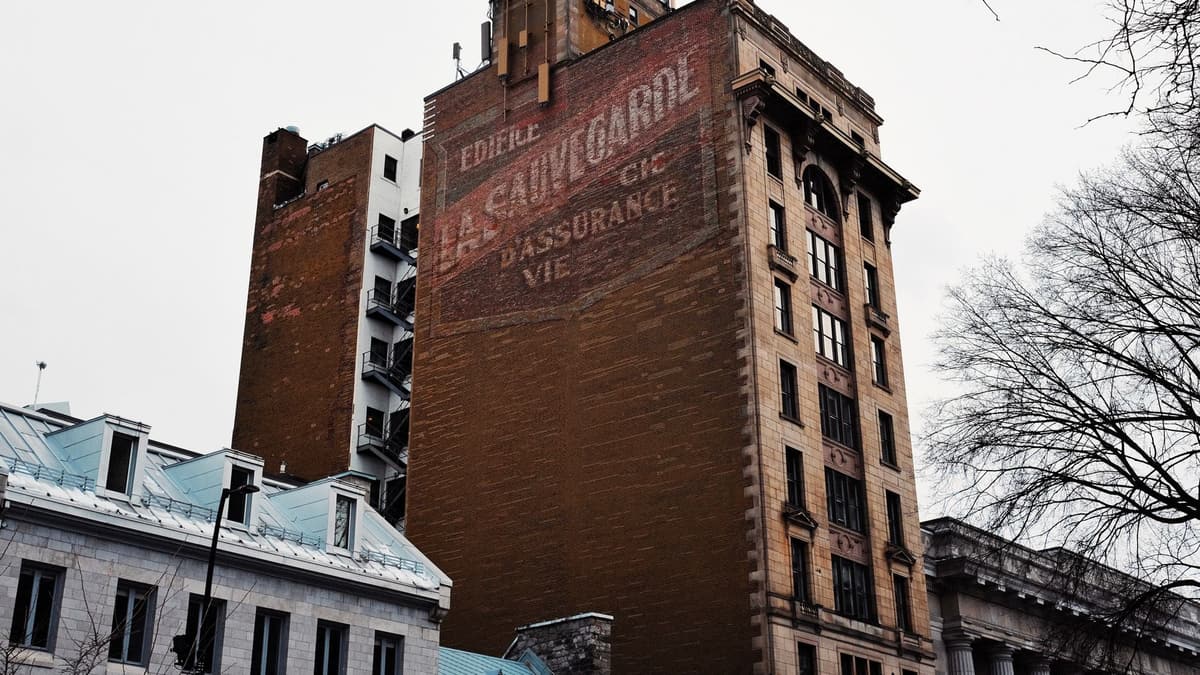
You are at the top of Place Jacques-Cartier, a long cobbled square that slopes down toward the port, lined with terraces, flower sellers and street performers in summer.
The rest of this stop is in the full audio tour.
Notre-Dame-de-Bon-Secours Chapel
Stand in front of the small stone chapel and look up at its roof.
The rest of this stop is in the full audio tour.
Clock Tower Quay
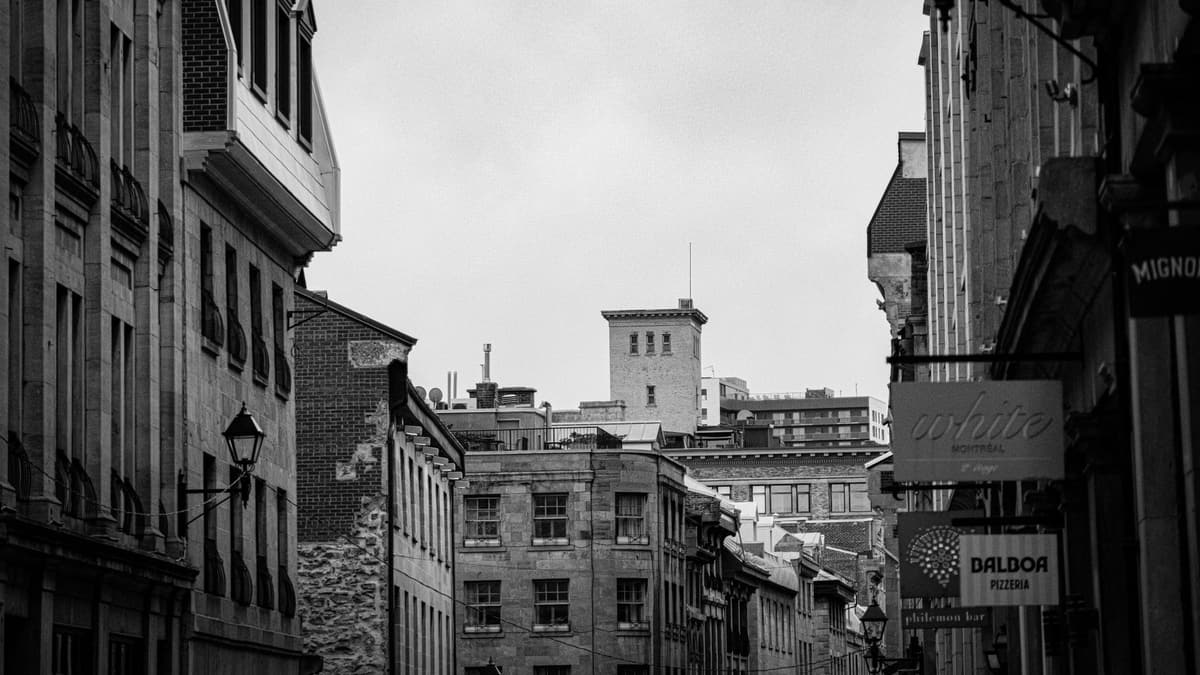
You have reached the end of the line, the Clock Tower at the tip of its quay, with the river on three sides.
The rest of this stop is in the full audio tour.
Do this walk with other people on the next scheduled tour.
About 2.8 km, roughly 38 minutes at an easy pace · 7 stops
Friends walk freeMore audio tours in Montreal
$10.99City Highlights