
 $14.99Film & Fiction
Greenwich Village Walking Tour: Folk Clubs, Hidden Courts, Stonewall
Choose how you'll do this walk in our app

 Friends walk free
Every tour also runs as a scheduled group walk you can join in the app.
More audio tours in New York City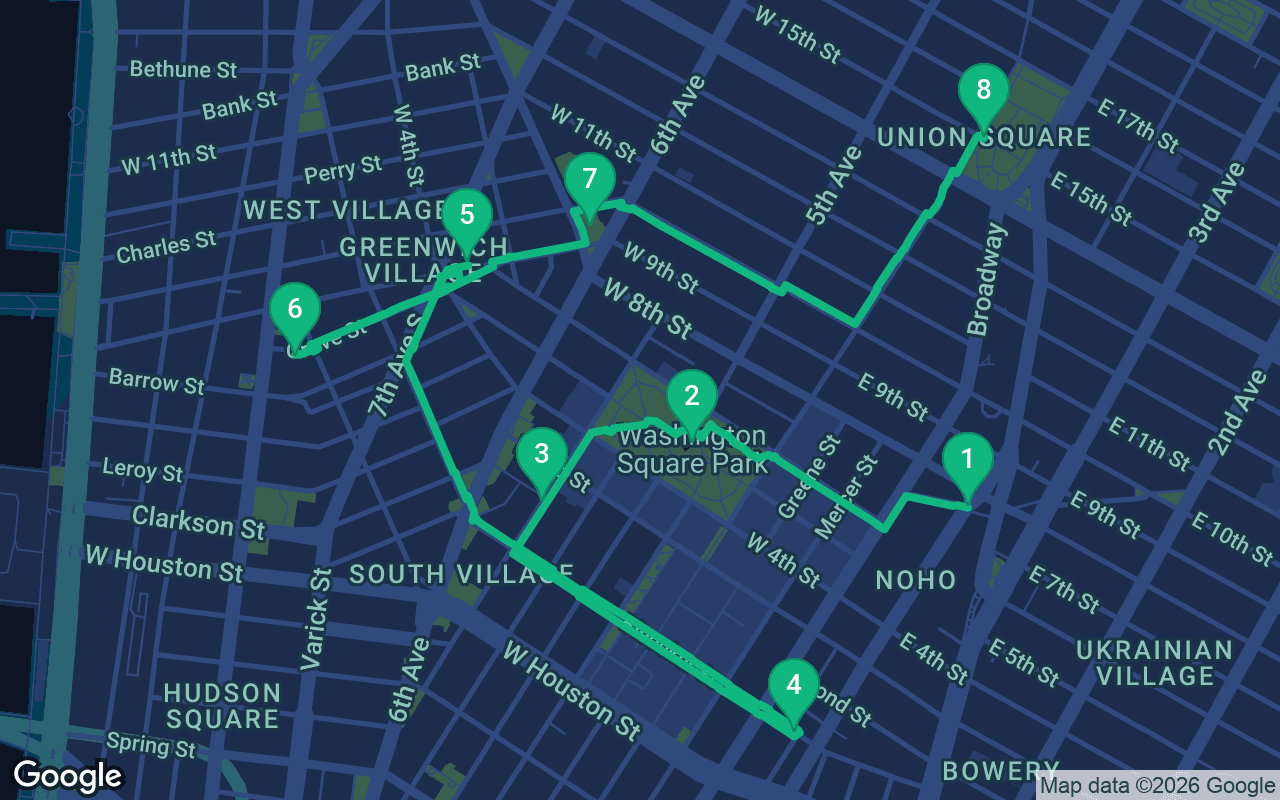
About 4 km, roughly 56 minutes at an easy pace.
- 1Astor Place and Cooper Triangle
- 2Bleecker Street
- 3Washington Square Park: The Heart of the Greenwich Village Self Guided Walking Tour
- 4MacDougal StreetFull tour
- 5Grove Court and Bedford StreetFull tour
- 6Christopher Street and StonewallFull tour
- 7Jefferson Market GardenFull tour
- 8Union Square ParkFull tour
This tour is narrated
Press play on the first 3 stops for a 30-second demo of the narration. In the app, the intro and those 3 stops play in full for free, each one chiming as you arrive. The whole narrated tour is yours for $9.99, a one-time purchase you keep for good.
Works with Garmin, Komoot, Strava, OS Maps and any GPX app.
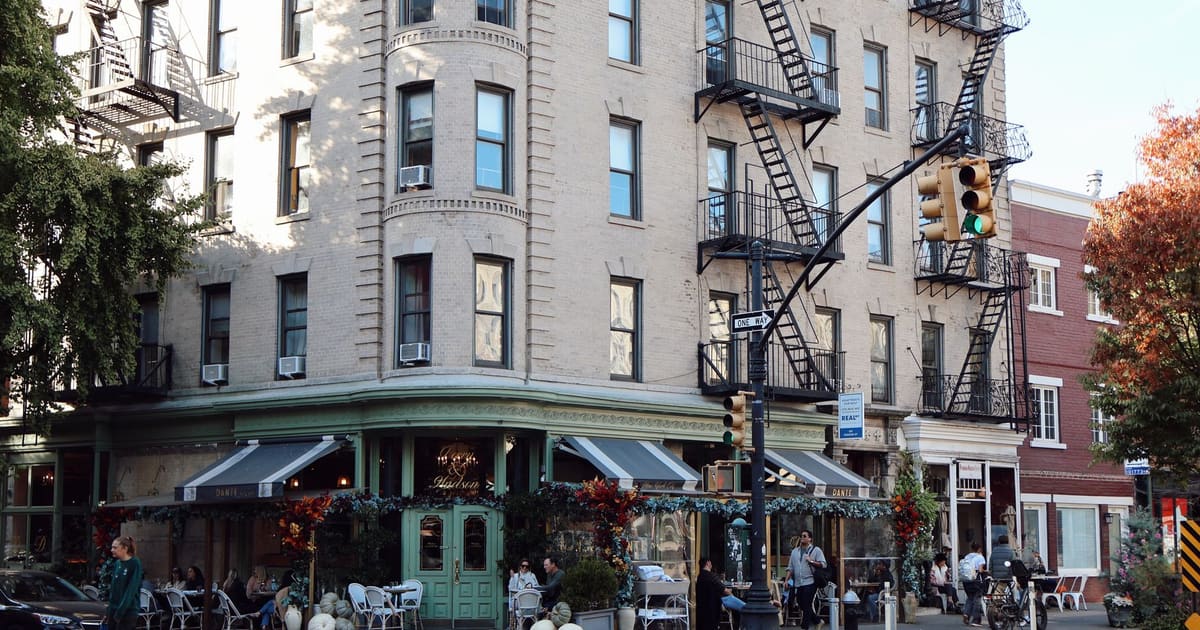
Greenwich Village is the part of Manhattan that refused to be tidy. Its streets were here before the famous grid, so they bend, cross each other at strange angles and carry names instead of numbers, and for two centuries the people who lived along them have had a habit of starting things: poetry movements, folk revivals, protests that went around the world. This walk starts at Astor Place on the Village's eastern edge, crosses Washington Square, ducks into the quietest lanes of the West Village, stands outside the Stonewall Inn and finishes in the open sweep of Union Square. It runs about four kilometers, roughly two and a half miles, and it is one of the most story-packed self-guided walking tours you can do in New York in a single afternoon.
Before you set off
Allow two to three hours at a stroll, more if you stop for coffee, a cannoli or a browse in a record shop, all of which this route will tempt you toward. The ground is flat the whole way, but the sidewalks are old, tree roots lift the paving stones and a few side streets keep their cobbles, so wear shoes you trust. Late morning into the afternoon is the sweet spot: the park is full, the cafes are open and the quiet residential lanes still feel quiet. Evenings on MacDougal and Bleecker get loud and crowded, which is fun but slower going. There is decent shade from the street trees in summer, and in winter the brick houses look their best under a low sun. Grove Court is a private courtyard, so you look through the gate rather than walking in, and the Jefferson Market Garden keeps limited, seasonal hours, so check before you go if you want to sit inside it. Everything else is out in the open and free.
Astor Place and Cooper Triangle
Stand on the little triangle of pavement and look for the big black steel cube balanced on one corner. It is a sculpture called Alamo, put here in 1967, and if a few of you push together it still turns on its point, which students have been doing ever since. Behind it rises a heavy brownstone building with arched windows: the Foundation Building of Cooper Union, the college Peter Cooper opened in 1859 so that working people, women included, could get an education for free. Downstairs, in its Great Hall, a little-known Illinois lawyer named Abraham Lincoln gave a speech in February 1860 that made him a serious candidate for president. Just to the south, in its own small park, Peter Cooper himself sits in bronze. This crossroads also has a darker memory. In 1849 a quarrel between fans of an English actor and an American one turned into a riot outside the opera house that stood near here, and soldiers fired into the crowd, killing more than twenty people. Down in the subway station, look for the small beavers set into the walls, a nod to the fur fortune of John Jacob Astor. When you are ready, walk west to Broadway, turn left and head south for about seven minutes until you reach Bleecker Street.
Bleecker Street
You are near the eastern end of Bleecker Street, which runs right across the Village and changes personality block by block. Before you turn west, look a few steps east of Broadway at number 65, a tall, creamy terracotta building with six winged angels holding up its cornice. It is the Bayard-Condict Building, finished in 1899, and it is the only building in New York by Louis Sullivan, the Chicago architect often called the father of the skyscraper. Now head west. In a block or two the street opens up beside three tall concrete towers set back on a lawn. These are New York University apartments designed by I. M. Pei, and standing between them is a giant concrete head, a much enlarged version of a Picasso sculpture called Bust of Sylvette, built here in the late 1960s. Keep going across LaGuardia Place and you reach the stretch of Bleecker where the folk and rock clubs crowded in, and where the Bitter End, open since 1961, still puts musicians on its small brick-walled stage. Farther west, the street turns into bakeries, cheese shops and boutiques, which you will see later. For now, turn right up Thompson Street and walk north for about five minutes until the park opens in front of you.
Washington Square Park: The Heart of the Greenwich Village Self Guided Walking Tour
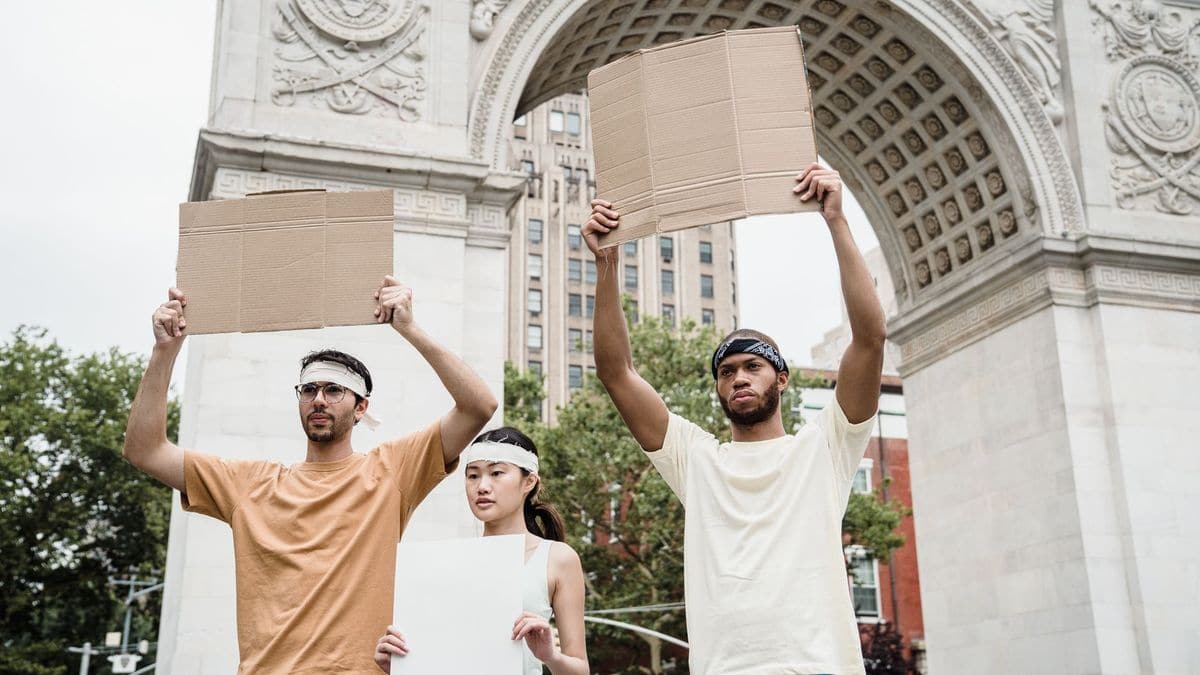 Find a spot near the fountain where you can see the white marble arch at the top of the park, framing Fifth Avenue as it runs north. The arch began as a temporary wooden one, put up in 1889 for the hundredth anniversary of George Washington's inauguration. People liked it so much that Stanford White designed this permanent version in marble, and on its north face two statues of Washington, one at war and one at peace, look up the avenue. Every part of this park has a past. Before it was a park this land was a potter's field, a burial ground for the poor and for victims of yellow fever, and many thousands of people still lie beneath the paths. In the northwest corner stands a huge English elm, thought to be well over three hundred years old; a story calls it the Hangman's Elm, though there is no firm record of anyone being hanged from it. Cars and buses once drove straight through the park, and in the 1950s the city planned a road through the middle. Neighbors, Jane Jacobs among them, fought it and won, and traffic was gone by the end of that decade. Today the park belongs to chess players, students, buskers and pigeons. Leave by the southwest corner, where the chess tables are, and walk a minute or two south down MacDougal Street.
The full tour continues in the app
- Distance
- 4 km
- Walking
- 56 min
- Steps
- ~5,600
- Narration
- 15 min
What's included
- All 8 stops, fully narrated
- Works offline once downloaded in the app
- Friends walk free one purchase covers everyone on your walk
Our tours are made to be meditative and immersive: you keep moving and simply listen. They're always better together, and the app plays the narration in sync, so you, your partner and your friends hear every stop at the same moment.
MacDougal Street
You are on the narrow, busy block of MacDougal Street below the park, and in the early 1960s this was probably the most important few hundred meters in American popular music.
The rest of this stop is in the full audio tour.
Grove Court and Bedford Street
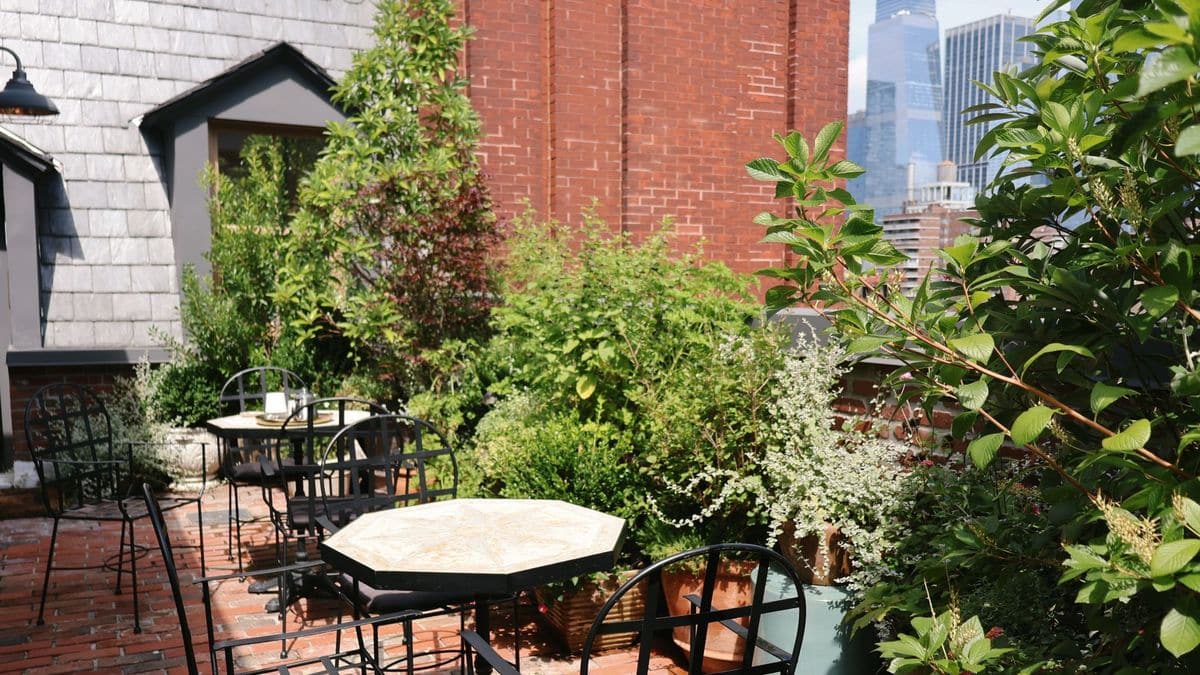
Stop at the corner of Grove and Bedford, and listen to how quiet it has gone.
The rest of this stop is in the full audio tour.
Christopher Street and Stonewall
You are standing beside Christopher Park, the little fenced triangle of green, and across Christopher Street is a low brick building with a neon sign: the Stonewall Inn.
The rest of this stop is in the full audio tour.
Jefferson Market Garden
That fairy-tale tower of red brick and pale stone, all pointed windows and steep roofs, belongs to the Jefferson Market Library, and it began life in the 1870s as a courthouse.
The rest of this stop is in the full audio tour.
Union Square Park

You finish at Union Square, where the narrow Village streets give way to wide open space and the noise of the city returns. The name has nothing to do with workers' unions.
The rest of this stop is in the full audio tour.
Do this walk with other people on the next scheduled tour.
About 4 km, roughly 56 minutes at an easy pace · 8 stops
Friends walk freeMore audio tours in New York City
$14.99Film & Fiction $16.99Film & Fiction
 $15.99Film & Fiction
 $17.99Film & Fiction
 $14.99Film & Fiction
 $7.99City Highlights
 $8.99City Highlights