October 2, 2026 · 6 min read
Geo Guessing Tips to Win More Rounds
My best Geo Guessing tips: read the photo before the map, spend the weekly hint on the right round, and post photos people love to guess.
657

September 27, 2026 · 8 min read
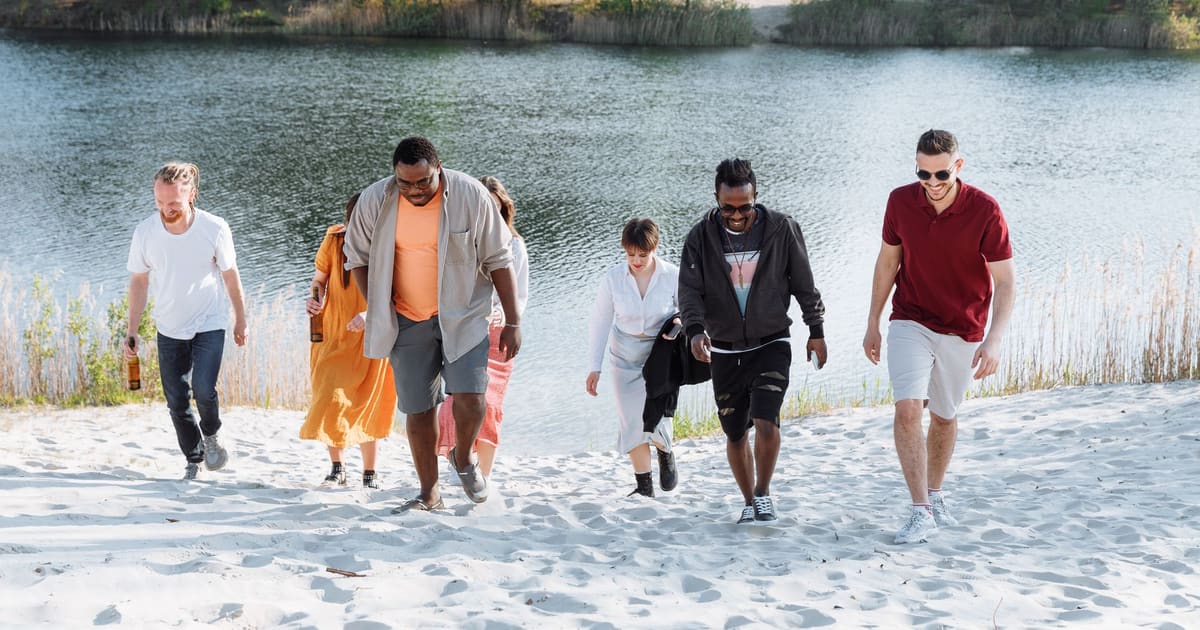
Most step challenges are a leaderboard with one winner and a lot of people who stopped checking by week two. A team walking challenge works the other way round: everyone banks steps toward one shared target, so the slowest walker matters as much as the fastest. That changes who shows up. Below are team walking challenge ideas built around relays and shared goals, with versions for an office, a friend group and a family, plus the fairness rules that keep them from going sour. For walking games of every other kind, our walking games guide has the full list.
A leaderboard rewards the people who already walk a lot. They win in week one, and everyone else quietly gives up, because a 4,000 step day next to someone's 18,000 feels pointless.
A shared goal flips that. Your 4,000 steps move the bar for everyone. Nobody is last, because there's only one score. And there's a gentle social pull: you don't want to be the one who didn't chip in this week. In my experience, that pull is stronger than any prize.
The trade-off is that a pure shared goal doesn't reward effort much. The fix, which several of the formats below use, is to mix a shared target with a small individual bonus.
1. The baton walk. Split the team into a running order. Each person has one day "holding the baton," and their steps that day count double toward the team total. Everyone walks every day, but each person gets one day in the spotlight. Great for teams of five to seven, one per weekday.
2. The virtual journey. Pick a real distance between two places, say the length of your country or the walk from your office to the sea, and convert it to steps at roughly 1,300 to 1,400 steps per kilometre for an average walking stride. The team banks steps until it "arrives." Post the progress on a map every Friday. It turns a number into a story.
3. The minimum-plus relay. Every team member must hit a personal floor, say 5,000 steps, every day for the day to count. Days where everyone clears the floor get banked. The team target is a number of complete days, not steps. This one stops your two keenest walkers from carrying everyone else, and it's the fairest format for mixed-fitness groups.
4. The handover. Real relays have handovers, so add one. Pair people up, and each pair does one walk together during the week. The team only banks the week's total if every pair walked. It's sneaky: a step challenge that's secretly a "get to know your colleagues" plan.
5. Team vs team, shared target. Two teams race to the same target, but the score is a percentage of the target, not raw steps. That way a team of four can beat a team of eight. Set targets so each team needs about the same per-person effort.
6. The weekend sprint. The team picks one weekend a month. The goal is to bank a big total in 48 hours, ideally with at least one group walk. It's a nice burst on top of a steadier weekly format.
In an office, keep it voluntary and private by default. Not everyone wants their step count on a screen in the kitchen. Report team totals, not individual ones. Make sure people with mobility limits can take part, for example by letting other activity count as an agreed step-equivalent, or by giving them a role like captain or route planner. Lunchtime group walks are the best tool you have, so put one in the calendar every week.
With friends, a small team of three to five works best. Use a group chat for updates, and let the team pick a silly team name. The stakes can be social: losing team buys the coffee, or the team that misses its target has to walk somewhere ridiculous together.
With a family, set a target low enough that the youngest member can make a real dent in it. Kids get very motivated by a bar filling up. Let them be in charge of checking the score every evening.
Cap a single day. If one person can bank 40,000 steps on a Saturday hike, the challenge stops being about the team. Cap what any one day can contribute.
Same counting method for everyone. Agree on phones or watches, not a mix, or at least accept that they count a bit differently. Arguments about step counts are the fastest way to kill team spirit.
No reshuffling teams mid-challenge. Even if one team is running away with it. A change halfway through feels unfair to the team that's winning.
Short seasons. Four weeks is plenty. Longer than that and attention drops. Better to run a fresh four-week round than one endless challenge.
If you'd rather not keep a spreadsheet, the Walk Pack in Walk With Me is a team step challenge with the maths done for you. A pack is a small group, up to five people, with a shared weekly step-goal bar and its own pack group chat. Everyone's steps fill the same bar. Pack invites go to people who are already your friends in the app, so it's built for a group you know.
The reward is shared too. When the pack hits its weekly goal, each member's own steps for that week convert to Social Steps and everyone gets bonus XP. And packs have their own board in the step rankings, ranked by month, so a pack can play team-vs-team against other packs without anyone setting it up.
The app also caps each day's steps before they count toward the rankings, which is the "cap a single day" rule above, built in.
Every team challenge hits a flat week, usually week three. Here's what helps:
Pick one format, find three to five people, and give it four weeks. If you want the shared bar, the chat and the bonus XP handled for you, Walk With Me is free on iOS and Android.
October 2, 2026 · 6 min read
My best Geo Guessing tips: read the photo before the map, spend the weekly hint on the right round, and post photos people love to guess.
October 2, 2026 · 7 min read
GPS Doodle is coming to Walk With Me. My tips for a higher match score: choosing the shape and the streets, sizing it right and walking every corner.

October 2, 2026 · 7 min read
Mystery Destination is coming to Walk With Me. My tips for solving it faster: reading the compass, trusting the warmth bands and choosing where to start.