
 $17.99Film & Fiction
Rome Trastevere Walking Tour: Village Lanes Up to the Janiculum
Choose how you'll do this walk in our app

 Friends walk free
Every tour also runs as a scheduled group walk you can join in the app.
More audio tours in Rome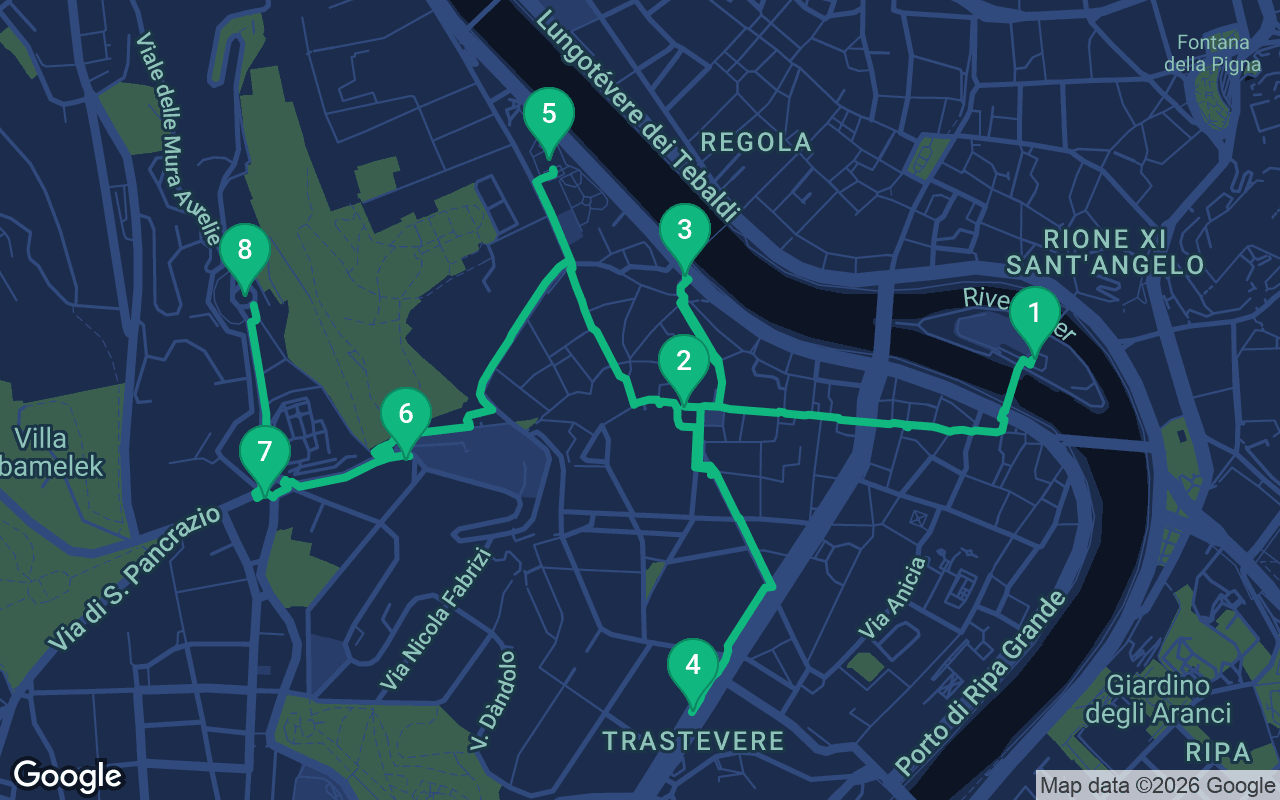
About 3 km, roughly 45 minutes at an easy pace.
- 1Tiber Island
- 2Piazza di Santa Maria in Trastevere
- 3Piazza Trilussa
- 4Villa Farnesina~€12 · optionalOptional entry ticket, not includedFull tour
- 5Fontana dell'Acqua PaolaFull tour
- 6Gianicolo TerraceFull tour
- 7Garibaldi MonumentFull tour
Not included in the tour: ~€12 entry (optional)Average per person. Prices change, so check before you go.
This tour is narrated
Press play on the first 3 stops for a 30-second demo of the narration. In the app, the intro and those 3 stops play in full for free, each one chiming as you arrive. The whole narrated tour is yours for $8.99, a one-time purchase you keep for good.
Works with Garmin, Komoot, Strava, OS Maps and any GPX app.
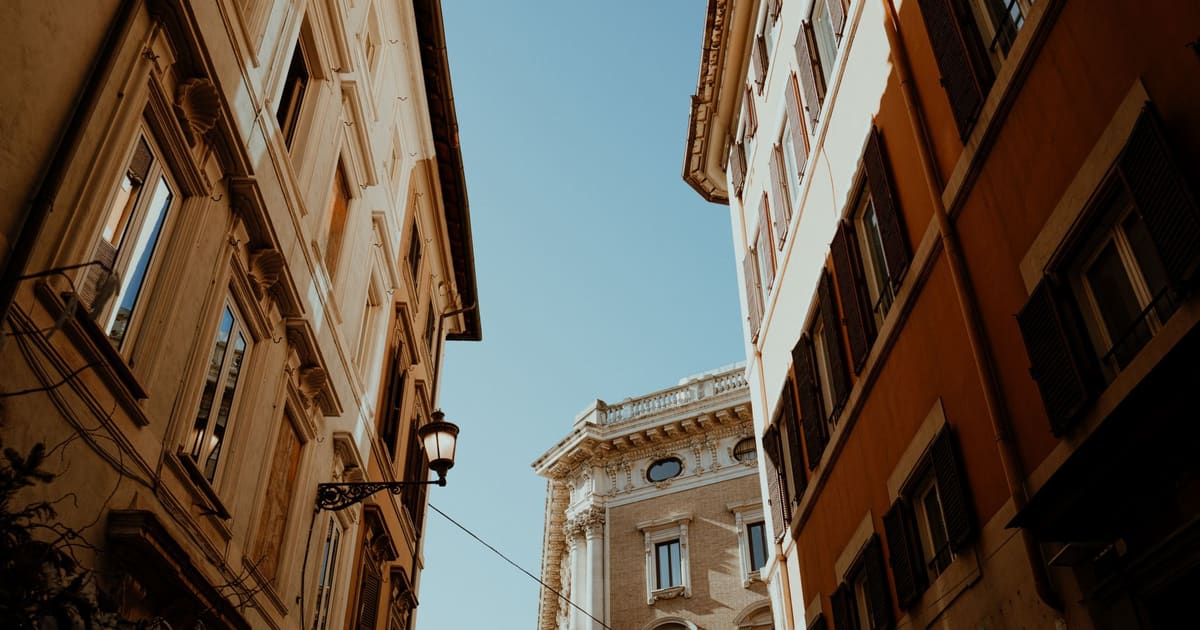
Trastevere means "across the Tiber", and for most of Rome's history that was exactly how it felt: a separate, working neighborhood of boatmen, millers and craftsmen on the far bank, proud of its own dialect and its own ways. This walk crosses over from Tiber Island, wanders the quarter's squares and lanes, stops at a banker's Renaissance villa by the river, and then climbs the Janiculum hill for the best free view in the city. It is about three and a half kilometers with one real climb in the second half, and it is one of the most relaxed self-guided walking tours Rome has to offer, all ochre walls, ivy and church bells rather than ruins and queues.
Before you set off
Give it two to three hours at a stroll, more if you stop to eat, and in Trastevere you will want to. The first half is flat; the second half climbs about sixty meters up the Janiculum on a winding road with steps cutting the corners, steady rather than steep, so take it slowly in the heat. The lanes are cobbled and uneven, and scooters squeeze through spaces that look too narrow for them, so keep to the side and wear shoes with a grip. Late afternoon is the best time to start: the squares fill up as the day cools, and you reach the top of the hill in time for the evening light over the domes. If you would like to see the frescoes inside the Villa Farnesina, check its opening days and hours before you go, since it keeps short ones. There is shade under the plane trees by the river and the pines on the hill, but very little in between, so carry water or refill at the free drinking fountains along the way.
Tiber Island
You are standing on Tiber Island, the boat-shaped strip of land that splits the river in two, the quiet stepping stone between central Rome and Trastevere. Walk to the side of the island facing downstream and lean on the parapet. In the middle of the river you will see a single stranded arch, standing alone in the current with no road on either side. That is the Ponte Rotto, the Broken Bridge. It began as the Pons Aemilius, the first stone bridge across the Tiber, in the second century BC, and it was patched and rebuilt for centuries until a great flood in 1598 carried most of it away for good. Since then it has been a ruin with nowhere to go. Behind you, most of the island is taken up by a hospital run by a religious order, the Fatebenefratelli, whose name comes from their founder's call to "do good, brothers". The little medieval tower by the bridge is a survivor of the days when noble families fortified the island. In summer, the riverbanks below fill with stalls, bars and outdoor cinema, and Romans come down to the water at night. When you are ready, cross the short bridge on the Trastevere side, the Ponte Cestio, keep straight on into the small square ahead, and follow the long, narrow lane leading west, Via della Lungaretta, for about ten minutes until it opens into a great square with a fountain.
Piazza di Santa Maria in Trastevere
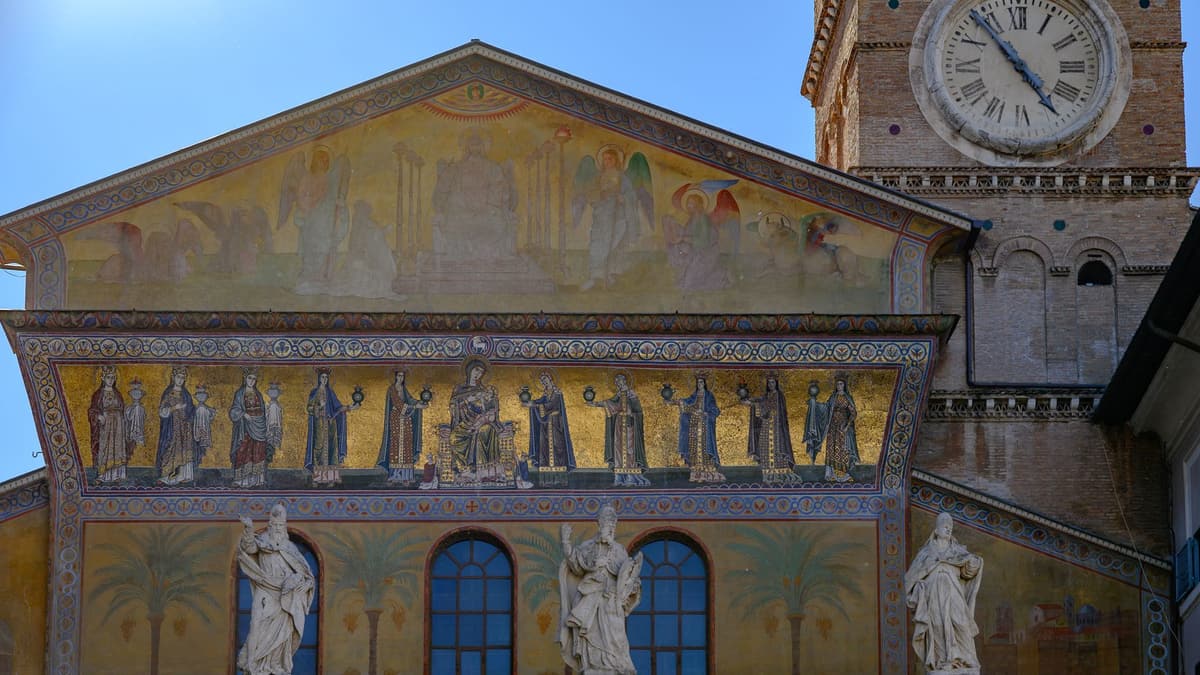 This is the living room of Trastevere. People sit on the steps of the fountain in the middle, children chase pigeons, and the café tables creep a little further across the stones each year. The fountain is one of the oldest in Rome, reworked more than once over the centuries. Now turn to the church. Santa Maria in Trastevere is among the oldest churches in the city, and it was probably one of the first places in Rome where Christians worshipped openly. Look up at the facade, where a band of gold mosaic shows the Virgin nursing her child with a procession of women carrying lamps on either side, glowing at its best in the late sun. An old legend says that in the year Christ was born, a spring of oil burst from the ground on this spot and flowed to the river, and Romans took it as a sign. If the doors are open, step inside to see the apse mosaics and the reused ancient columns lining the nave, no two quite alike. Trasteverini have long called themselves the noantri, dialect for "we others", and every July the neighborhood throws its own festival under that name. From the square, head north into the lanes past the small Piazza di Sant'Egidio, and keep going downhill toward the river; the walk takes about five minutes.
Piazza Trilussa
You come out by the river at Piazza Trilussa, a stepped square that is quiet in the morning and packed in the evening, when young Romans settle on the wide steps with a drink and a slice of pizza and watch the light go. The big fountain against the wall at the back is a lovely piece of urban recycling. It was built in the seventeenth century on the far side of the river, at the end of Via Giulia, and when the high embankment walls went up in the late 1800s it was taken down and rebuilt here, stone by stone. Look for the bronze statue of a man leaning against a wall as if he has stopped for a chat. That is Trilussa himself, the pen name of a much-loved poet who wrote in the Roman dialect, sharp, funny verses about politics and everyday life. One of his poems is carved on the wall beside him. The bridge in front of you is the Ponte Sisto, built for a pope in the fifteenth century, and from the middle of it you get one of the loveliest views in Rome, with the dome of St. Peter's rising beyond the river. To continue, walk a couple of minutes west from the square to the old city gate of Porta Settimiana, pass under it, and follow the long straight Via della Lungara for about five minutes. The villa sits behind a wall on your right.
The full tour continues in the app
- Distance
- 3 km
- Walking
- 45 min
- Steps
- ~4,200
- Narration
- 13 min
What's included
- All 7 stops, fully narrated
- Works offline once downloaded in the app
- Friends walk free one purchase covers everyone on your walk
Our tours are made to be meditative and immersive: you keep moving and simply listen. They're always better together, and the app plays the narration in sync, so you, your partner and your friends hear every stop at the same moment.
Villa Farnesina
Behind this garden wall stands one of the finest houses of the Roman Renaissance.
The rest of this stop is in the full audio tour.
Fontana dell'Acqua Paola
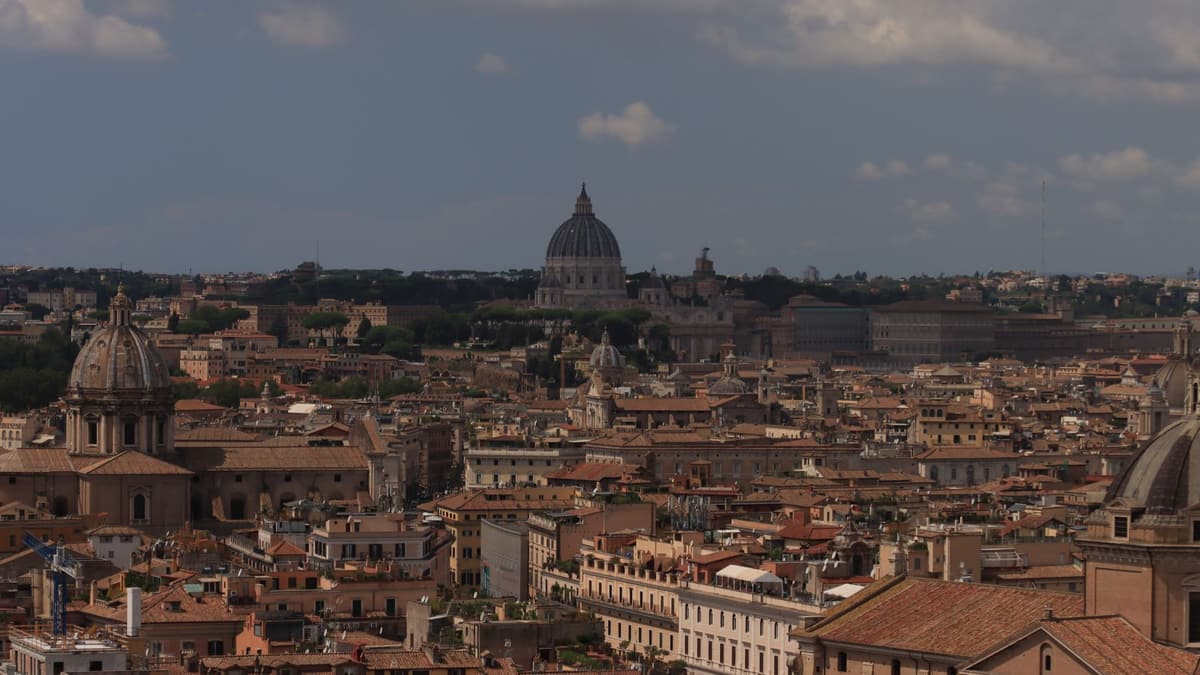
Catch your breath. You have climbed above the rooftops, and in front of you is the grandest fountain on this side of the river, a white marble wall of columns and arches with water pouring from it into a wide basin.
The rest of this stop is in the full audio tour.
Gianicolo Terrace
Walk to the balustrade and let the city spread out below you. This is the classic view from the Janiculum, and on a clear evening it is hard to beat.
The rest of this stop is in the full audio tour.
Garibaldi Monument
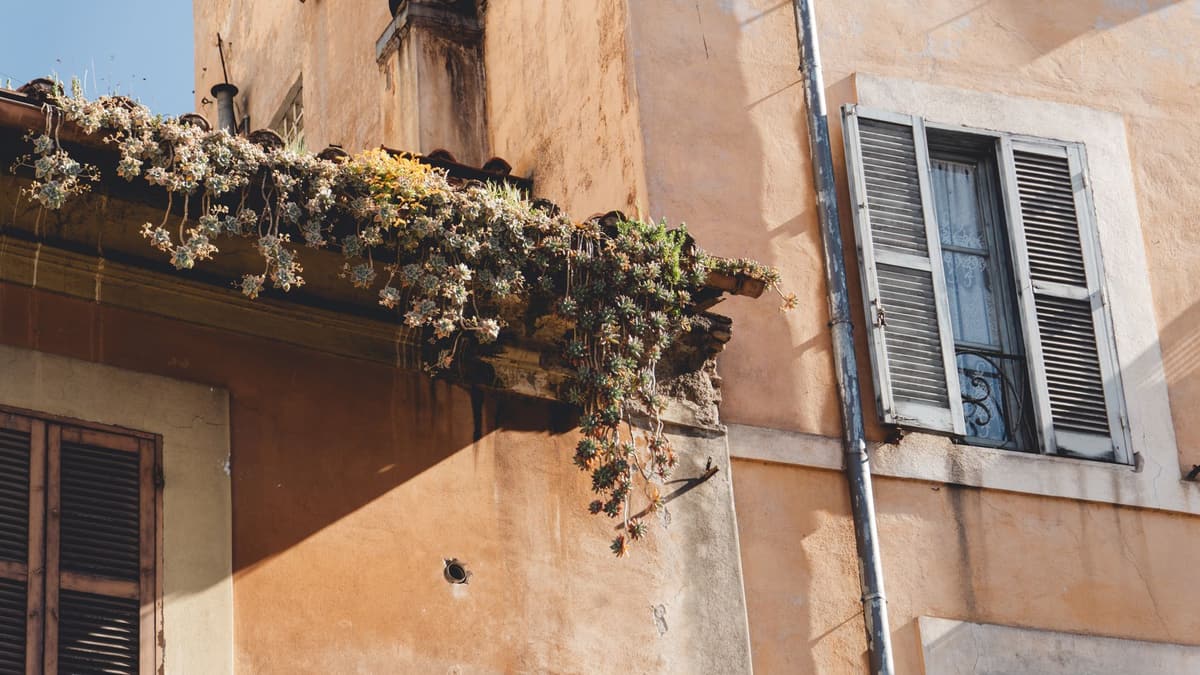
You finish under Giuseppe Garibaldi, the hero of Italian unification, sitting on his horse high on a stone pedestal and gazing out over Rome. The choice of this hill is no accident.
The rest of this stop is in the full audio tour.
Do this walk with other people on the next scheduled tour.
About 3 km, roughly 45 minutes at an easy pace · 7 stops
Friends walk freeMore audio tours in Rome
$17.99Film & Fiction $14.99Food & Tastings
 $14.99Film & Fiction
 $15.99Film & Fiction
 $17.99Games IRL
 $14.99Turning Points
 $10.99City Highlights
 $9.99City Highlights